 NEWS
NEWS
Maritime intelligence — curated daily from verified sources
Learn. Connect. Predict. Decide. Optimize.
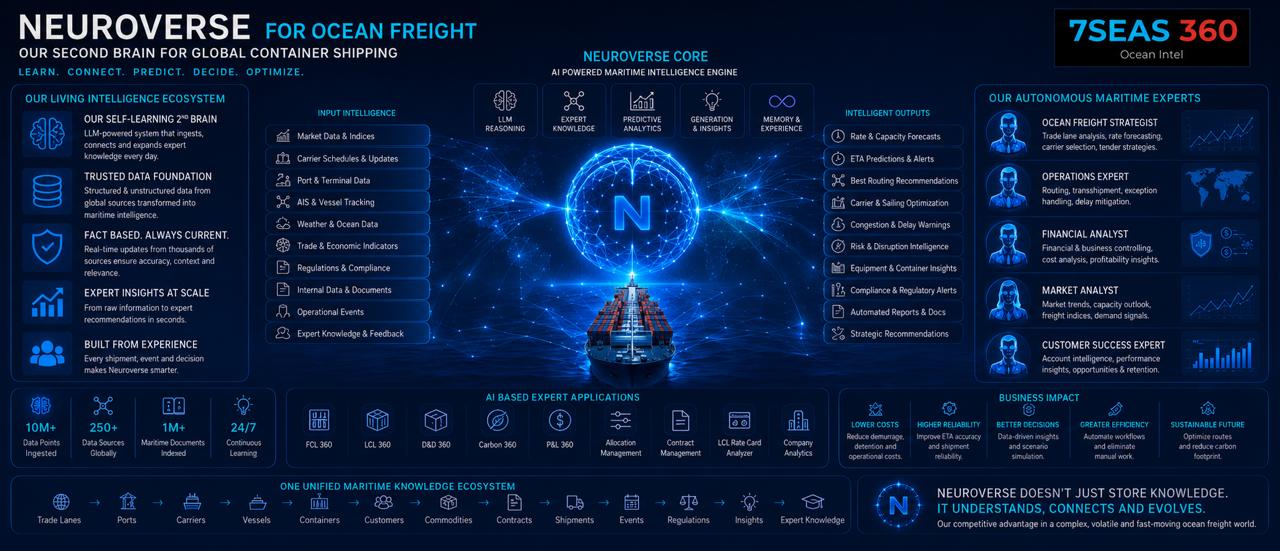
Ocean freight has never been more complex. Shifting trade lanes, congested ports, volatile rates and disrupted routes mean the signals are everywhere, but the intelligence to act on them is scattered. At 7SEAS 360, we built something to change that.
Neuroverse is not a database that sits still. It is a self-learning ecosystem that ingests data from thousands of trusted global sources every day, including market indices, carrier schedules, port and terminal data, vessel tracking, weather, trade indicators and regulations, and transforms raw information into maritime intelligence in seconds. Every shipment, every event and every decision makes it smarter.
At its core, five capabilities work in concert: LLM reasoning, expert knowledge, predictive analytics, generation of insights and memory of experience. The result is a system that does not just store knowledge. It understands, connects and evolves.
On top of this core sit our autonomous maritime experts: an Ocean Freight Strategist, an Operations Expert, a Financial Analyst, a Market Analyst and a Customer Success Expert. Each one turns the intelligence of Neuroverse into forecasts, routing recommendations, risk alerts and strategic guidance you can use today.
And it powers the tools you already know: FCL 360, LCL 360, D&D 360, Carbon 360, P&L 360 and more. One unified knowledge ecosystem connecting trade lanes, ports, carriers, vessels, containers, contracts and beyond.
The impact is real: lower costs, higher reliability, better decisions, greater efficiency and a more sustainable future.
Neuroverse is our competitive advantage in a complex, volatile, fast-moving ocean freight world. Now it is yours too.
Industry insights, thought leadership, and deep dives — coming soon.
The number that matters this week is not how many ships crossed the Strait of Hormuz, but how many crossings nobody can see. UKMTO's 11 September Voluntary Reporting Area overview holds traffic at roughly 90% below pre-conflict levels against a baseline near 138 vessel movements a day. Underneath that, the agency recorded about 20 US-facilitated transits a day on the southern route over the previous week against only 6 transits derived from AIS. JMIC counted 70 facilitated transits between 10 and 12 September. The roughly 3-to-1 gap tells operators two things. Almost all remaining movement runs on facilitated passage rather than on open commercial transit, and UKMTO says it is aware of UAE-facilitated vessels crossing with AIS switched off, which it cannot independently verify. For container shippers that converts a security story into a data-integrity story. Any ETA, track-and-trace feed or exception alert built on AIS positions is now under-reporting movement in and around the strait, and the error is not random.
The security picture has not improved to match the facilitated-transit volume. JMIC still rates the threat to commercial shipping as SEVERE and assesses deliberate hostile action as highly likely, warning specifically about mining activity in and around the Traffic Separation Scheme, projectile attacks, IRGC surveillance, VHF hailing and attempts to influence vessel routing. Three vessels were attacked in the latest 72-hour window: two unidentified ships each hit by two projectiles on 10 September, and a fully loaded tanker struck late on 12 September that suffered a severe fire. The mine question that governs whether the southern route is usable at all remains unresolved in public. CENTCOM Commander Adm. Brad Cooper said US forces spent months clearing Iranian mines from the internationally recognized lanes using Navy divers, SEALs and air power, and the administration has said mines were removed from international waters. JMIC has not followed, and continues to flag drifting or uncharted mines and active mine survey work. Clearing known mines from designated lanes is a narrower claim than declaring the waterway safe, and underwriters are pricing the wider claim.
The El Gaia case shows how contested even a single incident has become. The IRGC said the Panama-flagged tanker struck a mine while transiting an area it had closed to navigation south of the strait. CENTCOM called that false, saying the ship was disabled by an Iranian missile last month and then hit by a drone at the weekend while sitting in waters off Oman, and characterized the mine account as intimidation aimed at impeding commercial traffic. Oman confirmed the vessel is under tow with the fire contained and two crew missing. Whichever version an owner believes changes the route decision, because a mine strike implicates the water itself while a missile or drone implicates a targeting decision that better routing and flag choice can partly manage. Owners cannot resolve that dispute, so most continue to keep main-line container tonnage outside the strait entirely.
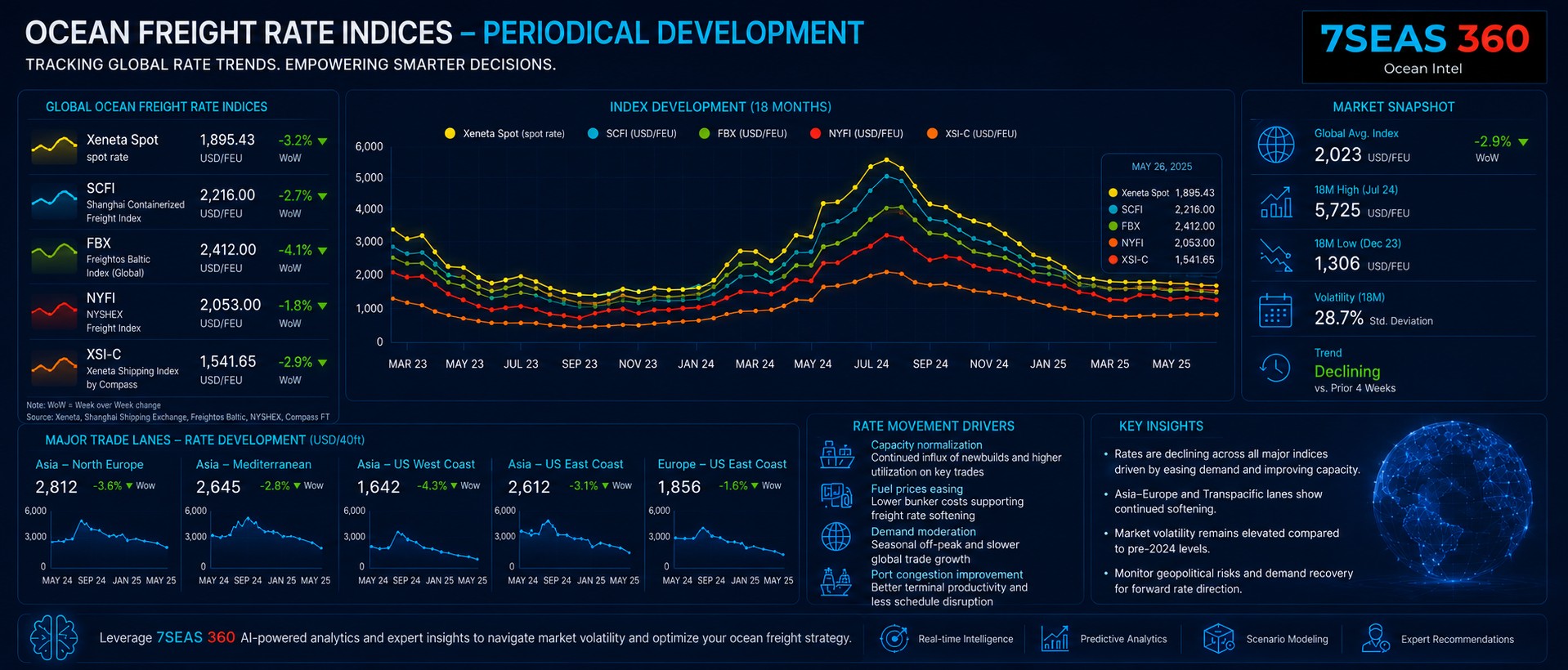
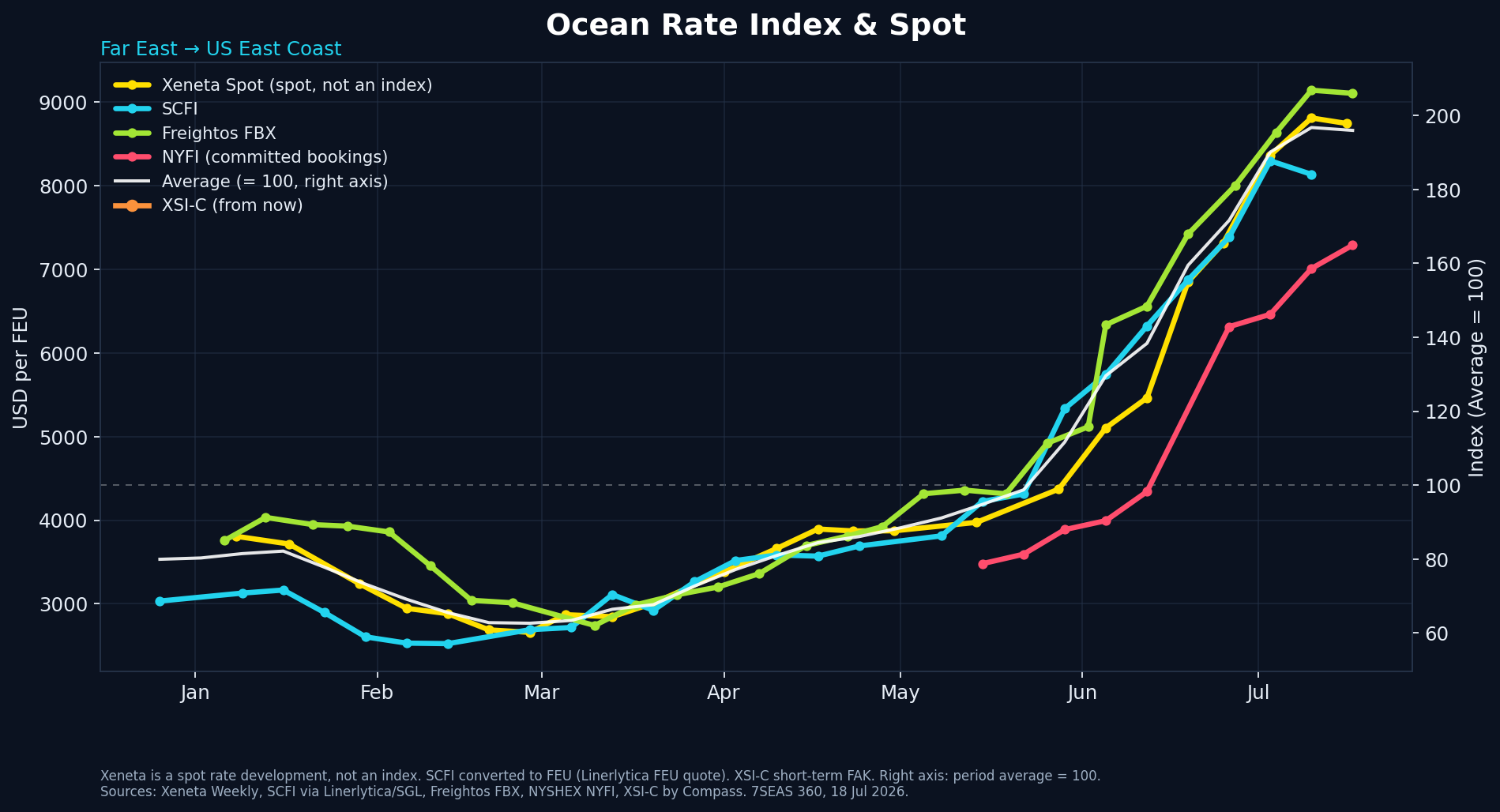
Nothing in the container rate picture moved with the escalation, and that separation is the practical planning point. The most recent published FBX week, to 8 September, still has Asia-North Europe near 4,500 USD/FEU and Asia-Mediterranean near 4,700 USD/FEU after Suez capacity returned to Mediterranean strings, while transpacific holds near 7,600 USD/FEU to the West Coast and 9,500 USD/FEU to the East Coast on typhoon-driven Far East congestion and Golden Week blank sailings. The Gulf crisis is setting regional access, compliance and insurance cost; congestion and capacity management are setting the global rate curve. Where the two meet is equipment and risk pricing. Linerlytica still counts 3.92m TEU, 11.4% of the global fleet, waiting at anchorages, and Gulf boxes keep cycling through Khor Fakkan, Sohar, Fujairah, Mundra and Nhava Sheva with overland legs that lengthen the empty return. On the cost side, the benchmark VLCC trade passing 1m USD a day for the first time is the clearest read available on what scarcity of willing tonnage now costs in this region, and it is the same scarcity that keeps Gulf container war risk surcharges of 2,000 to 4,000 USD per TEU in the market.
The Strait of Hormuz has returned to a near-standstill. Transits fell to seven vessels on Thursday 11 September, down from eleven the previous day and well below the ten-day average of fifteen, with early-September traffic averaging roughly ten commodity-carrying vessels a day against a pre-crisis norm of about eighty-five. The immediate trigger was a further round of escalation: a vessel was struck by an unknown projectile while transiting the strait on Sunday 13 September, caught fire and was evacuated, and Tehran has moved to formalize control of the waterway. Iran announced a wider exclusion zone outside Hormuz, and its newly created Persian Gulf Strait Authority published a list of 45 non-compliant vessels backed by threats of fines, detention and cargo confiscation. Washington countered that complying with Tehran's transit regime could itself expose owners to US sanctions. For container operators this converts a security problem into a compliance problem with no safe answer, which is why carrier appetite for Gulf calls has not recovered despite the July ceasefire collapse being two months old.
The container market's response has settled into a stable pattern that shippers should now plan around rather than wait out. Gulf cargo continues to move through relay ports outside the strait, with Khor Fakkan, Sohar, Fujairah, Mundra, Nhava Sheva and Hambantota absorbing the diverted volume before overland legs into the Gulf. The cost of that structure is visible in Jebel Ali's numbers: 374,000 TEU in Q2, down 86% quarter on quarter from 2.7m TEU, and 3.14m TEU across the first half against 7.77m TEU a year earlier, a traffic loss running at roughly 100m USD a month for DP World. Emergency war risk surcharges of 2,000 to 4,000 USD per TEU remain in the market and should be benchmarked line by line and time-limited so they stay renegotiable.
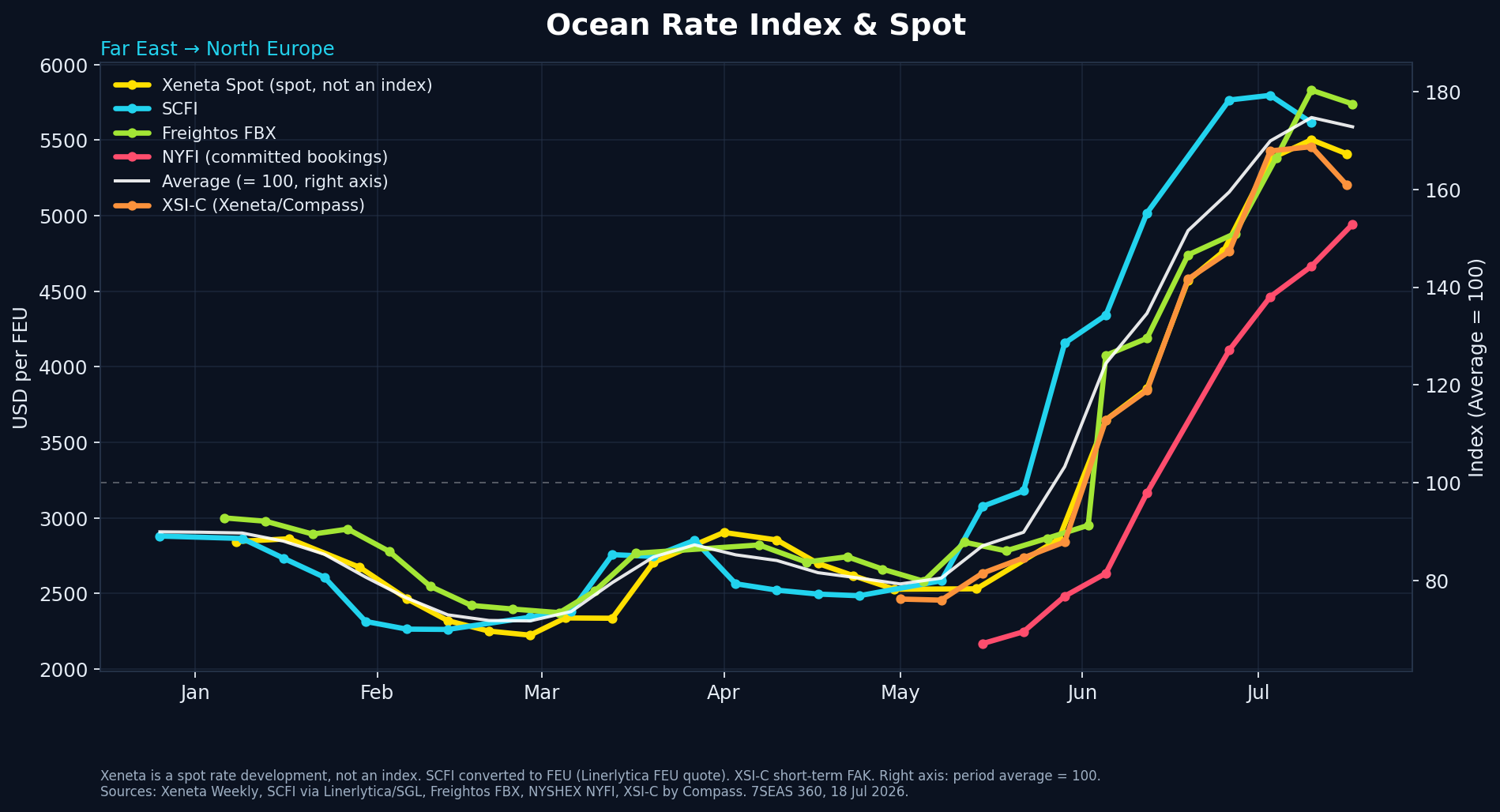
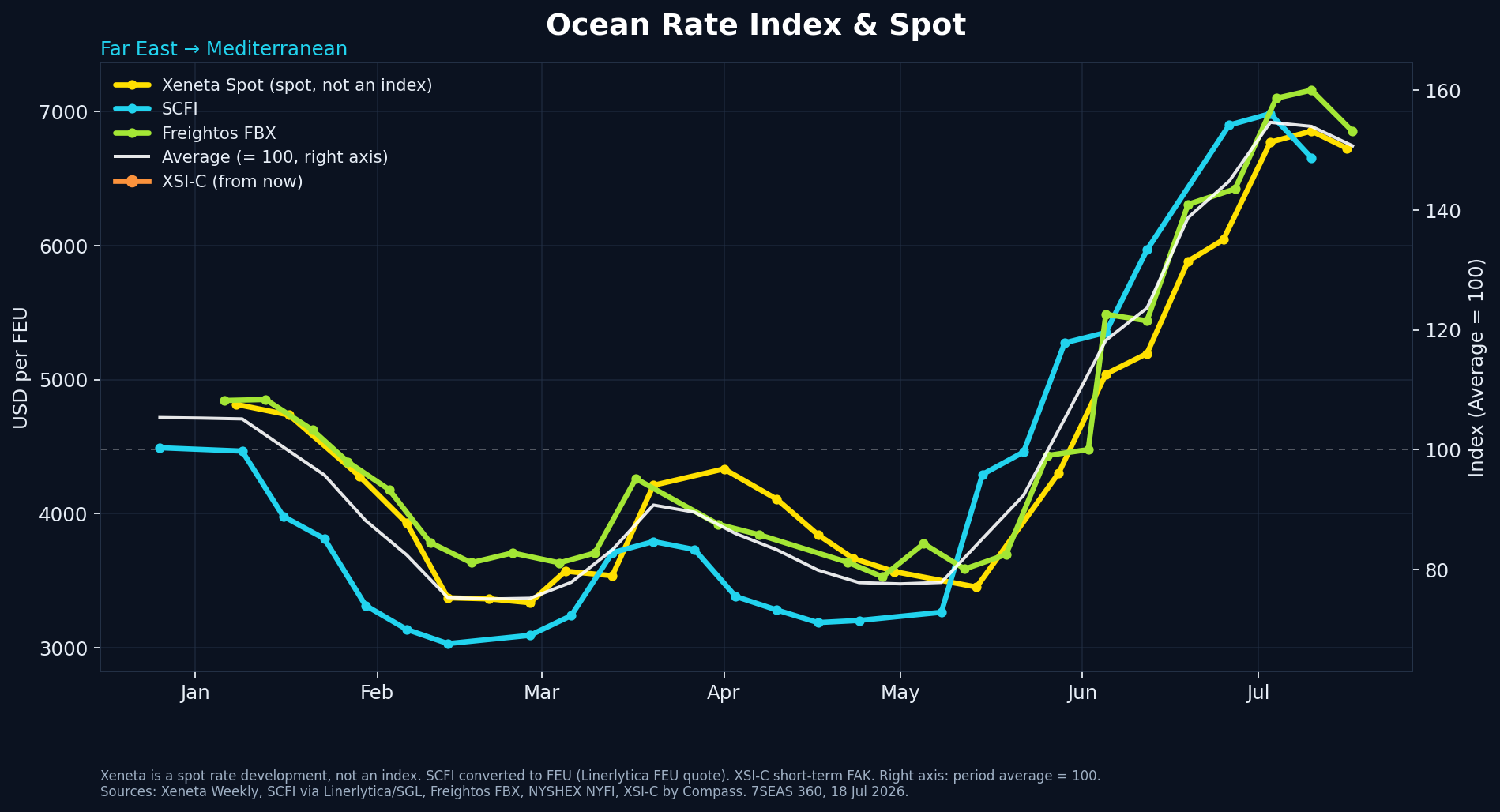
On Asia-Europe, the story of the past week is capacity returning through Suez rather than through Hormuz. Hapag-Lloyd reversed its Red Sea position and routed the 14,993 TEU AL JMELIYAH through the canal on the Asia-Med SE1/AE12 service, while Maersk logged ten trans-Suez trips in a single week. That released capacity is showing up in rates: FBX in the week to 8 September had Asia-North Europe down 3% to about 4,500 USD/FEU and Asia-Mediterranean down 1% to about 4,700 USD/FEU, with Mediterranean pricing since falling to level with North Europe. The divergence matters. Mediterranean rates are down 2,600 USD/FEU, or 37%, from the peak against 1,300 USD/FEU, or 23%, for North Europe, which points to Suez capacity landing first on Mediterranean strings while congestion at North European hubs, compounded by recent port worker action in Germany and the Netherlands, keeps those lanes firmer. Xeneta counts 18 of 48 Asia-Europe services calling at least one country in the immediate conflict area, equivalent to about 239,000 TEU of weekly capacity, so the exposure extends well beyond Gulf-bound bookings.
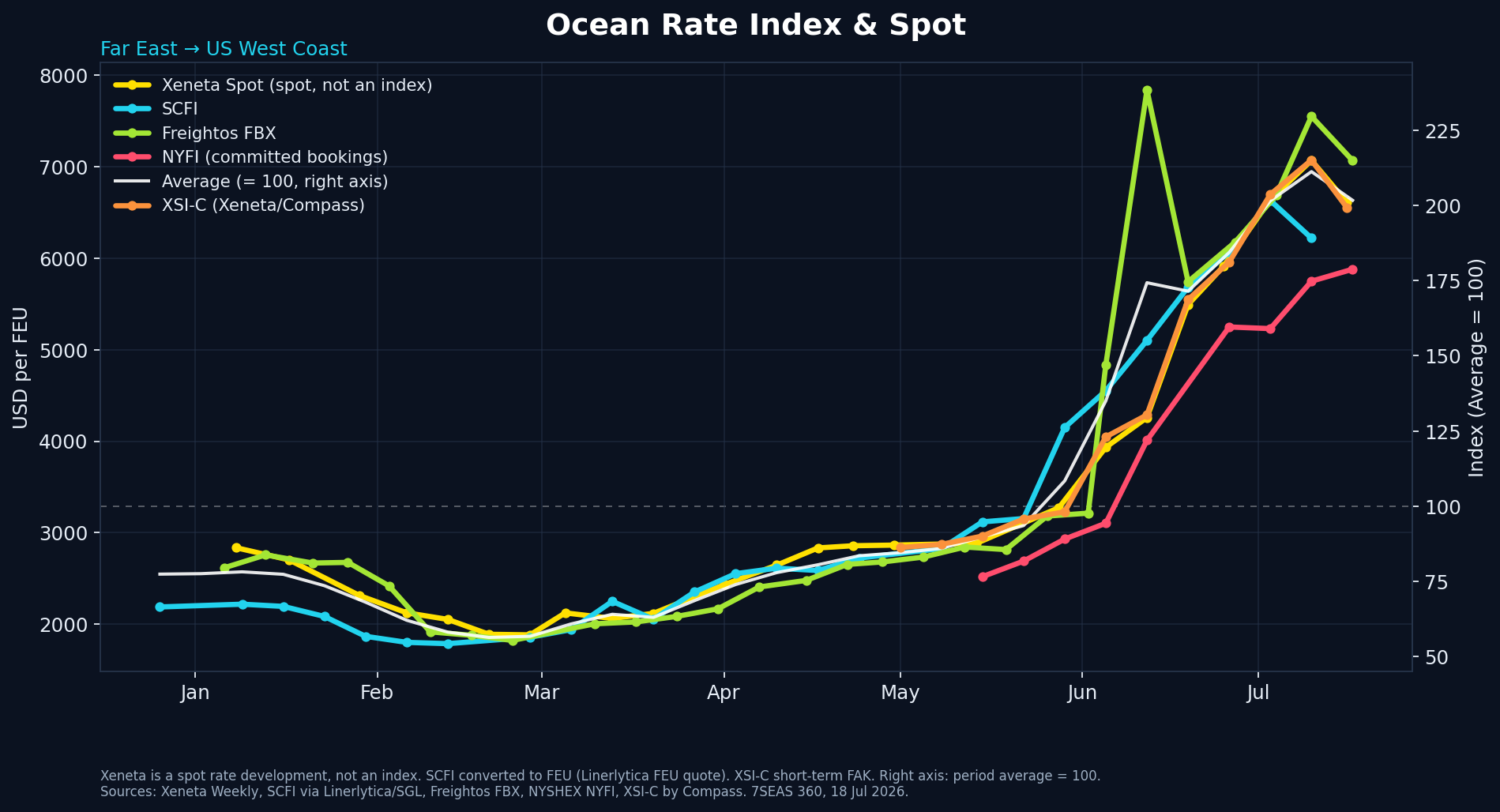
The transpacific is being driven by something else entirely. Rates of roughly 7,600 USD/FEU to the US West Coast and 9,500 USD/FEU to the East Coast are held up by typhoon-driven congestion at Far East hubs and by increased blank sailings as carriers rebuild schedules, not by Middle East risk. That distinction is the practical planning point: the Gulf crisis is now a regional access and compliance problem, while the global rate picture is set by congestion and by how fast Suez capacity unwinds. Equipment sits at the intersection of both. Linerlytica put 3.92m TEU, 11.4% of the global fleet, at anchorages waiting to berth, after a peak above 4.3m TEU that exceeded the 4.0m TEU pandemic record, and boxes stranded in relay ports compound an imbalance that shortening Suez rotations will only partly relieve. Rising bunker costs, back to June levels and about 60% above pre-war, set a higher floor under any rate correction that follows.
The strait is no longer the only place where risk sits. Attacks this week reached the highest level since the war began, and the damage is now being taken at anchorages and in Iraqi waters as much as in the strait itself, which changes the calculation for any operator still weighing a Gulf call. The proposed Iranian sanctions zone from Chabahar into the Gulf of Oman, if published with coordinates, would formalise what carriers have already priced: the Upper Gulf is a feeder market served from outside, not a main-line market. Container shippers should read the current rate picture carefully. Asia-Europe softening is not a sign that the Middle East risk is easing. It reflects post-peak demand, the partial return of some Mediterranean services to Red Sea transits, and capacity that is no longer absorbed by Gulf rotations. The elevated floor under both lanes comes from congestion at Far East and North European hubs and from bunker costs that have climbed back to June levels, around 60% above pre-war. The durable operational consequence is the Gulf routing itself. Jebel Ali's collapse out of the global top 30 is not a temporary dip in a port ranking; it is a rebuilt supply chain running through Fujairah, Khorfakkan, west coast India and GCC land corridors, with DP World's 50-year commitment to two east coast terminals signalling that the alternative is being treated as permanent infrastructure rather than a workaround. For shippers with Gulf-bound cargo, the planning assumptions for Q4 should be transshipment plus inland leg as the base case, war risk premium as a standing line item, and equipment availability out of the Gulf as the constraint most likely to be underestimated.
The Hormuz picture has hardened again. Ten days of Kpler tracking put average transits at roughly 10 vessels per day, the weakest reading since May and a fraction of the 85 to 90 daily transits recorded before the February conflict. Washington continues to describe the waterway as fully open; the traffic data does not support that reading, and for container operators the practical position is unchanged. Persian Gulf port calls are suspended or heavily reduced, war-risk premiums remain at multiples of pre-war levels, and the temporary Iran-Oman corridor announced in late August has produced no meaningful liner return. Tehran's plan to declare an exclusion zone running from the US blockade line into the Gulf, combined with a blacklist of vessels using the southern corridor, adds an insurance and sanctions dimension that most box carriers will not accept for a marginal trade lane.
The first-order effect on container shipping is no longer rate escalation but structural exclusion. Gulf volumes have not simply repriced, they have left the water. Cargo is moving overland into the UAE and Saudi Arabia, transhipment has redistributed to hubs outside the Strait, and boxes committed to Gulf rotations are effectively out of circulation. That equipment drag is the quiet cost, and it lands on lanes with no Middle East exposure at all.
On the main east-west trades, Hormuz is now a cost floor rather than a headline driver. Bunker prices back at June levels and around 60 percent above pre-war put a hard base under freight, but the week-to-week direction is being set elsewhere. Asia-Europe continues to soften: North Europe down 3 percent to about USD 4,500/FEU, Mediterranean down 1 percent to about USD 4,700/FEU, with Mediterranean lanes having given back 37 percent from peak-season highs against 23 percent for North Europe. The convergence is unusual, Asia-Mediterranean has averaged 17 percent above North Europe since 2017, and it most likely reflects the gradual return of Red Sea transits on some Mediterranean strings shortening the round voyage and releasing capacity, while North European congestion and the German and Dutch port strikes keep those lanes supported. Transpacific held near peak levels at USD 7,600/FEU to the West Coast and USD 9,500/FEU to the East Coast, cooling by 1 to 3 percent, with blank sailings and typhoon congestion in the Far East doing more to hold prices than demand. Panama at 32 daily transits and an El Nino watch adds a further capacity constraint into Q4.
For shippers, the planning position is: assume no Gulf liner normalization inside the current quarter, price Middle East cargo on multimodal routings through Khalifa, Sohar, Salalah or Jeddah rather than direct Gulf calls, and treat Asia-Europe softness as demand-led and reversible rather than a structural correction. The Red Sea recovery is the variable worth watching, because a durable Suez return would release more capacity into Asia-Europe than any Hormuz outcome will remove.
Six months into the closure, the two chokepoints that defined 2026 are moving in opposite directions, and shippers need to price them separately. The Red Sea is reopening in practice rather than in announcement: MSC switched its Himalaya Express to the Suez routing in both directions in late August, the first full service return since 2024, and Maersk has confirmed that over 30% of its Cape volumes are back on the trans-Suez leg. That capacity release is visible in the rate curve. Far East to North Europe has fallen 18% since early July to USD 4,532 per FEU and the Mediterranean is down 28% to USD 5,073, according to Xeneta's 3 September reading. Both lanes remain far above pre-crisis levels, at plus 111% and plus 61% against 28 February, but the direction of travel on the headhaul to Europe is now down.
Hormuz shows no equivalent movement. IMF PortWatch recorded six commercial transits on 30 August against a baseline near 85 per day, and war-risk cover for the passage remains priced at multiples that most operators will not pay, with several P&I clubs having withdrawn. For container shippers the practical consequence is that Gulf cargo has stopped being an ocean product. Carrier advisories describe a landside architecture instead: discharge at Khor Fakkan, Fujairah, Salalah or Jeddah, then truck legs into Sharjah, Jebel Ali and onward feeder connections into Kuwait, Qatar and Bahrain. The cost stack is explicit rather than buried, with emergency freight rates of USD 1,800 per 20ft, USD 3,000 per 40ft and USD 3,800 for reefer, special and dangerous goods, plus a USD 1,000 per container fee on any box that does transit the strait, covering insurance and crew risk compensation. Bookings for reefer, out-of-gauge and most dangerous goods into the upper Gulf remain suspended outright.
The equipment picture is the part that will outlast the closure. Empty returns across the UAE, Qatar, Bahrain, Kuwait, Iraq and Saudi Arabia's eastern ports have been pulled back to designated depots at Salalah and Jeddah, with drop-off charges of up to USD 1,000 per 20ft at Jebel Ali and USD 2,055 at Ajman. That means boxes are accumulating in a region where headhaul demand cannot lift them out, while North Asia runs tight. Linerlytica put 3.92m TEU, or 11.4% of the global fleet, idle at anchorages in the week to 1 September, after a peak above 4.3m TEU in late August that exceeded the 4.0m TEU high of the 2022 pandemic in absolute terms. Typhoon disruption at Ningbo and Shanghai added delays beyond ten days in the worst cases. The service consequence is measurable: global schedule reliability fell for a third consecutive month to 29.4% in August, down from a 30-month high of 39% in May, with Far East to Europe on-time performance collapsing from 47% in mid-June to 3% by the end of July.
Geopolitically the picture stayed unstable through the week. Iran claimed a strike on a US vessel in the strait on 6 September, which US authorities denied, and Saudi Arabia condemned an attack on a Bahri-owned tanker on 31 August in which two Filipino seafarers were killed. Prediction markets price a return to normal transit volumes by 30 September at low single digits and by year-end at roughly a quarter. For planning purposes through Q4, treat Hormuz as closed, treat the Red Sea as progressively reopening, and expect the transpacific rather than Asia-Europe to be the exposed lane into Golden Week.
What to do this week: rebase Asia-Europe budgets on the falling curve rather than July peaks, since carriers restoring Suez capacity will keep pressure on those lanes; lock transpacific coverage ahead of Golden Week in early October, where Xeneta expects further upward pressure; and for Gulf-bound cargo, confirm in writing which port pair the emergency freight rate applies to and whether the USD 1,000 transit fee is additive, because the landbridge and transit variants are priced differently. On equipment, forwarders with Gulf import volume should verify empty return locations before gate-out, not after, as the designated-depot regime overrides the delivery order.
The Strait of Hormuz is now closed in practice rather than in name. Windward counted eight transits in the 24 hours to 2 September against a pre-crisis baseline near 85 per day, and five of those eight moved without broadcasting AIS. That is not a shipping lane, it is an evasion corridor. For container operators the number that matters is the 55 boxships still sitting inside the Gulf out of 1,013 tracked vessels. Those ships are capacity that is neither trading nor releasing equipment, and Xeneta's earlier assessment that a genuine reset needs at least three clear months has not been overtaken by events. The cost side has moved faster than the volume side. Lloyd's List puts war risk claims from the conflict above USD 2 billion across more than 70 claims, the second largest marine underwriting payout in more than a decade, with the IMO counting over 72 attacks on ships since March. Hormuz premiums are running 40 to 60 times pre-crisis levels and can reach 10% of hull value. Charterers' liability cover now carries a blanket exclusion on any vessel with a Saudi nexus, which is a structural change in how Gulf-linked cargo gets underwritten, not a temporary surcharge. Volume has relocated rather than disappeared. Jebel Ali's H1 collapse from 7.77 m TEU to 3.14 m TEU, and a fall from 10th to 32nd in the global rankings, is the clearest single measure of what a closed chokepoint does to a transshipment hub. The replacement network is landside: DP World has pushed 500,000 TEU through GCC road and rail since March on roughly 3,000 truck movements a day, with bonded corridors running from Fujairah and Khor Fakkan on the Gulf of Oman into Jebel Ali, and a 50-year commitment to build 2.5 m TEU of east coast capacity at Al Rugaylat. That is a two to three year build, so the trucking workaround is the operating model for the foreseeable term. What shippers should read into flat headline rates is not calm. The Drewry composite held at about USD 4,465 per FEU this week, with transpacific strength offsetting Asia-Europe softness, because the Gulf premium is being charged where it actually lands: war risk, inland haulage, extended dwell and equipment repositioning. Asia-Europe and transpacific mainhauls are behaving like a normal peak season. Anything with a Middle East origin, destination or transshipment leg is not. Plan Gulf cargo on east coast UAE gateways with bonded trucking, budget the insurance line separately, and treat equipment availability at Indian and Asian origins as the constraint that bites first.
The six-month Hormuz crisis moved back from economic standoff to open exchange of fire this week. After Iranian missile strikes on two US air bases in Jordan over the weekend, US Central Command hit IRGC targets inside Iran on 1 September, naming attempted IRGC attacks on commercial shipping in the strait as the trigger. The June memorandum of understanding that briefly reopened the waterway in mid-June has now expired without a follow-on agreement, and Tehran has repeated that if Iranian oil cannot leave the Gulf, nobody else's will either. For box shipping the practical position is unchanged and stable in its own way: Hormuz remains closed to routine commercial container traffic, and no carrier is planning schedules around a reopening.
The cost of that is now visible in the port data. Alphaliner's first half review shows Jebel Ali handling 3.14m TEU against 7.77m TEU a year earlier, with Q2 down more than 90% to 374,000 TEU, dropping the Middle East's premier hub from 10th to 32nd globally. Khalifa Port fell out of the top 50. What replaced the water route is land. DP World has pushed 500,000 TEU through GCC road and rail corridors since March, running roughly 3,000 truck movements a day on bonded lanes from Fujairah and Khorfakkan into Jebel Ali, and in July committed to two new east coast terminals so that ships can reach a UAE gateway without entering the strait at all. Shippers with Gulf cargo should treat Fujairah, Khorfakkan and Sohar as the primary discharge points and price the inland leg into the door rate, not as an exception surcharge.
On the two trades that matter most to European and transpacific shippers, Hormuz is no longer the binding constraint. Linerlytica counts 3.92m TEU, or 11.4% of the global fleet, sitting at anchorages, down from a record 4.3m TEU the week before after typhoon Saudel disrupted Ningbo and Shanghai with delays exceeding ten days. That congestion, not the Gulf, is what keeps vessel availability tight and charter rates firm. At the same time the Red Sea is quietly reopening: MSC has returned its Himalaya Express to Suez in both directions, its first complete service return since 2024, and Maersk says more than 30% of its Cape volumes are back on the trans-Suez route. The net effect on Asia to Europe is loosening supply, with spot rates around USD 5,000/FEU to North Europe and USD 6,000/FEU to the Mediterranean, some 15% below the early July peak. The equipment picture is the counterweight: boxes that entered the Gulf before the closure are still stranded or repositioning overland, and Indian gateways absorbing diverted volume continue to run long dwell times. Plan Q4 bookings on the assumption of softer Asia to Europe rates, tight equipment on Middle East and Indian Subcontinent legs, and no Hormuz transit before year end.
The mine-clearing progress announced last week is already undone as a signal. On 30 August US forces struck two Iranian launchers on Larak Island, the first American strike on Iran in about a month, after IRGC units were observed preparing to fire rockets carrying sea mines into the Strait. Tehran has promised a response. For container operators the practical reading is that the waterway can be declared physically clear and remain commercially unusable, because the risk that matters is the one that reappears between the survey and the sailing.
The traffic data reflects that. Commercial transits are back to roughly five vessels a day against a normal baseline near 85, and weekly counts had already been falling before the strike. What container movement exists is opportunistic rather than scheduled. The two Cosco boxships that passed Larak this week went through in a tight pair and continued to Port Klang, which is the pattern now: individual probes by operators with the risk appetite and the state backing to absorb an incident, not a restored service loop. AIS switch-offs mean the true count is somewhat higher than the visible one, and the gap itself tells shippers something about how the transit is being priced internally.
The more consequential story for cargo owners is landside. Jebel Ali is being kept warm rather than worked, running around a thousand moves a day against roughly forty thousand before the war, with Q2 throughput at 374,000 TEU against 3.8m TEU a year earlier. The workaround ports that absorbed the diversion have now become the constraint. Median waiting at Fujairah has more than doubled to 9.25 days and Khor Fakkan is at 4.81 days, while Jebel Ali waits at 0.08 days because there is nothing in the queue. Shippers routing to the Gulf are no longer trading transit risk for a longer routing; they are trading it for a queue, and the queue is now the longer part of the delay.
Ocean rates are sending a divided signal. Asia to Europe spot levels continued to soften, with Freightos recording a 1% weekly decline to North Europe and 4% to the Mediterranean, and Shanghai to Rotterdam sitting near USD 4,825 per 40ft. Transpacific was steadier, with Shanghai to Los Angeles flat around USD 6,818 and Shanghai to New York down 2% to USD 9,333 as carriers manage capacity into the shoulder season. Base rates on the mainlanes are therefore not carrying the crisis. The Gulf premium sits in the surcharge stack, layered as war risk, emergency conflict, fuel and peak season additionals, and that structure is what will decide landed cost into the Middle East well into Q4.
Underneath all of it, the equipment problem is compounding quietly. More than 200,000 TEU is effectively trapped inside the Gulf, piling up at workaround ports that generate no backhaul, while Asian origins lose the boxes that would normally return through Gulf rotations. Specialised equipment, reefers, flat racks, open tops and tanks, remains the tightest and least elastic part of the fleet. This is the part of the crisis that outlasts any reopening announcement: even a durable ceasefire leaves several months of repositioning cost before global box availability normalises. Forwarders quoting Q4 and Q1 business should be pricing that tail, not just the transit.
The number that matters this week is not the transit count. It is the gap between a diplomatic process that is finally producing structure and a container market that cannot yet act on it. Oman and Qatar are working two parallel channels into Tehran, and for the first time Iran has agreed to put its reopening conditions in writing. A phased joint navigation corridor is a real construct, not a communique. But conditions historically include an end to the US blockade of Iranian ports, compensation and sanctions relief, and Washington has stepped back from talks in favour of economic pressure. That is a wide gap to close.
For shippers the practical picture is unchanged. Hormuz remains effectively shut to liner traffic. Jebel Ali, a top-ten global gateway before February, handled 374,000 TEU in the second quarter and has fallen out of the global top thirty. The workaround network through Fujairah, Khor Fakkan, Salalah and the Jeddah land bridge is functioning, but it is a cost structure, not a substitute. Transit times into the upper Gulf run days longer and inland trucking has become a fixed line item rather than an exception.
Rates tell you demand is not the constraint. Asia-Europe spot levels drifted lower again this week on both the North Europe and Mediterranean legs, and carriers are defending the level with blank sailings rather than watching cargo bid it up. Transpacific eastbound is absorbing the bulk of the cancellations. In a normal year that would read as a soft market. Here it reads as a market where the Gulf demand that would have tightened Asia-Europe headhaul has simply been removed from the equation.
The risk we would watch into September is equipment, not rates. Every box that goes to Salalah and then onto a truck stops circulating. It accumulates where there is no outbound service to lift it, and it does not return to the Asian origin that needs it. If a corridor deal does land, the reopening will not be instant. It will be gated by where the containers physically are, and that repositioning bill falls due whatever the diplomats agree.
Planning guidance is unchanged: hold Gulf routings on the alternative gateways through Q4 booking cycles, price the inland leg explicitly rather than as a surcharge, and secure equipment commitments in Asia now rather than assuming a corridor announcement restores supply.
The Hormuz crisis has moved from a physical risk problem to a legal one. Iran's newly created Persian Gulf Strait Authority named 45 vessels as non-compliant with its transit regime and threatened fines, detention and confiscation of cargo, extending the same treatment to any ship that works STS or transhipment with a listed hull. Washington answered within 48 hours: OFAC guidance issued on Monday states that accepting PGSA services, or even replying to its information requests, exposes US and non-US companies to sanctions. For a shipper, the practical consequence is that the set of carriers both willing and legally able to serve the Middle East Gulf just contracted again, and the pool of vessels that can safely be nominated for STS relay work outside the strait contracted with it. At least 14 of the blacklisted ships have already been attacked in or around Hormuz this year, so the list is not an abstract compliance annoyance.
The container numbers show what this has already cost. Two containerships made outbound Hormuz passages last week. Jebel Ali moved 374,000 TEU in Q2 against 3.8m TEU a year earlier, a 90.1% collapse, and DP World is burning roughly USD 100m a month to keep the terminal in a state where it can restart. Gulf cargo now moves through Fujairah, Khor Fakkan, Sohar and the Jeddah land bridge, which adds handling, adds days, and adds a second set of demurrage clocks that most contracts of carriage were never written to cover. All-in rates Shenzhen to Jebel Ali sit at USD 8,250 to 9,500 per 40HQ.
The wider market is not offering relief. Global port congestion has passed the covid-era peak at 4.3m TEU waiting to berth, driven by storm disruption in East Asia, with 139 ships queued at Shanghai and 77 at Ningbo. That congestion is the main reason equipment is short: boxes are not missing, they are sitting in queues and in the wrong hemisphere. Linerlytica has the SCFI 156% above its pre-conflict level and the Platts Container Index hit USD 7,565 per FEU on 21 August, the highest this year. The one structurally positive development is on Asia-Europe, where MSC has put the Himalaya Express back through Suez in both directions and Maersk has returned more than 30% of its Cape volumes to the trans-Suez route. That releases tonnage, but it releases it into a system already short of berth windows, and Panama's cut to nine Neopanamax slots a day from 3 September removes flexibility on the transpacific side at the same moment.
What to do this week. Assume Gulf routings stay via Fujairah, Khor Fakkan and Sohar into Q4 and price them that way rather than quoting a Jebel Ali direct that may not exist. Screen your nominated carriers and any STS relay tonnage against the PGSA list and against Monday's OFAC guidance before you fix, because an owner that solves its Tehran problem may be creating your Washington problem. Build 10 to 14 days of buffer into Asia-Europe and transpacific transit expectations for congestion alone, book equipment earlier than instinct suggests, and take the Suez returns as a rate signal for Q4 rather than as capacity you can count on this month.
Six months into the closure the market has stopped pricing a reopening. The week to 16 August brought 73 Hormuz transits against 91 the week before, and containerships remain almost entirely absent at zero to two movements a day. What matters for box shippers is no longer the strait itself but the two structures that have hardened around it. First, the Gulf has been re-plumbed: Jebel Ali runs at about a tenth of normal container throughput while Fujairah, Khor Fakkan, Sohar and the Jeddah land bridge absorb the cargo, and DP World is paying roughly USD 100m a month to keep Jebel Ali warm for a restart nobody can date. Second, the cost shock has migrated from spot into contract. Long-term Far East to North Europe rates are up 50% since 28 February and Far East to US East Coast up 42%, which means the crisis premium is now locked into procurement cycles well beyond any ceasefire.
The more actionable development this week is the split between fronthauls. European trades have been softening for over a month, with Far East to North Europe down 2.8% to USD 4,801 per FEU and Mediterranean down 3.8% to USD 5,526 per FEU. US trades keep climbing, with the East Coast at USD 10,527 per FEU, close to 300% above pre-crisis. The resulting USD 3,334 per FEU gap between the two US coasts is wider than the total pre-crisis cost of shipping a container into either one. For anyone with routing flexibility, a West Coast entry plus inland rail or truck is now worth modelling seriously, even where it adds days and handling. The European lane also proves carriers are not immune to pushback, which is useful leverage going into the autumn tender round.
Planning assumption for Q4: treat the closure as the baseline, not the exception. Contract short. Xeneta's guidance holds, secure space for the coming quarter with an adjustment mechanism rather than locking a twelve-month rate into a peaking market. Build Gulf coverage on the eastern UAE and Oman ports rather than on a Jebel Ali restart. And watch the Iranian service-fee proposal: if passage is repriced rather than reopened, the cost floor for Gulf cargo moves up again regardless of how the diplomacy ends.
The week's two developments point in opposite directions and both matter. On the water, the strait became more dangerous rather than less: a ship linked to ADNOC was attacked on Friday night, the third hit on an ADNOC vessel in 48 hours, and the UAE named Iran directly. Traffic reflects the risk. Transits fell to 73 in the week to 16 August from 91 the week before, and the container picture inside that number is close to a shutdown. Containership passages have averaged half a vessel a day over the past month, and box capacity crossing Hormuz has fallen to roughly 7,700 TEU a day against about 376,000 in 2025. Ashore, carriers have stopped waiting. Hapag-Lloyd and MSC have both stood up third-party feeder links into the Gulf, which is what allowed Hapag-Lloyd to reopen upper Gulf bookings, and CMA CGM has run a multimodal version of the same idea since March. The practical read for shippers is that Gulf access is being rebuilt around the strait, not through it, with Fujairah, Khor Fakkan, Sohar and the Jeddah land bridge as the load-bearing nodes. That rebuild is expensive and it is not temporary. Jebel Ali moved 374,000 TEU in Q2, down 90.1% year on year, and DP World is carrying about USD 100m a month to keep the terminal ready for a reopening nobody can date. On the head-haul trades the divergence held. Freightos' 18 August reading puts Asia to North Europe near USD 4,700 per FEU and Asia to Mediterranean near USD 5,000, both softer as European demand cools and as congestion rather than the Gulf sets the marginal price. The transpacific went the other way, up 9% to about USD 7,400 to the US West Coast and 3% to a new high of USD 9,400 to the East Coast, with the peak running longer than most carriers planned for. Equipment remains the quiet constraint. More than 200,000 TEU sits stranded inside the Gulf and cannot cycle back to Asian load ports, which keeps empty availability tight for exporters in India and East Africa regardless of what the strait does next. Plan Gulf-bound cargo on feeder and land-bridge routings with two to three weeks of buffer, price war risk and conflict surcharges into landed cost, and treat any reopening headline as a rate event before it is an operational one.
The expiry of the 60-day US-Iran memorandum on 18 August removes the last multilateral framework covering commercial passage through Hormuz. What replaces it is not a vacuum but an Iranian regime: a designated corridor agreed in principle with Oman, a requirement for Iranian authorisation, and confirmed plans to levy service fees on transit. Enforcement is visible. A chief engineer died on 17 August when the panamax Minoan Dignity was hit by a projectile five nautical miles off Oman, and Iranian state-linked media claim a UAE-owned tanker was detained near Qeshm Island for failing to comply. For container operators the practical question is no longer whether the strait reopens but at what commercial cost, and a fee structure benchmarked to cargo value would make calls at Jebel Ali and Khalifa marginal even under a ceasefire. Traffic reflects that. Transits ran at 78 in the week to 9 August against 95 the previous week, well below a pre-crisis baseline above 130 vessels a day, and roughly 250,000 TEU of weekly container capacity remains displaced from the Gulf into landbridge routings via Khor Fakkan, Sohar and Jeddah. Weekly capacity into Jeddah and King Abdullah is up 19% as carriers institutionalise the workaround. On the head-haul trades the picture diverges. Asia to North Europe has come off its July peak to around USD 5,000 per FEU, down 14%, and Asia to Mediterranean sits near USD 6,000, down 16%, as European demand cools. The transpacific peak has run longer than expected, with carriers holding rates through blank sailings. Far East to Persian Gulf spot pricing is the outlier at 2.8 times January levels, above both the COVID and Red Sea peaks on that corridor, which is a direct measure of the scarcity premium on Gulf access. The equipment layer is the one that outlasts the politics. Gulf terminals were the empty container reservoir feeding Indian and East African export hubs, and with that pool inaccessible and North Asian and European ports congested, box availability rather than vessel capacity is the constraint. Any reopening will fix the routing before it fixes the equipment position, and shippers should plan the fourth quarter on landbridge assumptions with earlier equipment booking and explicit war risk and route deviation clauses.
The Strait of Hormuz remains effectively closed to routine commercial shipping in week 34, and the container picture has not improved. Lloyd's List Intelligence recorded 78 transits between 3 and 9 August, down from 95 the week before, with non-Iranian-linked movements falling to 45 from 63. Containerships and gas carriers are back in the trackable data after earlier pauses, so the lane is not shut in an absolute sense, but UKMTO puts AIS-detected traffic at around 90% below pre-conflict levels against a pre-war baseline of more than 130 vessels a day. Inbound non-Iranian transits are the one line moving the right way, running above the pre-MoU weekly average of 15 for a second week.
The routing shift is the operational story for anyone with cargo booked through the Gulf. UKMTO logged 20 projectile-strike incidents in and around Hormuz since 6 July, with 16 of 18 recent strikes falling on the southern Omani corridor coordinated with US NCAGS. Engine rooms were the primary damage location in 12 cases, which means the realistic failure mode is a vessel losing propulsion inside a narrow waterway. Owners are responding by moving north into the corridor run by Iran's Persian Gulf Strait Authority: 19 outbound and 26 inbound AIS-visible vessels used the northern route last week, against 8 and 5 on the southern one. The traditional Traffic Separation Scheme stays suspended. Shippers should assume their carrier's Gulf leg now runs through Iranian-controlled water, and should ask rather than assume.
For volume, Container Trades Statistics puts H1 2026 Middle East Gulf losses at 1.8-2.0m TEU, with regional imports down 21% and exports down 31%. Global container trade still grew over the same period, which tells you demand relocated rather than disappeared. Rate behaviour reflects that split: Asia-Europe spot levels are drifting down as the European peak fades, while carriers push increases on the transpacific, Latin America, Indian subcontinent and Middle East trades and hold them up with blank sailings. Linerlytica has TEU-mile demand expanding faster than fleet supply, so the inefficiency itself, longer voyages, congestion and rerouting, is what keeps freight elevated rather than any underlying tightness.
The equipment imbalance is the exposure most shippers are still underpricing. Diversions to Jeddah, Khor Fakkan, Fujairah, Sohar, Duqm and Salalah, plus boxes parked in India, Oman and Pakistan, have put large volumes of gear outside the normal repositioning cycle. Equipment exists in the region; it is not where it is needed, and cross-border repositioning cost and lead time will persist well past any political settlement. Newbuild box deliveries do not fix a geographic mismatch. Plan Gulf equipment availability on a horizon measured in quarters, not weeks.
Politically there is no near-term off-ramp. Mohsen Rezaei has tied reopening to the US releasing Iranian frozen assets and ending regional conflicts; Foreign Minister Abbas Araghchi has said the Oman corridor talks are a separate matter and that Tehran has not decided to resume negotiations with Washington. US Treasury has signalled further economic measures. Marine underwriters already estimate USD 1.5-2.0bn in claims from around 70 casualties since the end of February, and are modelling total-loss filings if deprivation of use passes twelve months. The IMO counted 65 confirmed vessel incidents and 17 seafarer deaths as of 11 August. Base your Q4 planning on continued disruption, not on a reopening.
This week the crisis stopped being a transit count and became a line in the accounts. Hapag-Lloyd disclosed roughly USD 600m of Middle East costs in the second quarter, covering bunkers, insurance, storage, service rerouting and inland transport. Set against group EBIT of USD 176m, the disruption cost the carrier more than three times what it earned. Maersk, running the same Gemini network, came out the other way: Ocean EBIT of USD 935m against USD 229m a year earlier, average loaded rates up 22%, utilisation at 96%, and full-year EBITDA guidance raised to USD 10.5-12.5bn. The difference is not luck. Maersk moved Gulf cargo onto alternative ports and landbridge routes and redeployed the freed vessel capacity into growing trades, and its Logistics and Services arm grew 15% partly on those Gulf landbridge solutions. For anyone still treating the Gulf as a routing problem, that is the answer: the money is in the workaround, not in waiting for the strait.
The more important shift for shippers is that the crisis has reached the contract market. Xeneta records long-term rates up 41% to the US West Coast, 40% to the US East Coast, 41% to North Europe and 17% to the Mediterranean since the end of February. Those increases are far behind the spot market, which is 271% and 287% above pre-crisis levels on the two US coasts, and that gap of USD 4,103/FEU on Far East to USWC is exactly the leverage carriers are bringing into renewals. Peter Sand's guidance is to avoid twelve-month commitments in a rising market and take shorter agreements that hold capacity but allow repricing if spot turns. On current evidence that is the right call, because the spot picture is already splitting: transpacific firm on constrained capacity and blanked sailings, Asia-Europe softening for a fifth week with Shanghai-Genoa down 8% and Rotterdam down 5%, and new Asia-Mediterranean FAK levels of USD 6,700 to 7,100 from 15 August that look ambitious against fading demand.
Nothing in the strait itself improved. Total transits fell 18% week on week, with outbound down 30%, and the five-day average sits near 13 vessels, close to the lowest since mid-May. Washington and Tehran spent the week contradicting each other in public, one claiming total control of the waterway and the other insisting no ship passes without permission, which leaves owners with no usable guidance. The practical consequence is a compliance problem stacked on top of a security problem: paying for safe passage risks OFAC exposure, refusing to pay risks the ship. That is not a decision a shipper can make for a carrier, but it is one that will keep surcharges in place and schedules unreliable regardless of what the next headline says. Plan the fourth quarter on the assumption that Gulf cargo moves overland or through alternative ports, price contract renewals short, and do not build a budget around a reopening date.
The week that began with talk of a breakthrough ended with the familiar wartime status quo. The Iran-Oman understanding on route coordinates was never a reopening, only a traffic-management framework, and Iran's 8 August demand list, followed by a US counter-list on 11 August, has pushed a workable arrangement further out. Transits fell to about six vessels a day over the weekend against a pre-war norm of 130 to 140. For container operators the practical position is unchanged since February: the Gulf is a one-way risk, and almost nobody is taking it.
The commercial damage has shifted from freight rates to equipment. With 79 boxships and 312,812 TEU idle inside the Gulf and only 17 vessels out since the closure, more than 200,000 TEU of capacity sits where it cannot earn. The boxes matter more than the slots. Empties that would normally cycle back to North Asia are locked in, and carriers are now insisting empties be returned outside the Gulf. That shortage lands on Asian origins already dealing with hub congestion, and it is the single line item most shippers underestimate when they model Middle East exposure.
On the mainlanes the picture is diverging. Asia-Europe is in a textbook post-peak slide, down 8 percent to North Europe and 7 percent to the Mediterranean last week, with carriers defending the level through blanked August sailings and abandoned mid-month increases. Rates are back to mid-June but still around USD 2,000/FEU above the pre-peak baseline of mid-May, which suggests demand has come off its top rather than collapsed. Transpacific has gone the other way as the US peak stretched into August, with the East Coast at a new high near USD 9,400/FEU and the West Coast recovering USD 1,300/FEU this month. For anyone tendering now, the read is straightforward: take Asia-Europe on the softness, hold short on transpacific, and budget separately for Gulf equipment repositioning rather than assuming it clears with a ceasefire.
The diplomatic story and the operational story moved in opposite directions this week, and the gap between them is where shippers now have to plan. Iran announced on 5 August that it had agreed the coordinates of new commercial routes through the strait with Oman after several rounds of talks. Under the proposal reported to Reuters by a senior Iranian source, Tehran would be able to intervene with inbound traffic while outbound traffic would run a corridor between Iran and Oman with exit clearance granted through Oman after notifying Iran. On paper that looks like a reopening mechanism. In practice it is not one, because the payment leg is blocked from two directions at once.
The first block is insurance. On 23 July the Lloyd's Market Association issued a clause for use by war risk underwriters that terminates cover for a vessel that has paid a transit fee, toll or other charge for passage through Hormuz. The LMA wording is explicit: insurers have no liability to indemnify any such payment and, where such a payment has been made, are discharged from their obligations in respect of the vessel. The second block is sanctions. The United States has sanctioned the Persian Gulf Strait Authority that Iran established in May to operate the waterway, and the US Treasury prohibits US persons from receiving services from the Iranian government related to a guarantee of safe passage. Four industry sources told Reuters that any payment could lead to asset freezes. Iran is seeking 5% to 7% of cargo value, Oman is discussing around 3%, and Washington wants nothing. A vessel that pays sails uninsured and potentially in breach of sanctions. A vessel that does not pay does not get cleared. That is the reason a route agreement has not moved a single container line back into the Gulf, and it is the reason any headline about a reopening should be read against the insurance certificate rather than the diplomatic communique.
The industry has now said so formally. Eight of the largest shipping associations, among them BIMCO, the International Chamber of Shipping, the World Shipping Council, the Asian Shipowners Association and the European Shipowners Association, wrote to UN Secretary-General Antonio Guterres and IMO Secretary-General Arsenio Dominguez describing compulsory transit or service fees as a toll in all but name and warning that they would establish a precedent capable of undermining the legal framework governing straits used for international navigation. Dominguez had already told Al Jazeera in April that coastal states have no right to introduce tolls, payments or charges on such straits. The IMO's governing council said in July that passage through the traffic separation scheme, adopted in 1968 with regional agreement, should remain free of tolls and charges. The counter-argument that matters commercially came from Deborah Elms of the Hinrich Foundation, who noted that Hormuz itself is not a major container chokepoint, but that if tolls are applied here and the precedent spreads to other waterways, container and bulk trades are the ones that would be hit hardest.
On the water nothing has improved. Xeneta's Peter Sand puts total daily transits in the teens since mid-July, roughly one tenth of pre-war levels, with containership transits running between zero and two per day. Windward recorded nine crossings in the 24 hours to 6 August, four inbound and five outbound, one of them an outbound bulk carrier that ran dark for about 33 hours before reappearing, and counted 53 container ships inside the Gulf out of 1,039 tracked vessels. Transits rose to 17 in the 24 hours to 9 August from four the day before, which is the same weekly volatility Lloyd's List warned against reading as confidence. Security deteriorated over the weekend. The UAE said Iran struck an ADNOC tanker with a missile in the early hours of Saturday 8 August as it crossed the strait, drawing condemnation from the GCC, Qatar, Saudi Arabia and Jordan. ADNOC said on Friday that 15 of its vessels have been attacked since the conflict began, three of them this week, killing one crew member and injuring 20. The IMO has confirmed 64 incidents and 17 deaths in the region, with at least 6,000 seafarers still stranded in and around the strait as of late July.
For container procurement the practical picture has split. On Asia to Europe, the crisis is no longer the marginal price setter. Xeneta's 6 August assessments put Far East to North Europe at $4,965 per FEU, down 4.9% on the week, and Far East to Mediterranean at $6,079, down 4.8%. Those lanes are being priced by soft demand and capacity management, with 58 blanked sailings scheduled across the East-West trades between week 32 and week 36 out of 723 planned departures, and Sand flagging that carriers are cancelling advertised weekly departures at the last minute. Transpacific went the other way, with Far East to US West Coast up 13.8% to $6,824 and Far East to US East Coast up 12.8% to $9,988, closing on the $10,000 mark. Middle East lanes remain the exception where Hormuz still sets the price directly, through relay routings via Salalah, Khor Fakkan and Jeddah and through stacked war risk, emergency fuel and peak season surcharges. Three things follow. Buy Asia to Europe capacity against schedule reliability and blanked sailing data rather than against crisis narrative. On Gulf traffic, treat the route agreement as unpriced until an underwriter will write cover against it, and ask any carrier quoting a Gulf reopening to state which war risk facility it is relying on. And on equipment, remember that boxes are still trapped on the wrong side of the strait and are not rotating, which keeps availability tight on lanes that have nothing to do with the Middle East.
The most consequential development for container shippers this week did not happen in the strait. The Joint War Committee has extended the Red Sea listed area for war risk insurance by roughly 800 kilometres to the north, which places Jeddah and Yanbu inside the zone that attracts additional premium. Jeddah is not an incidental port in this crisis. It is the anchor of the land bridge that Gulf-bound and Gulf-origin boxes have been relayed through since mainline services stopped calling inside the Gulf, alongside Salalah and Khor Fakkan. The detour that the market adopted to avoid Hormuz risk has now been formally repriced for Red Sea risk. Shippers who negotiated relay routings in June and July on the assumption that the workaround was the cheap leg should expect that assumption to be tested at the next quotation, and should ask carriers to show the war risk component separately rather than accept it folded into an all-in rate.
The strait itself is busier on paper. Lloyd's List Intelligence counted 84 transits between 27 July and 2 August against 45 the previous week, with non-Iranian-linked traffic rising to 52 from 28 and westbound non-Iranian movements nearly doubling to 21. Non-Iranian containership transits resumed after a one-week pause. Lloyd's is explicit that weekly volumes fluctuate enough that this should not be read as returning confidence, and the composition supports that caution. Windward's 4 August snapshot recorded 18 crossings, 11 inbound and 7 outbound, of which seven ran dark and two were visible only as unflagged radar signatures on satellite imagery. The single container vessel in that count, Marshall Islands-flagged, crossed the southern corridor with an AIS gap of about twelve hours. Container ships inside the Gulf number 52 out of 1,057 tracked vessels, down from 55 two days earlier. This is not the return of liner tonnage.
The security case has narrowed rather than eased. Iran is now striking the bypass route directly: two vessels using the Omani channel have been hit since 1 August with at least one further attempt, including a Liberia-flagged bulk carrier struck roughly 20 nautical miles northeast of Khasab on 3 August, at the same coordinate as an incident the night before. Around a quarter of confirmed non-Iranian traffic still uses that channel. US Central Command continues its blockade of Iranian ports, reporting 45 merchant ships redirected, two disabled and two boarded. Diplomatically the signals cancel out. Washington has announced a new round of talks that Tehran rejects, Qatar's mediators are working a short-term arrangement, and Secretary of State Rubio has cited progress in Oman-Iran talks on traffic management while the President threatens further strikes if the chokepoint stays shut. None of that has produced a development an underwriter would price on.
On the commercial side the picture is unchanged from last week and worth restating because it is the operative one. The Drewry WCI composite last printed at $4,255 per FEU on 30 July, a third consecutive weekly fall, with Shanghai-Rotterdam at $4,677 and Shanghai-Genoa at $5,630. Carriers are answering with surcharge architecture rather than base rate: CMA CGM's emergency fuel surcharge took effect on 1 August alongside a peak season surcharge of $1,500 per container from North Europe to the Middle East and Red Sea, transpacific GRIs of $2,000 to $3,000 per FEU went in on the same date, and MSC has set a 15 August FAK of $7,800 per FEU to North Europe and $6,700 to the Mediterranean. Xeneta has North Europe to Jebel Ali running around $5,200 per FEU against below $1,000 before the crisis, and still counts only 11 active container services in or through the Arabian Gulf against 99 before, roughly 74,000 TEU against 3.2m TEU. Xeneta's best case for a return to more normal network operations remains no earlier than mid-September. Plan Gulf lead times off the relay routing, add 7 to 21 days, and treat every risk-linked surcharge, including the newly extended Red Sea premium, as a separately negotiable and time-limited line item.
The strait is busier than it was a week ago and no safer. Windward counted 12 identified transits in the 24 hours to 2 August against 5 on 31 July, but six of those twelve crossed without AIS and two were visible only as radar-length signatures on satellite imagery, roughly 97 and 229 metres, with no flag and no identity. The composition still tells container operators that this is not their traffic returning. Of the twelve, two were container ships: one Comoros-flagged vessel inbound on the northern corridor broadcasting normally while carrying a high smuggling-risk profile, and one Saint Vincent-flagged vessel outbound through the southern corridor with its transponder off. The dark-transit share has now held at about half of daily traffic for several weeks, which is a stable pattern rather than a passing spike.
The security case against resuming Gulf calls has if anything hardened. A Bermuda-flagged LNG carrier was struck in the southern corridor on 1 August while running dark with Qatari-origin cargo, the second Qatari-linked gas casualty in a week. On 3 August UKMTO reported a cargo vessel struck by an unknown projectile roughly 20 nautical miles northeast of Khasab, Oman, in the same waters where an unexplained explosion had been reported the previous evening. Both incidents involved vessels that were dark or had recent AIS gaps, which removes the last operational argument for running silent as a risk-management tactic. MOL has said publicly it will not resume normal Hormuz transit until safety is demonstrated in practice, and CMA CGM, which had eleven ships trapped inside the Gulf during the closure, has signalled it will not assume pre-conflict conditions return the moment the strait formally reopens.
For container shipping the number that matters this week is Xeneta's service count. Ninety-nine services operated in or through the Arabian Gulf before the crisis, carrying about 3.2m TEU of nominal capacity. Eleven are still active, worth roughly 74,000 TEU. That is not a schedule problem, it is the removal of a regional network, and it explains why Gulf-bound boxes now move through Salalah, Khor Fakkan and the Jeddah land bridge with seven to twenty-one days added to pre-crisis transit, and why empty equipment is not cycling back. Indian export hubs that depend on empties returning from Middle East ports have been running a 40 to 45% shortfall. Meanwhile the east-west trades are moving in the opposite direction: the Drewry WCI fell for a third straight week to $4,255/FEU on 30 July, Shanghai-Genoa dropped 6% to $5,630 and Shanghai-Rotterdam 3% to $4,677, and Linerlytica recorded Asia-Europe business closing below $5,000/FEU as the 1 August increase lost support. Carriers are answering with capacity discipline and a second attempt at pricing, eight blank sailings next week against seven this week, MSC's 15 August FAK at $7,800/FEU to North Europe and $6,700 to the Mediterranean, and transpacific GRIs of $2,000 to $3,000/FEU applied on 1 August. Shippers with Gulf exposure should treat war risk and emergency surcharges as separately negotiable line items, time-limit them to 30 or 60 days, and plan Gulf lead times off the relay routing rather than off any reopening date. Xeneta's own best case still puts a return to more normal network operations no earlier than mid-September.
Last week's reading of first cracks in the blockade has not held. Windward's count for the 24 hours to 31 July puts Hormuz transits at five vessels against a pre-crisis baseline of roughly 140 a day, and three of those five were OFAC-designated. That composition matters more than the raw number: sanctioned and dark-fleet tonnage is now the majority of what moves through the strait, which tells container operators that the traffic resuming is not the traffic they run. Twelve of the nineteen crossings Windward logged were dark, and its satellite analysis has identified around a dozen distinct no-AIS commercial hulls making the passage since the crisis began, spanning everything from small cargo ships to VLCCs. The southern corridor stays untested by legitimate tonnage, reinforced on 31 July when a Liberia-flagged bulk carrier reversed course after an IRGC warning delivered over VHF, and the KAVOMALEAS continues to burn near Larak Island eleven days after it was struck.
For container shipping the operational picture has settled into a stable, expensive equilibrium rather than a reopening. Mainliner calls into the Gulf remain suspended and the boxes move through Salalah, Khor Fakkan and the Jeddah land bridge, adding seven to twenty-one days to pre-crisis transit depending on the routing chosen. Windward tracks 45 container ships inside the Gulf and 90 in the Red Sea, the latter carrying the workaround volume. Carriers are pricing that reality into contracts: CMA CGM, ONE and Maersk are all layering a new August wave of emergency fuel and contingency surcharges onto Middle East trades as bunker costs climb, and the surcharge scopes deliberately exclude Khor Fakkan, Jeddah, King Abdullah and Sohar, which is a direct admission that those four ports are now the Gulf's front door.
The rate side runs the other way and shippers should not read it as relief. The Drewry WCI composite fell 3% to $4,255/FEU on 30 July, its third consecutive weekly decline, with Shanghai-Genoa down 6% and Shanghai-Rotterdam down 3%, while Shanghai-New York held flat. This is demand softening after the frontloading wave, not risk receding, and carriers are answering with eight blank sailings next week against seven this week. The practical result for a shipper is a lower headline rate carrying a higher all-in cost once surcharges and the extra one to three weeks of transit are counted.
The risk map is also widening. The 29 July drone strike on two gas carriers at Damietta puts a live incident on Egypt's Mediterranean coast, well north of the two chokepoints that have defined this crisis, and Windward assesses an Iran or Ukraine retaliation link as more likely than a Houthi origin. Saudi Arabia's announcement of a 14-country coalition headquartered in Riyadh to protect the Red Sea and Bab el-Mandeb is the first structured multinational answer on the southern side, but it addresses the Houthi threat, not Hormuz. Plan Gulf cargo on the transshipment routings through August and treat any single-week uptick in strait traffic as noise until mainline carriers reinstate direct calls.
Five months into the closure, the first cracks are showing. Ship-tracking data from Kpler/MarineTraffic shows Hormuz traffic picking up this week despite continued hostilities: Qatar pushed out its first LNG cargo in three weeks on Thursday, other vessels are slipping through with transponders off, and the US Navy has escorted some tankers, though it told the industry that systematic commercial escorts are not feasible for now. For container shipping the more meaningful number comes from Linerlytica: only 21 boxships remain stranded inside the Gulf, down from roughly 100 when the crisis began, with most evacuated over the past three weeks. That removes a large part of the trapped-asset problem, but it has not eased the tonnage squeeze; the idled container fleet is at its lowest since February and charter rates keep climbing as carriers compete for any open ship. The rate picture continues to soften from its crisis-and-peak-season highs: the Drewry WCI fell a third consecutive week, down 3% to $4,255/FEU, with Shanghai-LA at $5,739 and Shanghai-NY flat, as the tariff-driven frontloading wave fades and carriers blank sailings to slow the slide. The strategic read: tanker-first normalization tests are underway, but no mainline carrier has resumed Gulf calls, war risk premiums and fuel surcharges remain in force, and the Houthi pressure on Bab el-Mandeb still threatens the Jeddah workaround from the south. Shippers should treat the current rate softness as a booking window and keep Gulf routings on weekly review; a genuine container-service restart will show up first in insurers' terms and carriers' Gulf call announcements, not in transit counts.
The two chokepoints now move in tandem. Hormuz remains effectively closed to container shipping, with fewer than 10 commodity vessels transiting daily over the weekend against roughly 88 in normal times, and a pause in US-Iran strikes has not translated into ships returning. The new element is the southern Red Sea: after the Houthi closure declaration against Saudi-linked tonnage and attacks on Saudi oil installations, Bab el-Mandeb transits dropped to 11 vessels on Sunday. This matters for container flows because the Jeddah workaround, the main route carriers use to keep Gulf cargo moving via the Mediterranean and northern Red Sea, depends on the region staying navigable; a Houthi attempt to control Bab el-Mandeb the way Iran controls Hormuz would squeeze it from the south. Against this backdrop the rate picture is counterintuitive: spot rates on the main east-west lanes eased for the first time since April, with Asia-USWC down 6 percent and Asia-N. Europe down 2 percent, as frontloaded peak season demand cools and extra loaders add capacity. Carriers abandoned their planned July 15 increases. But the floor is firm: bunker costs are up 12 percent, war risk premiums keep rising, Maersk holds its Gulf restrictions, and typhoon-driven congestion across Chinese ports is absorbing tonnage. For shippers on Asia-Europe and the transpacific, the near-term window favors locking in rates before fuel surcharges catch up; anyone with Gulf or Saudi cargo should expect longer transits and re-check routing assumptions weekly.
On its 144th day the Strait of Hormuz remains, for container purposes, closed. Only about 15 vessels were AIS-visible crossing in the 24 hours to 19 July against a normal flow near 88, Maersk, MSC, CMA CGM and Hapag-Lloyd are still holding Gulf bookings, and war-risk cover sits near 5% of hull value against 0.15% before the fighting. What has changed this week is the rate signal. For the first time since the closure drove Asia-Europe spot levels to war highs, the main container spot indices turned down: the composite fell 4% to about $4,374/FEU on 23 July, Shanghai to Genoa dropped 5% to about $5,988/FEU, Shanghai to Rotterdam eased 1% to about $4,824/FEU, and on the transpacific Shanghai to Los Angeles fell 6% to about $5,878/FEU with Shanghai to New York down 4% to about $7,598/FEU. The driver is not de-escalation, it is supply and demand: new capacity keeps entering the fleet, the early-peak frontloading that propped up July volumes is fading, and carriers are adding blank sailings back onto Asia-Europe, four scheduled next week against two, to defend price. The Hormuz risk premium is still in every quote, but it is now competing with a softening fundamentals picture, and on the headline index the fundamentals are winning. The read for shippers is that the two forces are decoupling. Base spot rates may keep drifting lower into next week, yet the cost of actually moving Gulf-linked or diverted cargo is not falling, with emergency fuel and conflict surcharges landing from August and the equipment imbalance east of the Strait still unresolved. Plan on the all-in landed cost and the equipment position, not the softening index headline.
The Strait of Hormuz remained largely closed to commercial shipping through 21 July, its 142nd day of disruption, after renewed US-Iran fighting and a series of vessel attacks. Following Iran's attacks on three commercial vessels on 7 July and US strikes on IRGC maritime targets, transit activity collapsed: monitors logged only 11 AIS-visible crossings in the 24 hours to 19 July, against a normal flow near 88 to 138 vessels per day. A Cyprus-flagged container ship was disabled by an engine-room fire after being struck while transiting on 12 July, with the crew abandoning ship. For container shipping the direct exposure is concentrated: roughly 100 boxships, about 10% of the global fleet, are caught in the Gulf backup, but the second-order effect on rates is far larger. Asia-Europe is absorbing most of the pressure, with Far East to North Europe spot rates up 144% since late February and Far East to Mediterranean up 102%, headline levels near $5,800/FEU and $7,200/FEU respectively. Bi-weekly general rate increases and peak-season surcharges continue to hold, layered on bunker surcharges near $500/FEU and emergency Gulf surcharges of up to $3,000/FEU. Transpacific lanes stay firm on frontloading and diverted tonnage, while the tightening of equipment and empty-container repositioning out of the Gulf is now the variable to watch into the second half of the year. No near-term normalization is in sight.
The Strait of Hormuz is, for container purposes, closed. Whether Tehran's declaration is legally or militarily accurate matters less than what carriers are actually doing: the major lines have stopped taking Gulf bookings, East-West services are omitting Gulf calls, and boxes destined for the Arabian Gulf are being discharged wherever they can be trucked in from. Fujairah and Khor Fakkan, the natural fallback outside the Strait, are quoting four-week-plus berthing waits. War risk surcharges of USD 1,500 to 4,000 per container are now standard on anything still moving.
The more consequential shift is on the Asia-Europe route. With Gulf capacity stranded and network slack disappearing, the economics of the Cape routing have finally broken. Maersk and Hapag-Lloyd are putting an Asia-Mediterranean-Turkey service back through Suez, with the first transit expected around 24 July, and CMA CGM has committed three services beginning with INDAMEX, which cuts fourteen days off a 91-day round trip. This is not a security all-clear. ZIM is still waiting on insurance approval, and a cargo vessel was attacked near Al Hudaydah on 5 July. It is a capacity decision made under pressure, and shippers should read it as such.
Asia-Europe spot rates are climbing, now at their highest level since September 2024, with carriers pushing FAK increases and peak season surcharges into a market where blank sailings have all but stopped. Shanghai-Rotterdam and Shanghai-Genoa have both moved up week on week. Transpacific remains elevated on the same equipment-and-capacity story, with East Coast and Gulf services tighter than West Coast because Panama draft limits are still capping effective capacity.
For shippers, three practical points. First, if you have Gulf-destined cargo, assume trucking from Sohar or Dammam and price the delay in, not the surcharge alone. Second, if you are buying Asia-Europe for Q4, the Suez services now returning will offer materially shorter transits but carry a security premium and a reversal risk; do not lock long on the assumption the corridor stays open. Third, check your equipment position before you check your rate. The empties stuck east of Hormuz are the constraint that will bite in August, and leasing at spot will cost more than the freight differential you are negotiating.
On 17 July the Hormuz crisis is pulling in two directions at once. On the security side it has hardened into an open blockade: on 15 July US Central Command said its aircraft fired Hellfire missiles to disable the Curacao-flagged tanker M/T Belma, which had ignored repeated warnings while attempting to reach an Iranian port near Kharg Island. That marked the sixth consecutive day of US-Iran exchanges, with US strikes on Iranian command centres and missile sites and Iranian fire at US bases across the Gulf. For container shipping the strait remains a war-risk exclusion zone rather than a transit lane. Roughly 34 vessels crossed in the past 24 hours, against about 40-50 a day during the June ceasefire and near 150 a day before the war, and the largest box lines are holding their suspensions with Asia-Europe services routed around the Cape of Good Hope, adding 10 to 14 days per voyage on top of the standing Red Sea detour.
The container market, however, is giving the first signal that the rate spike has topped. Asia-North Europe spot rates sit around $5,503/FEU, up about 148% since mid-May, and Asia-Mediterranean around $6,855/FEU, up about 106%, but the transpacific has turned: Far East to US West Coast fell roughly 5% week-on-week and the Mediterranean eased about 2%, the first weekly declines since the escalation began. Analysts read this as the peak passing rather than relief arriving. Carriers' mid-July general rate increases are expected to be smaller than the start-of-month round, capacity is still being added on the Asia trades, and some forwarders judge that the frontloading demand which drove the surge has already crested. The wildcard is diplomatic. Iranian officials have privately told US negotiators that the strikes on commercial vessels were a mistake by an 'errant' hardline faction and that Tehran wants to keep talking, and a fresh round of US-Iran negotiations is scheduled for Oman on Saturday 18 July, led on the US side by Vice President Vance, Jared Kushner, Steve Witkoff and Secretary Rubio. That is the first credible off-ramp since the 8 July truce collapse. For shippers the practical stance is unchanged for now: plan on the strait being unusable for scheduled container services, keep Asia-Europe on Cape transit times, but watch Saturday's Oman talks closely, because a genuine ceasefire is now the fastest path to unwinding both the war-risk premiums and the empty-container imbalances building behind the reroutes.
Two weeks into the renewed closure, the Strait of Hormuz is functioning as a war-risk exclusion zone for container shipping rather than a transit lane. Reported crossings collapsed to 10 on 12 July from a normal run rate near 88 a day, and the three carriers that dominate the Asia-Europe trade have now formally pulled their boxships out. Maersk is rerouting Gulf-bound cargo through Jebel Ali transhipment with Cape diversions on the mainline, CMA CGM has put all Asia-Europe services onto the Cape of Good Hope, and Hapag-Lloyd is doing the same with surcharges stacked on top of the Red Sea contingency adders already in force. The practical effect is a second simultaneous long-way-round detour on the world's busiest east-west corridor, and container diversions industry-wide are up roughly 360%.
Rates are moving accordingly but unevenly. Asia-North Europe is around $5,500/FEU and Asia-Mediterranean has pushed past $7,000/FEU as the Med feels the Suez-plus-Hormuz squeeze most directly. Transpacific, structurally insulated from the strait, is still elevated at $7,069/FEU to the US West Coast and $8,808/FEU to the East Coast, with Shanghai-Los Angeles up about 253% on the late-February baseline; carriers layered $2,000-$3,000/FEU general increases on the Pacific from 15 July. The Gulf itself is the sharpest pain point: Jebel Ali, the region's principal transhipment hub, is congesting from diverted tonnage while Khalifa, Dammam and the Qatari, Bahraini and Kuwaiti ports sit largely cut off from mainline service. The geopolitical trigger remains live, with a 7,000-TEU vessel struck on 11 July and oil up about 10% and bunkers up 5% on the week, so the equipment repositioning and empty-container imbalances now building behind the Cape reroutes are likely to outlast any near-term de-escalation.
On 13 July the Hormuz crisis has hardened into an open dispute over whether the strait is even usable, layered on a wider kinetic exchange. Overnight into 12 July US Central Command launched a fresh round of strikes it framed as an effort to degrade Iran's capacity to attack civilian mariners and commercial ships transiting the strait. At least ten projectiles were reported on Qeshm Island, and explosions were reported across Bushehr, Bandar Abbas, Jask, Sirik, Konarak and Chabahar, with several military sites said to be hit. Striking port and coastal infrastructure directly, rather than inland targets, raises the operational risk to any commercial call in the lower Gulf. Iran responded on two tracks. The IRGC Navy declared the strait closed after saying it fired warning shots at a vessel on an unauthorised route, and Iran launched a drone attack on US rocket-launcher systems in Kuwait alongside further strikes touching Bahrain, Qatar and Oman. The result is a public contradiction: President Trump said the strikes had reopened the strait 'for business', while the IRGC and the Persian Gulf Shipping Association describe passage as impossible, and UKMTO and US Naval Forces Central Command maintain that the southern lane remains an international waterway carrying two-way traffic. For container shipping the argument is academic against the traffic data. Windward recorded about 21 commercial transits on 11 July, split roughly 12 outbound and 9 inbound, against a pre-crisis baseline near 88 a day and an ordinary peacetime flow far higher still. The Combined Maritime Forces' Joint Maritime Information Center held the strait threat level at SEVERE on 12 July. The big four box lines have not moved off suspension: Maersk continues to route Gulf-bound cargo via Jebel Ali transhipment with Cape diversions for Asia-Europe, CMA CGM and Hapag-Lloyd keep Asia-Europe on the Cape of Good Hope, and MSC limits Gulf calls, with Cape routing still adding 10 to 14 days per voyage. On price the escalation continues to stack on an already firm peak season. Asia-North Europe has risen to about $5,400 per FEU and Asia-Mediterranean has passed $7,000, both building on gains since mid-May, while the transpacific holds near its recent highs above the $7,000s per FEU. Carriers are pressing the increases through: HMM has set a peak-season surcharge of $3,000 per 40ft container effective 15 July, and emergency conflict surcharges of $2,000 to $4,000 per box are being applied on affected trades on top of standing Gulf surcharges, with war-risk cover still running at a multiple of normal. Practical takeaway for shippers: discount the open-versus-closed messaging and plan on the strait being unusable for scheduled container services, keep Asia-Europe on Cape transit times with the extra 10 to 14 days through at least the rest of the quarter, lock transpacific and Asia-Europe space and budget ahead of the 15 July surcharge round, and watch three tracks, whether the strikes on Iranian ports draw a wider Gulf response, the security of Kuwait, Bahrain, Qatar and Oman after the retaliation, and any move toward a renewed ceasefire, before assuming a return to the strait.
On 10 July the Hormuz picture has moved from a tested ceasefire to no ceasefire. President Trump said at the NATO summit that he now considers the US-Iran ceasefire 'over' and that further negotiations would be a 'waste of time', after Iranian attacks on commercial vessels in the strait and mutual accusations of violating the interim deal. That statement removes the diplomatic floor that had underpinned any near-term reopening. The kinetic exchange has widened rather than cooled: the US military said its latest round of airstrikes hit around 90 targets across Iran, up from the 80-plus reported on 8 July, and Iran retaliated with a wave of strikes on three Gulf states that set off alerts in Qatar, Bahrain and Kuwait. The Gulf Cooperation Council condemned the earlier Iranian attacks on the Saudi commercial vessel Wadiyan and the Qatari LNG carrier Al Rekayyat as they transited the strait. For container shipping the direct hits remained tankers, but the operating consequence is that the strait is now treated as closed. Transits are running near 34 a day against a pre-crisis baseline of about 88, and the big four box lines have hardened from diversion to suspension. Maersk has stopped new Hormuz transits and is routing Gulf-bound cargo via Jebel Ali transhipment while diverting Asia-Europe around the Cape of Good Hope, CMA CGM has activated Cape routing for all Asia-Europe services, Hapag-Lloyd has suspended Hormuz transits and reroutes via the Cape, and MSC is running Asia-Europe via the Cape with Gulf calls limited to escorted convoys. Cape routing continues to add 10 to 14 days per voyage and a double-digit cost premium. On price, the escalation stacks on top of an already firm early peak season: Asia-Mediterranean rose another 11% week on week for the week ending 8 July, transpacific spot pushed past $7,900 per FEU, and the July GRIs and PSS have held, adding more than $3,000 per FEU on the transpacific since late May, with carriers layering Gulf and India-Pakistan surcharges of about $1,000 per container on top. War-risk insurance is running near eight times normal. The commercial dispute that dominated late June, Iran's plan to levy service fees on transiting vessels once the free-passage window closes in mid-August, is now secondary to live hostilities. Practical takeaway for shippers: treat the strait as closed for container routing, plan Asia-Europe on Cape transit times with the extra 10 to 14 days for the rest of the quarter, lock transpacific and Asia-Europe space early given firm peak-season rates, budget for sustained war-risk and surcharge exposure, and watch three tracks, whether any new ceasefire attempt emerges after this exchange, the security of the wider Gulf after the strikes on three states, and mine-clearance and safety certification, before assuming any return to the strait.
On 8 July the Hormuz picture has re-escalated sharply. Iran's Revolutionary Guard fired missiles at three commercial vessels in roughly 24 hours, two on the night of 6 July and a third on the morning of 7 July, striking a Qatari LNG carrier reported as the Al Rekayyat and a Saudi-flagged crude tanker among them; both ships were significantly damaged, an engine-room fire was reported, and all crew were confirmed safe. Al Jazeera and Reuters describe it as the heaviest day of attacks on shipping since the US-Iran peace deal, and it directly tests the negotiations meant to reopen the strait. The United States responded in kind: CENTCOM said early on 8 July that it had completed a round of strikes on more than 80 targets, air-defence systems, coastal radar sites and dozens of IRGC small boats, describing the operation as an effort to degrade Iran's ability to disrupt international maritime trade. The vessels hit this time were tankers rather than container ships, so the direct damage sits outside the box-shipping scope, but the consequence for container shipping is real and negative. With live missile exchanges back in and around the strait, Maersk, MSC, CMA CGM and Hapag-Lloyd remain committed to the Cape of Good Hope and have reissued safety guidance prioritising crews, and Hormuz throughput holds near 25 transits a day against a pre-war baseline near 110. Any hope of a near-term container return to the strait has slipped further out. On price, the most recent Freightos print, for the week ending 2 July, put Asia-North Europe at $2,707 per FEU, up 11% on the week, and Asia-Mediterranean at $3,850 per FEU, up 15%, and the fresh escalation adds upside pressure rather than relief; Brent crude moved toward $73 a barrel on the attacks, lifting bunker and war-risk cost exposure for any Gulf-linked service. The commercial dispute is now entangled with live hostilities: Doha talks continue, but Iran keeps signalling it will charge service fees on transiting vessels once the 60-day free-passage window closes around 17 August, framing them as service charges rather than tolls, and the US is resisting that. Practical takeaway for shippers: treat the strait as unsafe for container routing and do not plan direct Gulf transits on it, hold Asia-Europe on Cape transit times with the extra 10 to 14 days built in for the rest of 2026, lock transpacific and Asia-Europe space early given firm peak-season rates, budget for continued surcharge and war-risk exposure, and watch three tracks now, the durability of the ceasefire after this exchange, mine-clearance and safety certification, and the toll-versus-fee outcome in Doha, before assuming any normal return to the strait.
On 6 July the Hormuz recovery has stalled and partly reversed. The IMO-Oman corridor that finally appeared on the chart in late June is not holding: between 2 and 3 July at least eight commercial vessels that tried the toll-free route were forced to turn back under IRGC threat, with Windward tracing movement patterns consistent with the turn-back orders, and the IRGC restating that the only authorised transit routes are the ones Iran designates and that ships must maintain VHF contact with its navy while crossing. Traffic has slipped in step, with roughly 25 to 35 transits a day recorded on 2 to 4 July against a pre-war baseline near 110, well down from the 70-crossing single-day peak on 25 June; Lloyd's List notes vessels keep moving in small numbers but the IMO evacuation scheme stays suspended after the late-June strike on the Ever Lovely. For container shipping the posture has hardened rather than eased. Maersk, MSC, CMA CGM and Hapag-Lloyd have now confirmed their Cape of Good Hope contingency will remain fully funded and operational for the remainder of 2026, with schedules and service contracts rebuilt around the longer routing, so the extra roughly 3,500 nautical miles and 10 to 14 days on each Asia-Europe voyage are baked into the network and Gulf calls stay limited to escorted convoys. That entrenched capacity drain, on top of peak-season demand, keeps rates rising: Freightos puts Asia-North Europe at $2,707 per FEU, up 11% on the week, and Asia-Mediterranean at $3,850 per FEU, up 15%, as carriers implement FAK increases and peak-season surcharges, while transpacific to the US West Coast is running about 40% above pre-war levels and Asia-North Europe about 20% above, and Gulf-linked emergency surcharges reach $3,000 per FEU. The newest layer is commercial rather than military. The Islamabad Memorandum guarantees free passage for 60 days, but Iran is now signalling it will levy service and insurance fees on transiting vessels once that window closes, framing them as charges for services rather than tolls, and the US is resisting that in the Doha talks. Even if a channel is eventually certified clear, shippers may face a new per-transit cost in the Gulf. Practical takeaway for shippers: treat the IMO corridor as unreliable and do not plan direct Gulf container routing on it, keep Asia-Europe on Cape transit times with the extra 10 to 14 days built in for the rest of 2026, lock transpacific and Asia-Europe space early given firm peak-season rates and thin blank-sailing cushion, budget for continued surcharge exposure, and watch two tracks now, mine-clearance certification and the toll-versus-fee outcome in Doha, before assuming any normal return to the strait.
On 1 July the Hormuz picture takes a meaningful step toward normalization without actually clearing. The development that was missing on 29 June, a single verified safe channel, now exists on paper: on 27 June the US Navy-led Joint Maritime Information Center widened its recommended route near Oman, and Oman opened a temporary maritime corridor coordinated with the IMO, with vessels asked to follow the published coordinates and coordinate their passage. Traffic has kept recovering behind that, with Kpler recording 70 crossings on 25 June, the highest single-day count since the 1 March closure, though still under 60% of the roughly 120 transits a day seen before the war. For container shipping the practical posture has not yet changed. The nine largest carriers keep Asia-Europe sailings on Cape of Good Hope routing with their crisis surcharges intact, adding about 3,500 nautical miles and 10 to 14 days per voyage and holding any Gulf calls to escorted convoys, so roughly 10% of global container capacity stays tied up in the longer routing. The reason box lines are slower to return than tankers is the mine question: reports that Iran lost track of mines it planted mean the strait cannot be certified clear, and the IRGC has publicly warned vessels off the new route, so carriers read the corridor as a naval and tanker channel first, not yet a dependable lane for scheduled liner services. That capacity drain keeps rates firm. Drewry's composite World Container Index stands at $4,166 per 40ft as of 25 June, a 22-month high, led by the Pacific, where Shanghai to Los Angeles rose 12% to $5,750 per FEU and Shanghai to New York rose 6% to $7,149 per FEU as importers frontload ahead of the 24 July expiry of the Section 122 tariff surcharge; July peak-season surcharges and general rate increases are filed across both basins. Underneath it all a backlog of about 2,300 vessels, including roughly 1,566 cargo ships, is still queued in the Gulf and Gulf of Oman, which will keep container equipment and box positions dislocated and schedules unreliable even as the corridor slowly draws the queue down. Practical takeaway for shippers: treat the IMO corridor as real progress but not a green light for direct Gulf container routing, keep Asia-Europe planned on Cape transit times with the extra 10 to 14 days built in, lock transpacific space early given the frontloading and thin blank-sailing cushion, budget for a firmer July across both basins, and watch mine-clearance certification and IRGC signals before assuming liner services return to the strait.
On 29 June the Hormuz picture is genuinely two-sided. On the traffic side it looks like a recovery: Lloyd's List Intelligence recorded 49 transits on 24 June and 43 on 25 June against a pre-crisis baseline near 93, and about 125 vessels in the week after the ceasefire, the highest weekly count since the war started in late February. On the risk side the recovery is anything but settled. The Singapore-flagged Evergreen container ship Ever Lovely was struck by a projectile roughly 7.5 nautical miles off the Omani coast on 25 June as it left the strait, damaging the bridge superstructure; all 21 crew were unharmed and US officials attributed the strike to the IRGC, after which the IMO paused its evacuation scheme for ships still trapped in the Gulf. For container shipping the practical posture has not changed: Maersk, MSC, CMA CGM and Hapag-Lloyd are keeping Asia-Europe sailings on Cape of Good Hope routing, which adds about 3,500 to 4,000 nautical miles and 10 to 14 days per voyage and soaks up vessel capacity, with MSC charging $1,200 per TEU and Gulf calls limited to escorted convoys. That capacity drain keeps rates firm. Drewry's composite World Container Index rose 5% to $4,166 per 40ft on 25 June, led again by the Pacific, where Shanghai to Los Angeles jumped 12% to $5,750 per FEU and Shanghai to New York rose 6% to $7,149 per FEU as importers frontload ahead of tariff changes; Asia-Europe held firmer-to-flat with Shanghai to Rotterdam up 1% to $4,392 per FEU. July peak-season surcharges and general rate increases are filed across both basins. The one clear de-escalation signal is diplomatic: on 28 June the US and Iran halted attacks and agreed to resume Hormuz talks in Doha, and war-risk premiums have eased to roughly eight times pre-crisis levels from a peak near 4,000 times. Practical takeaway for shippers: treat the traffic rebound as real but reversible, keep Asia-Europe planned on Cape transit times with the extra 10 to 14 days built in, lock transpacific space early given the frontloading and a thin blank-sailing cushion, budget for a firmer July across both basins, and watch the Doha track and a single verified safe channel before assuming any return to direct Gulf routing.
On 26 June the Hormuz story is less about the strait itself moving and more about where the rate pressure is now landing. For container shipping the Asia-Europe picture is unchanged: the four mega-carriers, Maersk, MSC, CMA CGM and Hapag-Lloyd, are keeping their Gulf restrictions and Cape of Good Hope routing in place despite the diplomatic push to reopen, and the Cape detour continues to add 10 to 14 days per voyage, soaking up vessel capacity and keeping supply tight. What has shifted this week is the transpacific. Drewry's composite World Container Index rose 5% to $4,166 per 40ft on 25 June, but the move was led by the Pacific rather than Europe: Shanghai to Los Angeles jumped 12% to $5,750 per FEU and Shanghai to New York rose 6% to $7,149 per FEU, with importers frontloading ahead of expected tariff changes and only four blank sailings announced for the coming week. Asia-Europe lanes remain elevated in parallel, with North Europe quotes above $2,700 per FEU and Mediterranean rates around $3,850 to $4,000 per FEU. Underneath the rates, the geopolitical base is still unsettled. A 17 June memorandum of understanding promised 60 days of no-charge transit through Hormuz, but Iran re-declared the strait closed on 20 June after strikes on Lebanon, and reported traffic has swung between roughly 5 and 35 vessels a day against a pre-crisis baseline near 93. US and Iranian negotiators established a communication line in Geneva on 21 June to deconflict and assure safe passage during the window, yet many vessels are still dimming AIS and hugging the Omani shoreline, so the channel stays opaque for container lines weighing a return. Practical takeaway for shippers: budget for a firmer July across both basins, lock transpacific space early given the frontloading and thin blank-sailing cushion, keep Asia-Europe on Cape transit times with the extra 10 to 14 days built in, and treat the 60-day Hormuz window as a fragile arrangement rather than a reopening until a single verified channel and stable insurance terms hold.
The Hormuz picture on 24 June is one of structure hardening around the disruption rather than easing out of it. Instead of a clean reopening, a dual-transit regime is taking shape: an Iranian-controlled northern route and a US-backed southern corridor routed through Omani territorial waters, leaving masters to pick between two channels that neither side has fully verified as safe. For container carriers that is not a signal to come back. The mine problem underneath the diplomacy is the harder constraint. Reporting indicates Iran has lost track of mines it laid and therefore cannot fully reopen the waterway, while clearance using underwater drones is still assessed at 40 to 50 days. On the water, transits rebounded over 19 to 21 June, with Kpler counting roughly 71 crossings and a weekend peak near 35, but Iran declared the strait closed again on 20 June and the flow that does move is dominated by escorted tankers, not boxships. Commercial container traffic sits at about 5 to 10% of pre-February levels. The carrier response is unchanged and firm: Maersk, MSC, CMA CGM and Hapag-Lloyd keep suspending or tightly limiting new Hormuz bookings and continue routing Asia-Europe around the Cape of Good Hope, with Gulf-linked capacity running near 40,000 TEU a week against roughly 100,000 before the crisis and a partial recovery to 50,000 to 60,000 TEU only expected later in July. Rates and surcharges are moving up in step. Shanghai-Rotterdam reached about $4,340 per FEU, up around 15%, and Shanghai-Genoa about $5,760 per FEU, up around 12%, with North Europe quotes frequently above $5,000. Maersk has now fixed concrete July peak-season surcharges: $750 per TEU on Far East to North Europe and Mediterranean from 7 July, $1,800 per TEU to Southern Africa and Indian Ocean Islands and $1,000 per 40ft to the Middle East from 1 July. Practical takeaway for shippers: treat the dual-corridor arrangement as fragile, book and budget July Asia-Europe space now with the new surcharges priced in, and keep an extra 7 to 14 days of transit buffer until a single verified channel, mine clearance and stable insurance terms are in place.
The Hormuz reopening that looked underway last week wobbled on 20 June, when Iran declared the strait closed again over alleged Israeli ceasefire violations and Washington's failure to implement the first clause of the 17 June Islamabad memorandum. The IRGC navy renewed mine and targeting warnings to passing ships. US Central Command countered that the waterway never closed and recorded 55 merchant transits on 20 June, a post-war high, but those crossings are dominated by escorted tankers, not container ships. For box carriers the contradiction is the story: until safety is verified and consistent, lines will not unwind Cape of Good Hope routings they spent four months building. Maersk and MSC continue to send Asia-Europe services around southern Africa and put full schedule restoration at six to eight weeks after a durable reopening, since contracts, vessel positioning and fuel procurement for the rest of 2026 already assume the Cape. On the water, commercial transits sit at roughly 5 to 10% of pre-February levels, fewer than ten vessels a day versus over a hundred before, and the central deep-water channel stays shut pending clearance of around 80 mines, an estimated 40 to 50 days of work, while war-risk surcharges remain elevated. The rate picture moves the opposite way from the diplomacy. Xeneta assesses Asia-North Europe near $2,880 per FEU, about 30% above pre-crisis, and carriers are rolling cargo, cutting allocations and layering mid-June GRI and PSS steps of $1,000 to $2,000 per FEU with further July increases of up to $2,000 per FEU. An early peak season, driven by frontloading ahead of bunker adjustments, tariffs and the July hikes, is tightening origin space and worsening equipment imbalances exactly as the Hormuz queue holds boxes and ships out of position. Practical takeaway for shippers: treat the reopening as reversible, lock July space and rates early, and keep an extra 7 to 14 days of buffer in Asia-Europe plans until transits, mine clearance and insurance terms hold steady.
After nearly four months of closure, the Strait of Hormuz is moving toward reopening under a US-Iran agreement formally signed today. The 14-point Islamabad Memorandum of Understanding triggers a 60-day negotiation period and commits Iran to allow toll-free transit for at least 60 days. For container shipping the relief is real but slow. Roughly 100 boxships, about 10% of the global fleet, are among the 750-odd vessels ensnared in the Hormuz region, and executives warn it will take weeks to clear the queue as ships converge on UAE and Saudi ports. The bigger drag on the Asia-Europe trade is structural: the top four lines, Maersk, MSC, CMA CGM and Hapag-Lloyd, suspended Hormuz transit in early March, and most have rebuilt 2026 schedules, contracts, vessel positioning and fuel procurement around the Cape of Good Hope, the routing already forced by the Houthi campaign. Unwinding those arrangements is not a switch lines will flip on a memorandum alone. Two risks keep carriers cautious: residual underwater mines and war-risk insurance premiums that remain high despite the diplomatic breakthrough, prompting the industry to demand operational clarity before normal calls resume. On rates, the spike has largely unwound, with Asia-North Europe spot near $2,850/FEU and drifting back toward pre-war levels, though equipment imbalances, blank-sailing adjustments and a peak-season pull-forward ahead of the 1 July bunker adjustment are keeping origin bookings tight. Shippers should still buffer an extra 7 to 14 days into May and June plans until the backlog drains and security guarantees firm up.
Almost four months after the Strait of Hormuz effectively closed to commercial shipping on 28 February, the waterway remains a ghost route and the container market is now driven more by the secondary effects of the conflict than by the strait itself. With most lines avoiding the Gulf and rerouting Asia-Europe and Asia-US East Coast services around the Cape of Good Hope, voyages run 10 to 14 days longer, an estimated 5 to 7% of global fleet capacity is locked up in steaming distance, and box availability has tightened. Spot rates have surged across every east-west trade: Xeneta puts Far East-US West Coast at $3,933/FEU, up 109% since the crisis began, while Asia-Europe lanes are up 51 to 65% and the broader market index has risen sharply on early peak-season frontloading. Congestion at the Singapore and Port Klang transshipment hubs, where carriers are rebuilding networks around the blockade, is compounding delays, and bunker costs roughly 70% higher are flowing through to surcharges. Around 138 container ships with close to 470,000 TEU stay stranded inside the Persian Gulf. On the geopolitical side, a fragile US-Iran ceasefire faltered in early June, the US naval blockade of Iranian ports has expanded into the Indian Ocean with tanker boardings, and reopening talks continue without shipowners showing willingness to return. For shippers, the practical message holds: plan for Cape routings, longer transit times, elevated rates and fuel surcharges through the summer, and book early.
The Strait of Hormuz had its most important day since the closure began, but it happened in a conference room rather than on the water. On 14 June the United States and Iran announced a framework to extend the ceasefire and reopen the Strait, with a formal accord set for signing on 19 June in Switzerland. For container shipping the signal matters, yet the working reality for the week ahead is unchanged. Daily transits were still a trickle in early June, roughly two on 7 June against a normal flow near 100 ships, and the major box carriers, Maersk, MSC, CMA CGM and Hapag-Lloyd, are keeping Hormuz transits suspended until the ceasefire proves it can hold. Insurers are taking the same cautious line: war risk premiums and Gulf surcharges price off verifiable stability rather than political statements, so cover stays near crisis levels and the Arabian Gulf remains a listed conflict zone for now. That keeps the Cape of Good Hope as the default routing for Asia-Europe strings, our top-priority corridor, adding 10-14 days per round trip and holding effective capacity tight. The twist this week is on the demand side. An early peak season is lifting spot rates on both the Asia-Europe and transpacific lanes just as the Cape detour absorbs capacity, so the two forces now stack: shippers face firm and rising rates even as the headlines turn toward peace. The honest read for planners is that a signed accord on 19 June starts a clock, it does not flip a switch. Carriers will want escorted proof of safe passage, restored insurance terms and a stable security picture before they unwind Cape rotations, and the equipment stranded inside the Gulf will take weeks to recirculate once they do. For the coming days the assumption remains Cape routing, elevated rates and a watchful eye on whether the 19 June signing turns an announcement into open water.
More than three months into the closure, the Strait of Hormuz has shifted from an acute shock to a structural fact that container shipping is now planning around rather than waiting out. On the priority Asia-Europe corridor, carriers have stopped treating the Cape of Good Hope as an emergency detour and have made it the default, adding 10-14 days and an estimated 5-7% of global effective capacity to absorb the longer rotations. That capacity drain, more than any surge in demand, is what keeps Asia-North Europe spot rates near $2,850/FEU and roughly a fifth above pre-conflict levels. The transpacific lane, second in our hierarchy, is carrying the spillover: Shanghai spot rates to Los Angeles and New York are up between 59% and 129% since late February as vessels and equipment are pulled toward the rerouted networks, even though West Coast service delays remain modest. The Middle East lane itself stays largely cut off, with only a trickle of transits versus the usual ~100 ships a day. The subtler risk sits in equipment: empty and reefer boxes are stranded in Gulf ports and cannot cycle back to Asian load centres, so even as the share of the global boxship fleet held inside the Gulf eases from its 1.4% peak toward 1.0%, the imbalance threatens box availability on lanes far from the conflict. Maersk, which has not moved a ship out of the Gulf since mid-May and is trucking cargo around the Strait, illustrates the cost: carriers are paying for longer voyages, higher fuel and idle equipment with no clear reopening date. For shippers, the planning assumption for the coming weeks is continuity of disruption, not relief.
The Strait of Hormuz reaches roughly its 102nd day of effective closure since the February 28 outbreak of conflict, and the container market is now absorbing a double shock: an unresolved chokepoint and the start of peak season. IMF PortWatch data shows commercial transit stuck at about 11% of pre-crisis volume — roughly 10 vessels per day against a normal ~95. Around 100 containerships remain trapped inside the Arabian Gulf, and Maersk reports it has not had a ship leave the Gulf since mid-May, with six of its vessels still stranded inside. All major carriers — Maersk, MSC, CMA CGM, Hapag-Lloyd, COSCO and Evergreen — maintain suspended Gulf bookings and force-majeure postures, with COSCO, CMA CGM and Hapag-Lloyd halting new bookings across a wide range of Middle East Gulf destinations.
Rerouting via the Cape of Good Hope is now structural: MSC moves all Asia-Europe strings via the Cape at a $1.2k/TEU surcharge, while Maersk runs Jebel Ali transhipment plus Cape diversions at roughly $1.0k/TEU. The capacity drain, compounded by June 1 GRIs and peak-season surcharges, is driving rates sharply higher: Far East-USWC sits at $3,933/FEU (+109% versus pre-conflict), Far East-USEC at $5,103/FEU, Far East-North Europe at $3,649/FEU (+27% in a single week) and Far East-Mediterranean at $5,041/FEU.
On the geopolitical side, Washington is quietly assisting willing shippers through a low-profile version of 'Project Freedom' — CENTCOM says it coordinates with rather than formally escorts commercial vessels, which transit with transponders off, hugging the Omani coast to avoid Iranian mines. Between 30 and 70 ships are reported to have crossed since early May, but war-risk premiums remain roughly 4,000 times pre-crisis levels, and the DFC's $40bn government reinsurance backstop has still written zero business and covered zero transits. Equipment imbalances continue to deepen as empty-container repositioning to Gulf origins stays impossible, and recovery timelines remain measured in weeks to months even after any resolution.
The Strait of Hormuz reaches roughly its 100th day of effective closure since the February 28 outbreak of conflict, and the container market is now absorbing a double shock: an unresolved chokepoint and the start of peak season. IMF PortWatch data shows commercial transit stuck at about 11% of pre-crisis volume — roughly 10 vessels per day against a normal ~95. Around 100 containerships remain trapped inside the Arabian Gulf, and Maersk reports it has not had a ship leave the Gulf since mid-May, with six of its vessels still stranded inside. All major carriers — Maersk, MSC, CMA CGM, Hapag-Lloyd, COSCO and Evergreen — maintain suspended Gulf bookings and force-majeure postures, with COSCO, CMA CGM and Hapag-Lloyd halting new bookings across a wide range of Middle East Gulf destinations.
Rerouting via the Cape of Good Hope is now structural: MSC moves all Asia-Europe strings via the Cape at a $1.2k/TEU surcharge, while Maersk runs Jebel Ali transhipment plus Cape diversions at roughly $1.0k/TEU. The capacity drain, compounded by June 1 GRIs and peak-season surcharges, is driving rates sharply higher: Far East-USWC sits at $3,933/FEU (+109% versus pre-conflict), Far East-USEC at $5,103/FEU, Far East-North Europe at $3,649/FEU (+27% in a single week) and Far East-Mediterranean at $5,041/FEU.
On the geopolitical side, Washington is quietly assisting willing shippers through a low-profile version of 'Project Freedom' — CENTCOM says it coordinates with rather than formally escorts commercial vessels, which transit with transponders off, hugging the Omani coast to avoid Iranian mines. Between 30 and 70 ships are reported to have crossed since early May, but war-risk premiums remain roughly 4,000 times pre-crisis levels, and the DFC's $40bn government reinsurance backstop has still written zero business and covered zero transits. Equipment imbalances continue to deepen as empty-container repositioning to Gulf origins stays impossible, and recovery timelines remain measured in weeks to months even after any resolution.
Ninety-six days after the Strait of Hormuz effectively closed on 28 February, it remains shut to container shipping. Xeneta describes the strait as still closed to boxships, with roughly 100 containerships trapped inside the Arabian Gulf — Hapag-Lloyd alone reports four vessels stuck, one of them in transit for four weeks. Daily transits have collapsed to around 10 ships versus about 95 in normal times, and the few crossings that do happen are mostly US-escorted, high-risk runs that do not signal a return to normal traffic.
The freight impact has settled into a sustained plateau rather than a fresh spike: Xeneta's June data shows spot rates up 75% from China to the US East Coast, 51% to North Europe, 45% to the Mediterranean and 57% on the transatlantic versus pre-conflict levels. War-risk insurance — the single biggest deterrent to crossing — sits near 4% of a ship's hull value for seven days of cover, roughly 4,000 times pre-crisis pricing.
Carriers continue to route Asia-Europe and Gulf cargo around the Cape of Good Hope, adding 3,500-4,000 nm and 10-14 days per voyage and pulling 10-20% more tonnage into the same loops; Gulf-destined boxes are transshipping via Salalah and Khor Fakkan onto feeder and landbridge networks. Crucially, the market is not behaving like a clean supply shock: a structural capacity glut is offsetting much of the Hormuz disruption, and Linerlytica reports that carriers keep announcing FAK increases only to undercut them when utilisation fails to hold.
On the diplomatic track, a US-Iran framework for a 60-day ceasefire extension and a phased reopening has been floated, with Iran expected to clear the mines it laid — but Tehran reported no negotiating progress as of 3 June, reports suggest Iran has lost track of some of its own mines, and a 15-nation mine-clearing coalition led by the Royal Navy and France is only now taking shape. Recovery remains a matter of weeks to months even once a deal lands, and equipment imbalances continue to deepen as empty repositioning to Gulf origins stays impossible.
More than three months after traffic through the Strait of Hormuz seized up on 28 February, the chokepoint remains effectively closed to container shipping — transit is running at only about 5% of the pre-war norm. The end of the US naval blockade of Iranian ports on 29 May has not restored confidence: most carriers are unwilling to send boxships through the 21-mile channel until a durable peace deal explicitly guarantees safe passage.
Maersk has not had a vessel leave the Gulf since mid-May and has six ships stranded inside, while MSC continues to route every Asia–Europe service around the Cape of Good Hope. Xeneta estimates the conflict has displaced roughly 250,000 TEU of weekly capacity, with carriers leaning on landbridge and transhipment workarounds via Jebel Ali, Khor Fakkan, Sohar and Jeddah rather than risking direct transits.
The cost shows up in rates and reliability: Asia–North Europe spot pricing sits around $2,880/FEU, up about 30% on pre-conflict levels, and China–Jebel Ali rates have surged more than 270% since end-February. Cape reroutes add about two weeks per leg and keep major Indian and Gulf-feeder ports congested.
On the geopolitical side, a conditional ceasefire mediated by Pakistan remains fragile; Iran is policing the strait under new IRGC procedures and demanding tolls above $1 million per ship, a practice maritime authorities reject under international law. For shippers, the practical takeaway is unchanged: plan for Cape transit times, persistent surcharges, and severe equipment shortages on Gulf-origin lanes for weeks to come, even if the ceasefire holds.
Six weeks into the blockade, the Strait of Hormuz remains effectively closed to mainstream container traffic. Vessel transponder data shows Hormuz running at roughly 5% of its pre-war average, and commercial operators emptied the waterway again this week after a second round of US strikes against Iranian military targets. Iran's Islamic Revolutionary Guard Corps has formalised control via a new 'Persian Gulf Strait Authority', requiring full coordination and clearance from Iranian forces for any passage.
The IRGC reported coordinating 26 transits in 24 hours on May 20, but talks with Washington over a wider reopening remain stalled and the US-led 'Project Freedom' escort initiative has so far moved only a handful of ships, including the Maersk-operated Alliance Fairfax in early May.
For container shipping, the structural impact is now visible in spot rates: Asia-N. Europe has risen $300/FEU since end-April to $2,900/FEU, matching the late-March wartime high, while Asia-Mediterranean spiked 20% in one week to nearly $4,400/FEU, a fresh wartime peak. Carriers are layering on GRIs and PSSs of $600 to over $1,000/FEU through mid-June, citing Red Sea diversions, longer transit times via the Cape of Good Hope, and frontloading ahead of new July BAFs.
Maersk, MSC, CMA CGM, Hapag-Lloyd and COSCO all keep Gulf bookings suspended; CMA CGM still has 14 vessels stranded inside the Gulf, and major lines are shifting tonnage toward India as a transhipment workaround. Equipment imbalances continue to deepen — empty repositioning to Gulf origins remains effectively impossible, and shippers are now planning around sustained alternative routing through the second half of 2026.
Five weeks after the U.S.–Iran ceasefire took effect, the Strait of Hormuz has not reopened in any meaningful commercial sense. According to Xeneta and Safety4Sea, the corridor remains effectively closed to standard container shipping, with vessel movement permitted only through IRGC-managed routing and selective clearance codes. Kpler's two-month assessment confirms that of the 53 container vessels trapped inside the Persian Gulf when transits became untenable, only around nine have successfully exited; two MSC boxships were seized by Iranian forces, and Linerlytica estimates roughly 170 containerships totalling about 450,000 TEU — 1.4% of the global fleet — remain inside or adjacent to the strait under exit restrictions. Windward analytics show approximately 3,200 vessels still positioned west of Hormuz awaiting clarity.
The commercial picture has bifurcated. COSCO completed a second Hormuz exit attempt after an initial abort, and Lloyd's List reports the carrier transited boxships once Iran widened its approved-nation list. Maersk moved a vessel through the strait on May 5 under U.S. military protection, while six India-flagged ships completed the first coordinated bilateral cluster transit under Tehran's operational assurances. These selective passages stand in sharp contrast to the broader picture: dark-vessel activity surged nearly 600% between April 19 and May 3, GPS jamming impacted around 470 vessels in 24 hours near Fujairah and Khor Fakkan, and IRGC fast-craft swarm formations have been observed escorting commercial traffic.
This administrative layer is hardening into policy. On May 16 the Chair of Iran's Parliament National Security and Foreign Policy Committee, Ebrahim Azizi, confirmed Tehran will 'unveil soon' the full details of a new mechanism to regulate maritime traffic through Hormuz, including fees collected by a Persian Gulf Strait Authority for 'specialized services'. The May 6 strike on a French container ship and subsequent U.S. responses underscore how fragile the diplomatic framework remains.
On the rates side, the Hormuz pressure plus tightening Asia–Europe capacity is driving an early peak season. Freightos data shows Asia–North Europe spot rates climbed to about $2,900/FEU, matching the March war-time high, while Asia–Mediterranean spot rates surged 20% to nearly $4,400/FEU. CMA CGM, Hapag-Lloyd and MSC implemented new FAK rates effective May 15 ranging from $3,500 to $4,500/FEU on Asia–North Europe and $4,500 to $4,600/FEU on Asia–Mediterranean. Cape of Good Hope rerouting continues to absorb roughly 2.5M TEU of global capacity. Equipment imbalances are now the lingering structural problem for shippers: empty repositioning back to Asian hubs from the Gulf remains effectively impossible, tightening export box availability in North America and parts of Europe. Saudi Aramco's CEO warned that if Hormuz disruption persists, the oil market will not normalize until 2027.
After nearly three months of effective closure, the Strait of Hormuz crisis is showing the first credible signs of de-escalation. On May 23, President Trump declared a peace deal reopening the Strait 'largely negotiated', with Iran's foreign ministry confirming a memorandum of understanding as the first phase, followed by broader talks within 30-60 days. Iran's IRGC Navy has begun selectively clearing vessels — 33 ships, including oil tankers, transited in the past 24 hours, though approximately 240 vessels remain queuing for permission.
For container shipping, the unwinding will be slow. Of the 53 container vessels originally trapped inside the Persian Gulf when carriers suspended Gulf service in late February, only 9 have successfully exited — 81% remain locked in. Operation Project Freedom, Trump's May 4 initiative to escort merchant ships out of the Gulf, was paused after just 48 hours with only two vessels successfully guided through. The CMA CGM San Antonio was struck by a cruise missile on May 5, injuring eight crew, underlining that the security environment remains fragile.
The rate picture has stabilized faster than expected. Far East to Mediterranean spot rates sit at $3,451/FEU — just 4% above pre-crisis levels — while Far East to North Europe is at $2,531/FEU. Carrier workarounds (Cape of Good Hope rerouting, emergency trucking corridors through Saudi Arabia/Iraq/Jordan/UAE, redesigned service networks) are functioning well enough that underlying overcapacity is reasserting itself.
Equipment imbalances remain the structural risk: roughly 3 million TEU of global capacity is tied up in port delays, Jebel Ali congestion continues to grow, and empty container repositioning to Gulf origins is still impossible. DHL forecasts full normalization will take 4-6 months even after a political settlement — meaning the equipment ripple effect will run well into Q4 2026.
Day 84 of the Hormuz disruption marks a structural shift: Iran has moved from de-facto control to de-jure tolling. On May 18, Tehran's Supreme National Security Council activated the Persian Gulf Strait Authority (PGSA) — formalizing a permit-and-fee regime that has been operating informally since March. The PGSA requires vessel operators to submit full documentation (ownership, P&I cover, crew lists, cargo manifests, intended routing) via a designated email channel; transit is approved only after payment, reportedly up to $2M per vessel and settled in Chinese yuan.
The transit numbers tell two stories. IRGC state media reported 26 ships (May 20) and 31 ships (May 21) cleared under its coordination — including container ships. IMF PortWatch data captured only 2 actual transits on May 21 against a 95/day pre-crisis baseline. The methodology gap matters: container lines are not yet returning to the strait at scale.
For container shipping the operational picture has not improved. Kpler's two-month review confirms 81% of the 53 boxships initially trapped inside the Persian Gulf are still there — only 9 have exited, while 2 MSC vessels were seized by Iranian forces. Roughly 170 containerships and 450,000 TEU of capacity (~1.4% of the global fleet) remain commercially marooned.
Rate signals are mixed but firm-to-rising on the lanes most exposed to Hormuz-driven fuel costs. Asia-North Europe spot rates climbed 10% week-on-week to $2,850/FEU per Freightos. Maersk's Vincent Clerc has publicly quantified the carrier's exposure at $500M/month in additional bunker costs, and confirmed those costs are being passed through. Gulf-origin cargo carries emergency surcharges of $1,500-$4,000/TEU where bookings are accepted at all.
For forwarders and shippers, the planning posture remains unchanged: assume no commercial liner service through Hormuz, route Gulf cargo via Jeddah/UAE land-bridges or alternative Indian Ocean gateways, build the new fuel surcharges into Q3 contracts, and watch the PGSA fee structure — if Iran publishes a formal tariff and carriers begin paying it, that is the trigger to re-evaluate Gulf service restoration.
Two months into the Strait of Hormuz crisis, the container market is no longer waiting for a single resolution event — it is adapting to a structurally controlled chokepoint. The US Navy's 'Project Freedom' escort operation launched May 4 with the high-profile transit of Maersk's US-flagged Alliance Fairfax through an 'enhanced security corridor' inside Omani waters. Within 36 hours President Trump paused the operation, citing diplomatic talks with Tehran.
The pause was reinforced the next day when CMA CGM's Malta-flagged San Antonio was struck by an Iranian projectile during a night transit near Oman, injuring eight crew — the 32nd shipping incident since hostilities began. Maersk has kept its Hormuz suspension in place, citing 'wavering confidence' in the ceasefire even as Pentagon chief Hegseth says the truce holds.
Kpler data from May 7 shows 42 of the original 53 trapped container vessels remain inside the Gulf, with only nine successful exits, two MSC vessels seized by Iranian authorities, and one damaged by debris. The commercial response is now a structural shift: MSC launched a new bypass service on May 10 linking Baltic and North European ports through Suez to Aqaba, King Abdullah Port and Jeddah, with an onward land bridge across Saudi Arabia to the UAE.
Freight rates reflect the capacity squeeze: Asia–North Europe FBX11 rose 11% to $2,707/FEU and Asia–Mediterranean FBX13 jumped 15% to $3,850/FEU in early May, while transpacific Asia–USWC ticked up 8% to $2,127/FEU. Cape of Good Hope rerouting continues to absorb roughly 2.5 million TEU of global capacity and adds 7–14 days to Asia–Europe transit. Hapag-Lloyd's $1,500/TEU war-risk surcharge remains in force.
The US naval blockade of Iranian ports enters its 35th day with no breakthrough in sight. Trump on May 13 declared the ceasefire on 'massive life support' and dismissed Iran's latest counter-proposal as 'a piece of garbage,' while Iran's First Vice President Mohammad Reza Aref doubled down: 'Our right to the Strait of Hormuz is established, and the matter is closed.' The IRGC Navy has now formally redefined Hormuz as a 'vast operational area' stretching from Jask to Siri Island.
For container shipping, the most important development is structural, not tactical: the world's top carriers are no longer treating the closure as a temporary detour. Maersk's Middle East Operational Update 30 (May 12) confirms that key services remain rerouted around the Cape of Good Hope and consolidated through Salalah, with strict empty-return windows. MSC has launched a new Europe-Red Sea-Middle East service via Aqaba, King Abdullah and Jeddah, while Hapag-Lloyd is rolling out feeder networks that fully bypass direct Arabian Gulf calls.
The rate picture is the most counter-intuitive signal of the week. Asia-N. Europe spot has slipped back to $2,707/FEU (only $100 above late-February pre-war levels) and Asia-Med sits at $3,850/FEU — well below the early-April spike. The reason: Cape capacity absorption is now priced in, and pulled-forward bookings are stabilising. But carriers and forwarders are warning of an unusually early peak season as shippers front-load Q3 volume.
On May 16, Kpler tracked just 16 vessels through the strait (6 inbound, 10 outbound) — overwhelmingly flags of convenience (Bolivia, Comoros, Iran, Antigua); mainstream box lines remain absent. Equipment imbalances continue to deepen, with empty repositioning to Gulf origins effectively impossible and congestion at Jeddah, Khorfakkan, Sohar, Fujairah and Salalah accumulating demurrage from day 5-7 of free time.
Eleven weeks into the Strait of Hormuz crisis, the picture has split in two. On the water, the situation remains acutely critical: 53 containerships belonging to the world's top liners are still trapped inside the Persian Gulf, and Kpler container data shows 81% of vessels caught when the strait effectively closed in late February are still waiting. Escape attempts have produced a clear hierarchy — COSCO leads with a 40% extraction rate, MSC has managed 29% (offset by two of its vessels being seized by Iran), and most other operators have failed to move a single ship out.
MSC has roughly 109,000 TEU of capacity marooned in the Gulf, Maersk around 70,000 TEU. The May 6 strike on a French-flagged container ship near the strait, followed days later by Iranian seizure of a tanker and US 'disabling' actions against two vessels, confirmed that even partial transits remain genuinely dangerous. President Trump's 'Project Freedom' US Navy escort initiative has been paused while Washington and Tehran resume direct negotiations.
Iran has unilaterally established a 'Persian Gulf Strait Authority' under the IRGC, requiring vessels to request transit permission; the UN maritime chief and US State Department have both rejected the framework as inconsistent with UNCLOS.
On the rate side, the shock has largely been absorbed. Xeneta's May 14 update shows Far East–Mediterranean spot rates now only 4% above pre-crisis levels. The structural capacity glut — heavily oversupplied newbuilds against demand that has not recovered — is offsetting what would otherwise have been a far sharper price spike. Carriers have reorganized around the disruption: Maersk is rerouting most Middle East services around the Cape of Good Hope and transhipping via Salalah Port, Hapag-Lloyd has introduced a revised feeder network that avoids direct Arabian Gulf calls, and MSC has launched a new Europe–Red Sea–Middle East service. Equipment imbalances continue to deepen — empty repositioning to Gulf origins remains nearly impossible — and even if a diplomatic settlement is reached, industry analysts expect months to clear the backlog.
Thirty days into the US naval blockade of Iranian ports and the Strait of Hormuz, the container shipping industry has moved decisively from emergency response to permanent network redesign. President Trump paused the 'Project Freedom' escort operation on May 5 to support Pakistan-mediated talks with Tehran, but the underlying naval blockade remains in force and Iran responded by formalising the 'Persian Gulf Strait Authority' — a permanent body to regulate, charge and clear every vessel transit.
The day before the pause, the CMA CGM 'San Antonio' was struck by a projectile during a night transit, with injured crew evacuated; it is the second CMA CGM incident in the strait in a month. For container shipping, the strategic question has shifted from 'when does Hormuz reopen' to 'how do we permanently bypass it'.
Maersk continues to suspend most Gulf crossings and is rerouting key Middle East services via the Cape of Good Hope, leaning on Salalah as a transhipment hub. Hapag-Lloyd has rolled out revised feed-based networks that avoid direct Arabian Gulf calls, while MSC launched a fresh Europe–Red Sea–Middle East service built around Aqaba, King Abdullah and Jeddah.
After three consecutive weekly declines, container spot rates snapped back this week as carriers pushed a new wave of emergency fuel and peak-season surcharges tied to Hormuz risk and feeder rerouting. Maersk's Q1 2026 print — EBITDA of $1.8B and ocean volumes up 9.3% YoY — shows the majors can absorb the structural shock, but Goldman Sachs estimates the GCC is losing roughly $700M per day in unmoved oil and gas exports. Equipment imbalances continue to deteriorate: empty container repositioning to Gulf origins is effectively impossible, backlogs at feeder hubs are deepening, and even a peace deal would leave weeks of suspended sailings and stranded boxes to unwind.
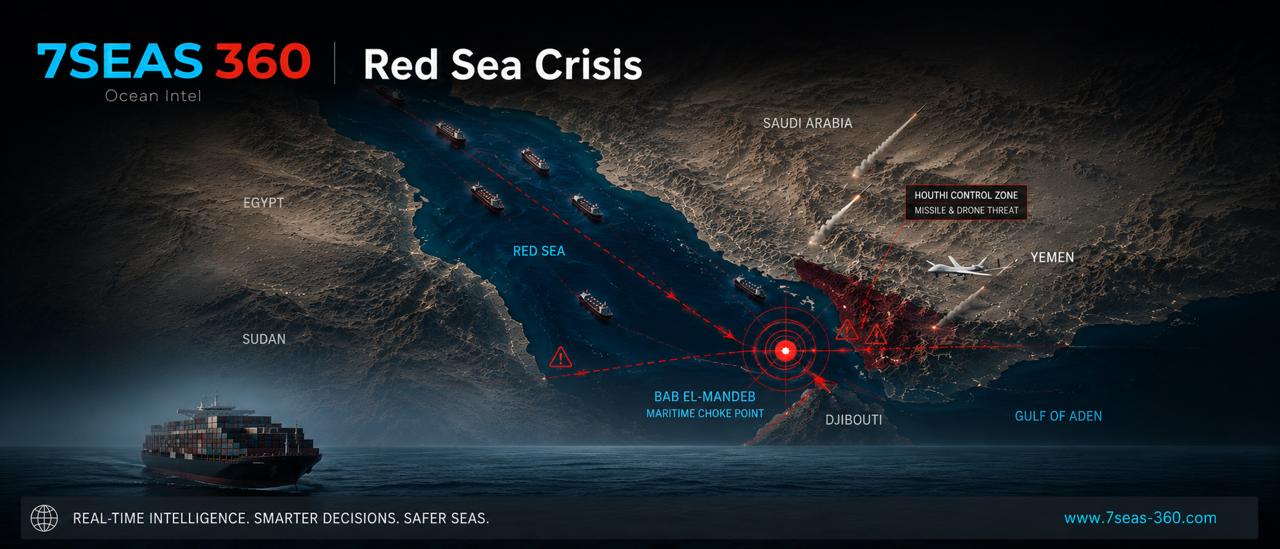
The Red Sea corridor has split into two divergent signals this month, and forwarders should not read one as cancelling the other. On the security side, the Houthis have finished what they started in July: with Mocha, Dhubab and now the Hanish island group in hand, they hold the eastern shore and the island approaches of Bab el-Mandeb outright. Territorial control of both banks of a chokepoint is a structurally different risk from episodic missile and drone attacks. It shortens warning times, widens the arc from which a vessel can be engaged, and gives the group a standing veto they can exercise at a moment of their choosing rather than a campaign they have to sustain.
On the commercial side, carriers are moving the other way. Cosco and OOCL have put five Asia-Europe and Asia-Mediterranean loops back through Suez, following CMA CGM's earlier phased return. The commercial logic is straightforward: roughly ten to fourteen days of round-trip time comes back, which releases vessels into a market already carrying too much capacity. That is precisely why rates are falling rather than rising, and why the Mediterranean legs are converging with North Europe. Shippers benefiting from cheaper Med rates this month are being paid, in effect, out of the freed-up tonnage, not out of any improvement in the security picture.
The cost that has not moved is insurance. War risk premiums in the listed area remain where they were, which tells you how underwriters assess the same headlines the carriers are reading. For a 100,000 dwt box ship that is a six-figure line item per transit, and it does not fall until the underwriting market sees a durable change on the ground. Nothing that happened in the past week qualifies.
For planning through Q4: treat the Suez return as reversible. CMA CGM has already reversed a return decision once this year, and the operational cost of flipping back to the Cape mid-rotation is schedule chaos rather than a clean switch. Book with explicit routing clauses, price the war risk surcharge as a separate and sticky line rather than assuming it decays with the spot rate, and hold Cape-routed contingency capacity for any cargo where a two-week slip is a commercial failure rather than an inconvenience.
For eleven weeks the Red Sea story has been about carriers coming back. MSC put four east-west services back through Suez, Maersk moved more than 30% of its Cape volumes across, and Lars Jensen put normalization by end-2026 on the table. On 10 and 11 September that story acquired a new variable: the Houthis took the coastline the lane runs past, including Perim Island in the middle of the strait, where the crossing narrows to roughly 20 kilometers.
Nothing has been fired at a containership. Windward's transit counts show traffic holding, with 13 inbound movements by midday on 11 September against 17 the day before, and the Houthi coordination center repeating that only Saudi-linked tonnage is a target. Outbound counts softened in the same window, but on a partial day that is a line to watch rather than a conclusion. Crude tankers have already voted with their positions: 78 waiting in or visiting the Red Sea between 4 and 11 September against an expected 57, a 38% increase that starts with the offensive on 3 September.
The change that matters to a boxship operator is the cost of the threat, not the volume of it. Earlier Houthi campaigns needed anti-ship missiles and long-range drones fired from inland. From Mokha, Dhubab and Perim the shipping lane is inside artillery range. That makes a selective blockade cheap to enforce and frees the longer-range systems for other work. A targeting list that has historically been applied loosely is now backed by a shoreline.
For shippers with Asia-Europe cargo the practical question is not whether the strait closes. It is whether the carriers who just committed tonnage to Suez rotations hold their nerve. Every reversal this year (CMA CGM in January, Maersk on ME11 and MECL in February) has come with days of notice and a two-week swing in transit time. Contract cover that assumes a Suez routing should be read against a Cape fallback, and war risk premiums at roughly 0.5% of hull value are already pricing the difference. Expect carrier advisories rather than headlines to be the first reliable signal.
The corridor is in an unusual state: operationally recovering, politically unresolved. Suez Canal throughput in early September ran at the highest weekly level since carriers first fled the Red Sea at the start of 2024, and the container share of that recovery is now material rather than symbolic. August's 196 container transits moved 1.68m TEU, a 184% year-on-year increase in capacity, and the average ship on the route has grown from 3,800 to 6,000 TEU, with nine ULCVs above 20,000 TEU transiting in the month. That is a different risk posture from the empty-box, naval-escorted test sailings of January. MSC's decision to restore Suez routings on Jade, Tiger, Albatros and Himalaya, alongside CMA CGM's continued backhaul shifts, means the return is now network policy at two of the three largest carriers rather than opportunistic single voyages. Asian port congestion at 4.3m TEU is a second, less discussed driver: shorter round trips free up tonnage that would otherwise sit waiting.
The rate consequence is arriving faster than most forecasts assumed. Asia-Mediterranean spot fell about 10% week on week in the first days of September to roughly USD 4,370/FEU, with North Europe down around 5% to roughly USD 4,090/FEU. The September general rate increase of about USD 500/FEU has not held, and forward paper at a 30% discount to current index levels tells you where the market expects the next quarter to sit. For shippers, the practical planning assumption for Q4 is softer Asia-Europe pricing and shortening transit times, not a return to 2024 conditions.
The geopolitical picture has not caught up with the commercial one. Houthi threats resurfaced over the summer and the July strikes on Saudi territory showed the underlying conflict is far from settled; 302 vessels transited Bab el-Mandeb in the week of 17-23 August, which is recovery but also concentration of exposure. Nothing in the current security position guarantees the corridor stays open, and the deciding variable for a full-network return remains war-risk insurance pricing and crew-safety policy rather than transit economics. Forwarders should keep Cape contingency in contracts through year-end and avoid pricing Suez transit times as permanent.
The significant move this week is Hapag-Lloyd. The carrier that pulled Gemini services back around the Cape in late February, after the US-Iran hostilities made the corridor untenable, has now sent the 14,993 TEU AL JMELIYAH through Suez on the Asia-Mediterranean SE1/AE12 service. Maersk added 10 trans-Suez trips in the same week. Until now the Gemini partners had been the cautious pair, restoring one loop at a time and reversing when conditions turned. With Hapag-Lloyd routing again, MSC, CMA CGM and Gemini are all putting scheduled services through Bab el-Mandeb at the same time. There is no longer a major Asia-Europe operator holding the line on the Cape as a matter of policy.
That should not be read as a finished recovery. The Suez Canal Authority still puts container traffic at around one fifth of pre-crisis volumes, and total transits held at 290 in the week to 30 August, 36% below normal. Bab el-Mandeb has sat 15% below its pre-blockade average for six weeks without moving in either direction. What has changed is not the volume, it is the commitment behind it. Carriers are now rebuilding rotations around the shorter routing rather than testing single voyages, and rotations are expensive to reverse.
The freight market is still being held up by something unrelated to the corridor. Linerlytica counted 4.3m TEU waiting to berth in the week to 25 August, 12.6% of the global fleet, easing to 3.92m TEU the following week. In absolute tonnage that August peak sat above the 4.0m TEU high of the 2022 pandemic congestion. Typhoon Saudel drove much of it, with Ningbo and Shanghai running delays of more than 10 days at the worst. One caution on the numbers: Linerlytica counts ships at anchorage, Sea-Intelligence counts capacity lost to delay against a baseline and reports 2.3m TEU. Different definitions, same conclusion, a large block of tonnage is out of the market. Meanwhile Freightos has Asia-Europe spot rates down about 15% from the early-July peak, and blank sailings have thinned. Capacity is returning from two directions at once, shorter voyages and fewer cancelled sailings, into demand that is already softening.
For forwarders and shippers the practical guidance has not changed, but the confidence in it has. Through Q4 your delay risk sits in the load port, not the corridor, so buffer for berth waits and confirm the actual routing on each individual sailing while carrier networks remain split between Suez and the Cape. On the commercial side, the fact that all three major Asia-Europe operators are now committed makes the 2027 capacity problem more likely, not less. Shorter voyages plus an orderbook near 40% of the fleet plus congestion that will eventually unwind is a combination that removes rate support. Keep Asia-Europe contract terms short or indexed where the counterparty allows it. The security assumption underneath all of this, that Houthi targeting stays confined to Saudi-linked tonnage, has now held for 15 days and for six weeks of blockade. It is the single variable that would reverse everything above, and the 17 August loss of an unattributed cargo ship off Al Mukha is a reminder that it is an assumption rather than a rule.
Two numbers define this week. Suez transits held at 290 in the week to 30 August, and Bab el-Mandeb has settled 15% below its pre-blockade average without falling further. Neither moved much, and that is the point. Six weeks after the Houthis declared a naval blockade of Saudi Arabia, the corridor has found a level and stayed on it, which is why Lloyd's List Intelligence has cut its Red Sea Brief from weekly to fortnightly. A specialist monitor halving its reporting frequency is a soft signal, but it is the kind of signal that tends to precede commercial decisions rather than follow them.
On the container side the return has crossed from tactical to structural. MSC did not simply run a test voyage, it restored four east-west services and rebuilt the rotations around the shorter routing, taking two ships out of each string and freeing roughly eight vessels. CMA CGM logged 15 Bab el-Mandeb transits in a week and Maersk 11, with Maersk confirming more than 30% of its previously Cape-routed Asia-Europe volume is back through Suez. Around 19% of total Asia-Europe capacity has now moved back. Lars Jensen puts full normalization by the end of 2026 within reach at this pace, with the caveat that some carriers may deliberately keep Cape strings running to soak up tonnage they cannot otherwise place. Note what the megamax test passages looked like: MSC Oliver and MSC Amelia went through with AIS switched off. Carriers are confident enough to route the ships and not confident enough to broadcast them.
What is holding the freight market together right now is congestion, not routing. Sea-Intelligence puts 2.3m TEU, 6.6% of the world fleet, out of action in port queues, up from about 5% in June against a 2.2% pre-pandemic norm. July schedule reliability dropped 6.1 points to 56.4%, the worst monthly fall since January 2021, and Asian hubs carried it: Shanghai at 21%, Ningbo at 34.6%, Singapore at 43.2%. That absorption is temporary. Sea-Intelligence estimates two to six months for the queues to unwind depending on the reference point, and a full Suez return would then subtract 8.7% from global head-haul TEU-mile demand in the first half of 2027 even with healthy 6.6% volume growth. Half a return is enough to turn TEU-mile growth negative. Set that against an orderbook near 40% of the fleet.
For forwarders and shippers this reframes the planning question. Through Q4 the operational risk sits in the origin port queue, not the corridor, so buffer against berth waits and verify the actual routing and cut-off on each sailing while the network stays split. The commercial risk sits in 2027. Anyone signing a long Asia-Europe contract now should understand that they are pricing against a market whose current firmness rests on ships stuck outside Chinese ports, and that the same Suez return carriers are advertising as a service improvement is also the mechanism that removes the tonne-mile support holding rates up. Keep contract terms short or indexed where you can. The security assumption underneath all of it, that Houthi targeting stays limited to Saudi-linked ships, has held for six weeks and remains the single point of failure.
A week without a confirmed incident in the southern Red Sea is worth stating plainly, because it is the first thing carriers look at. No attack or disruption was recorded at Bab el-Mandeb or in the northern Red Sea in the 48 hours to 1 September, Suez operations are normal, and traffic responded. Cargo vessel crossings at Bab el-Mandeb hit 30 on 31 August, the strongest day in a week that started at 21 and dipped to 13, and total traffic across the last two days of August ran at roughly half the 2023 baseline. That is the shape of a corridor slowly refilling rather than one reopening. The threat assessment behind it has not moved: Substantial at Bab el-Mandeb, Moderate in the north, with the Severe regional rating driven by Hormuz rather than the Red Sea. Houthi enforcement is still assessed as selective, aimed at Saudi-linked and Yemeni government-linked tonnage, and a shift to indiscriminate attacks is rated possible but not probable. Every carrier string now routed through Suez rests on that one judgment holding.
The new item this week is the Saudi-led Multinational Maritime Defense Coalition reaching Initial Operational Capability. Fourteen states, a named commander, command nodes in Riyadh and Jeddah, 13 charter accessions signed. That is real institutional progress and it deserves to be read for exactly what it is, no more. Initial Operational Capability is not Full Operational Capability. There is no combined battle group, no common rules of engagement, no automated common operational picture and no standing escort corridor. Surface tasking remains a sovereign opt-in for each member. Reports of live multi-sensor fusion and coalition basing outside Saudi facilities are not confirmed in official reporting. For a forwarder building a Q4 routing plan, the honest translation is that coalition protection is not yet a service you can book, and it should not be priced into a Red Sea decision this quarter.
The commercial driver has meanwhile shifted onto Chinese quays. Typhoon Saudel disrupted Ningbo and Shanghai again, and berthing delays are running past 10 days in the worst cases. Linerlytica puts 3.92m TEU, 11.4% of the global fleet, sitting at anchorages, down from 4.3m TEU the previous week but still above the absolute 2022 pandemic peak. That has two consequences worth building into your planning. First, it keeps absorbing capacity that carriers would rather have turning, which strengthens the case for the shorter Suez rotation and helps explain why the return has continued through a period of active Houthi operations against Saudi tonnage. Second, and more immediately, it means transit-time risk on Asia to Europe right now sits in the origin port queue, not in the routing. If you are choosing between a Suez string and a Cape string on quoted transit time alone, you are optimizing the smaller variable. Keep both routings costed, confirm whether the Suez service you booked is structural or a single sailing, and build your buffer against the berth wait at load port.
The Red Sea is running on two tracks that point in opposite directions, and shippers need to read both. On the commercial track, container lines keep coming back. MSC has now put its limited east-west Suez resumption on the record after a security review, joining Gemini partners Maersk and Hapag-Lloyd, CMA CGM and COSCO. Containership transits through Suez rose 15.4% in the week to 23 August and Bab el-Mandeb boxship crossings gained 10%, with the four-week Suez total at its highest since the Houthi campaign began. On the security track, the picture is worse than it was in July. The Houthi naval blockade declared against Saudi Arabia on 20 July is being enforced with anti-ship ballistic missiles, and the 24 August strike on the Bahri VLCC Amzan off Yanbu shows the reach now extends deep into the northern Red Sea. JMIC still rates Bab el-Mandeb as substantial, Al-Mokha remains closed after more than 25 missile impacts, and the Joint War Committee has pushed the listed area 800 km further north.
What is holding the return together is arithmetic, not confidence. The Hormuz closure has lifted bunker prices about 15%, which makes the Cape of Good Hope detour materially more expensive than it was through 2024 and 2025, and structural congestion in Asian and North European ports is absorbing vessel capacity that carriers would rather put back into rotation. Against that, a war risk premium near 1.0% of hull value and a two-week saving on the Asia to Europe headhaul look affordable. So far the Houthis have kept to a narrow targeting profile, Saudi-linked tonnage and Saudi port callers, and no non-Saudi vessel has been confirmed hit purely for calling a Saudi Red Sea port. That distinction is the whole basis of the current carrier calculation.
For forwarders and shippers the practical consequence is that Suez capacity is real but provisional. Lloyd's List describes carrier return decisions as reversible, and the record supports that reading, with CMA CGM and Maersk both having u-turned earlier this year within weeks of resuming. Plan Asia to Europe bookings for two transit-time scenarios rather than one, keep the Cape routing costed and contracted, and check whether your carrier's Suez string is a structural service or a one-off sailing before you commit inventory to the shorter schedule. Rates give some room to breathe, with Asia to North Europe down 20% from the July peak to around USD 4,700/FEU and the Mediterranean off 15% in a single week, but a mid-September emergency fuel surcharge of about USD 90/FEU is already announced and a widening of Houthi targeting criteria would reprice the lane within days.
The container market has crossed a threshold this month. With MSC's partial return, all four of the largest carriers now run at least some east-west services through the Suez Canal again, and the transit data confirms boxships are driving the recovery rather than following it. Containership transits through the canal rose 15.4% in the week to 23 August, and Bab el-Mandeb container movements added a further 10%, with figures likely to be revised upward once dark transits are identified. Four-week Suez volumes are at their highest since the Houthi campaign began, though still 40% short of the pre-crisis baseline.
What has changed is not the security picture but the risk calculus. The Joint Maritime Information Center still rates the threat to commercial shipping in the southern Red Sea as substantial, and the 24 August strike on the Bahri VLCC Amzan off Yanbu shows the campaign is active. The distinction carriers are working with is that Houthi targeting has stayed narrowly focused on Saudi-flagged, Saudi-owned and Saudi-managed vessels since the 20 July blockade declaration, with no confirmed attack yet on a non-Saudi ship purely for calling at a Saudi Red Sea port. That is a thin line to route a network across, and Lloyd's List Intelligence is explicit that carrier return decisions remain provisional and reversible.
For forwarders and shippers the practical questions are schedule reliability and rate direction. Suez routing removes roughly ten to fourteen days from Asia-Europe transit, but the return is being phased service by service rather than switched on at network level, so through-August and September bookings will see a split network: some strings via Suez, others still around the Cape, with different transit times and cut-offs on the same trade lane. Insurance has stayed manageable so far because P&I clubs moved fast on buyback cover, but pricing is being set case by case rather than by a market-wide rate, which means the war-risk line on a quotation now depends on the specific vessel and ownership chain rather than on the corridor alone. Verify the actual routing and the war-risk clause per sailing, not per carrier.
The capacity consequence is the one to watch into Q4. A broad return to Suez shortens voyages and releases effective capacity into a market that is already soft. If the security picture holds and the remaining Cape services switch back, the tonne-mile absorption that has propped up the container trades since 2023 unwinds fast, and the pressure moves from schedule risk to rate risk.
Two things are true at the same time on this corridor, and shippers need to plan for both. On the commercial side the return is now real and accelerating. MSC's decision on 24 August to put Jade, Tiger, Albatros and Himalaya formally back on Suez is the first structural commitment from the largest carrier rather than a one-off test passage, and it follows Maersk and Hapag-Lloyd moving AE19 and the AE2/NE1 loop back through the canal under Gemini. With CMA CGM and COSCO already carrying services on the route, every carrier in the top five now has capacity committed to Suez for the first time since late 2023. Transit volumes reflect it: roughly 1,090 movements over the past four weeks, the strongest four-week reading since January 2024.
On the security side the picture deteriorated in the same week. The strike on the Saudi tanker Amzan off Yanbu on 24 August pushed the Houthi campaign into the northern Red Sea, well above Bab el-Mandeb, and follows the fatal attack on the Tihamah on 11 August. The declared blockade is aimed at Saudi-linked tonnage rather than east-west container services, which is why the container return has continued regardless, but it changes the risk geometry of the whole corridor. War risk pricing has moved again, cover for Saudi-linked ships is now negotiated case by case, and the northern basin can no longer be treated as the safe end of the transit.
What this means operationally: transit time savings of up to four weeks against the Cape are now available on a growing number of loops, but every one of those loops is reversible at short notice. Suez traffic is still 41% below pre-crisis and Bab el-Mandeb has flattened rather than climbed, so the recovery is carrier-led, not security-led. Book Suez routings for the schedule benefit, price the Cape fallback into your contracts, and keep visibility on which specific string your cargo is on rather than on the carrier's headline position. A single incident involving a boxship would move several of these services back around Africa within days.
The picture at the end of August is two-speed. At the Suez end of the corridor, container volumes are recovering faster than at any point since the crisis began: 1,088 transits in the four weeks to 16 August, up 14% on the prior period and the strongest reading in more than two years. Maersk, Hapag-Lloyd and CMA CGM have all moved further services back through the canal, and CMA CGM has signalled to the Suez Canal Authority that more will follow. At the Yemeni end, traceable traffic through Bab el-Mandeb has been sliding since the Houthis declared their blockade on Saudi-linked shipping on 20 July, hitting a one-year low in early August. Part of that gap is genuine avoidance, part of it is ships going dark on AIS to reduce their profile.
What has changed for container operators is the character of the threat rather than its direction. The Houthi campaign is currently aimed at Saudi assets and Saudi-linked tonnage as part of Iran's pressure strategy on Red Sea energy exports, not at Asia-Europe box traffic as a class. That is why carriers have felt able to keep restoring loops through the same water in which the Tihamah was hit on 12 August and the Amzan on 24 August. It is also why the assumption is fragile. A missile that is accurate enough for a double-tap on a rescue operation does not distinguish reliably between a Saudi-linked hull and a neighbouring boxship, and the Houthi statement on the Amzan strike noted that other vessels in the target area fled.
For shippers the practical consequences are three. First, transit times on Asia-Europe are now genuinely variable service by service, not carrier by carrier, so booking on a lane average is misleading. Second, falling spot rates are a capacity effect, not a de-risking signal: the Suez routings that push rates down are the same routings that carry the war risk exposure. Third, the cost that is not in the spot number, war risk premium and surcharge stack, is where the corridor risk actually shows up on the invoice. Anyone contracting for Q4 should price the reversion scenario, a return to Cape routing at short notice with the ten to fourteen extra days and the associated equipment repositioning, rather than treat the current Suez recovery as a settled baseline.
Geopolitically the direction is not toward de-escalation. Saudi Arabia announced the start of a Red Sea defence alliance on 14 August, Yemen's internal conflict has slid back toward full-scale war, and the Strait of Hormuz remains under Iranian blockade, which is precisely what makes Yanbu and the Red Sea route so valuable to Riyadh and so attractive as a Houthi target. The Red Sea corridor is being reopened commercially while the security case for it is still unresolved.
The two signals in the Red Sea corridor are moving in opposite directions, and shippers need to hold both at once. On the volume side the recovery is real and measurable: roughly 1,090 transits through Suez in the four weeks to 20 August, the strongest reading since January 2024, with containerships and LNG carriers doing most of the work. Maersk puts more than 30 percent of its previously diverted Asia-Europe volume back on the Suez routing and argues the conditions for a fuller return are largely met, subject to port and landside constraints rather than security. MSC has been adding Bab el-Mandeb crossings incrementally rather than committing full strings. Even so, the corridor is running 41 percent under its pre-crisis baseline, which means the Cape routing is still the structural default for a large part of the trade.
On the risk side, 11 August reset the assumptions. The Tihamah strike was not a near-miss or a warning shot. It was a ballistic missile hit inside Bab el-Mandeb followed by a second strike while rescuers were evacuating the vessel, killing four seafarers and two members of the National Resistance Forces. It is the first loss of life on a merchant ship since the Iran conflict opened on 28 February, and it came during a period when transit counts were recovering. That combination is the point: the Houthis are running a selective targeting model, not a general blockade, and selectivity is harder to price than a blanket threat. The disputed cargo description, Saudi military equipment per the Houthis, food aid per Yemen's foreign ministry, tells you the targeting logic is opaque from the outside.
For forwarders and shippers the practical read is threefold. First, transit decisions are now vessel-specific rather than trade-lane-specific: ownership, flag, charterer, last port, and perceived Israeli or Saudi affinity matter more than the route itself, which is exactly what the IMO's risk-assessment guidance is pointing at. Second, insurance cost is no longer the binding constraint. At roughly USD 50-100 per TEU on cargo war-risk and around 0.20 percent hull premium per transit, the economics still favour Suez over the extra 10 to 14 days and bunker burn of the Cape for most Asia-Europe strings. Third, schedule integrity is the exposure that will actually cost money. Carriers are shifting strings back onto Suez, then pulling individual sailings after incidents, so a booking confirmed on a Suez rotation is not a guarantee of a Suez transit. Build the Cape contingency into transit-time commitments to your customers and check the routing at vessel level, not service level.
We hold the corridor at elevated. The volume trend supports continued normalisation. The 11 August attack is a reminder that normalisation and safety are not the same thing.
Two separate incidents inside eight days have moved the southern Red Sea from a corridor carriers were cautiously testing back to one they are avoiding. On 11 August a stationary cargo vessel was struck five nautical miles off the Yemeni coast near Al Mukha, killing six, the first fatalities in Bab el-Mandeb shipping in more than a year. On 18 August UKMTO reported a second vessel, unmanned at the time, hit by multiple projectiles about 40 nautical miles southeast of the same port and declared a complete constructive loss. Al Mokha Port itself is now shut to commercial traffic after more than 25 cumulative missile impacts on its berths. JMIC holds the Bab el-Mandeb and southern Red Sea at SUBSTANTIAL and, more significantly for network planning, rates the Strait of Hormuz at SEVERE. Two chokepoints on the same rotation are degraded at once, which is a different problem from 2024 when only one was.
For container shippers the operational answer has not changed: the Cape of Good Hope remains the working assumption for Asia to Europe and Asia to Mediterranean, with 10 to 14 days added per voyage and the corresponding capacity absorbed. What has changed is the cost of any exception. The Joint War Committee has pushed its high risk zone further north along the Saudi coast toward Jizan, and indicative war risk premiums for southern Red Sea voyages now sit at 1.0 to 2.0% of vessel value against roughly 0.3% before the 20 July blockade. On a modern boxship hull that is a six-figure line item per transit, before any crew or cargo consideration. Any carrier or NVOCC quoting a Suez routing at pre-August economics is quoting something they cannot hold.
The Q2 numbers show why carriers can live with this. Maersk raised full-year guidance for the second time this year on the back of USD 15.8 billion of quarterly revenue, Ocean EBIT of USD 935 million and average loaded rates up 22% at 96% utilisation, with rerouted Gulf cargo pushed onto landbridge and alternative port solutions. Hapag-Lloyd, in the same Gemini network, absorbed around USD 600 million of Middle East related cost in the quarter, more than three times its group EBIT, and still improved on Q1. Disruption is expensive to operate and profitable to price. That asymmetry is the structural reason no carrier is in a hurry to normalise the corridor.
The near-term watch item is the disconnect between risk and rate. Xeneta recorded Asia to Europe spot rates falling 5% in early August, meaning the market has not yet priced the escalation. Shippers reading that as an opening should assume it closes quickly if the attack tempo holds, most likely through a war risk or emergency surcharge layer rather than base rate movement. Plan Q4 nominations on Cape transit times, keep war risk exposure explicit in the quotation, and treat any carrier announcement of a Suez return as reversible until a full quarter of clean transits is on the board.
The Red Sea is running on two clocks at once. On the security clock, 11 August was the worst day in months: six dead aboard the Egyptian-owned Tihamah in the Bab el-Mandeb, the first loss of life in an attack on shipping since the Iran war opened on 28 February. The Joint Maritime Information Center still rates the threat as substantial, and Houthi messaging keeps pointing at Saudi-affiliated tonnage. On the commercial clock, the container lines are moving the other way. Maersk and Hapag-Lloyd shifted the Gemini AE19 loop back through Suez with immediate effect, the fourth Maersk service off the Cape since early July, and CMA CGM has three services routed via the canal including a full-loop INDAMEX. Nobody is calling this a network return, and nine Maersk services that could use Suez are still going around Africa.
The traffic data supports the cautious reading. Bab el-Mandeb passings were 273 in the week to 2 August, marginally up week on week, with the two weeks since the Houthi blockade on Saudi-affiliated traffic averaging about 15% below the month before the ban. Suez transits eased to 263 from 275. What stands out is the collapse in AIS-traceable transits to 200 in the week to 9 August, the lowest in a year. Read that as behaviour rather than volume: mainstream tankers going dark rose sharply in July, particularly on Saudi loadings, and the same instinct is spreading.
For shippers the practical exposure has moved from routing to insurance and to service reliability. War risk on southern Red Sea voyages sits above 1% of hull value, Saudi-linked voyages reach 3%, and parts of the Lloyd's market are trimming cover for vessels with recent Saudi port history. That cost lands in surcharges, not in the base rate. Meanwhile the rate side is softening, roughly 5% down week on week on Asia to Europe, as every service that moves back to Suez shortens its round trip by about four weeks and hands capacity back to the market. Plan Q4 bookings on the assumption that transit times on affected strings can change at short notice in both directions, and confirm with your carrier which specific loop your booking sits on rather than which carrier it is with.
The market is running two contradictory tracks at once. On the security track, the 11 August missile attack on the container ship Tihamah killed six people in the Bab el-Mandeb and ended the run of non-fatal incidents that had quietly underpinned carrier confidence since late February. A second strike on the rescue effort is the detail that matters most operationally, because it changes the calculation for any master weighing whether assistance will be available if a vessel is hit. Traceable southbound and northbound transits responded immediately, dropping to 200 for the week to 9 August, the thinnest week of AIS-enabled traffic in a year, with a share of remaining traffic going dark rather than staying home.
On the commercial track, the return to Suez has not stopped. Maersk and Hapag-Lloyd have now placed the Gemini AE19/SE4 Asia-Mediterranean string on the canal in both directions, and a 20,568 TEU westbound transit scheduled for 16 August brings the Asia-North Europe AE2/NE1 loop back as well. Cosco is putting its own tonnage through the strait for the first time in two years. This is not a fleet-wide reopening. It is a service-by-service reintroduction that carriers can reverse within a week, and shippers should read every schedule announcement as conditional.
The cost of that conditionality now sits mostly in insurance rather than freight. War risk quotes above 1% of hull value for the southern Red Sea, and up to 3% for Saudi-bound voyages, put six and seven-figure sums on a single passage before any freight is earned. With underwriters in the Lloyd's market limiting cover on Saudi-linked itineraries, the binding constraint on a Suez return is shifting from military risk assessment to whether the voyage can be insured at all. Meanwhile spot rates have eased about 15% from the July peak on both Asia-Europe legs, which tells you demand, not the Red Sea, is currently setting the price.
For shippers, the planning assumption for Q4 should remain dual-routing. Book to a service, not to a routing, and require the carrier to state the transit time under both Suez and Cape of Good Hope scenarios. Where cargo moves under Incoterms that leave you exposed to war risk surcharges, confirm now how those surcharges are passed through, because the insurance repricing is moving faster than the freight market.
Two stories are running in the corridor this week and they point in opposite directions. On 12 August the Tihamah was struck three times off Al Mokha, once while rescuers were still on scene, killing four seafarers and two Yemeni responders. IMO Secretary-General Arsenio Dominguez called again on owners and operators to assess risk thoroughly before transiting. Deliberately re-engaging a rescue operation, and following up with an uncrewed surface vessel, is a capability and intent signal that sits well above the tanker-focused disruption seen since the Houthi blockade of Saudi-linked shipping in mid-July.
Container operators have so far read it differently. Maersk and CMA CGM are putting three loops back through Bab el-Mandeb and Cosco is expected to add multi-purpose tonnage on its Red Sea and Mediterranean services. The driver is equipment and vessel scarcity rather than an improved security assessment. Around 2.4m TEU is tied up in Asian port backlogs after Typhoon Dolphin, and reinstating the Suez routing is the fastest way to release round-trip days. Xeneta's Peter Sand is openly sceptical of the causal link, noting the rerouting is not a quick fix and that Asian ports recover faster than the backlog figure suggests. That scepticism matters, because if the congestion argument weakens the commercial case for transiting weakens with it.
For shippers the practical point is that the risk is now priced into the base, not bolted on. The Joint War Committee's northward extension of the listed area pulls Jeddah and Yanbu into higher premium territory, and Maersk's two-tier surcharge from 1 August treats Red Sea exposure as a structural cost line. At the same time North Europe spot is drifting down towards USD 4,300 per FEU. Carriers are absorbing more risk for less rate, which is not a stable configuration.
Watch three things over the next fortnight. Whether the Houthis widen targeting beyond Saudi-linked tonnage, which is the trigger Lloyd's List Intelligence identifies for large-scale diversion. Whether the three reinstated loops actually sail as booked or quietly revert to the Cape. And whether the Asian backlog clears faster than expected, which would remove the commercial reason for being there at all. Booking Red Sea routings through September should carry a Cape fallback and a clear war risk cost assumption in the quotation.
The story this week is a carrier decision, not a transit count. Maersk and Hapag-Lloyd have added Jeddah to the Gemini AE15 Asia to Mediterranean rotation, and Maersk is adding an eastbound Jeddah call to MECL during August. Three weeks after the Houthis declared an embargo on Saudi-linked shipping, two of the three largest operators on Asia to Europe are putting a mainline service alongside in a Saudi Red Sea port. That is a materially different signal from the reversals of late July, when Maersk pulled selected services back around the Cape within a month of restarting Suez transits.
Read it as a risk-priced decision rather than a security judgement. Traffic through Bab el-Mandeb has stabilised at 266 transits for the week to 2 August after the initial 24% fall, Suez is flat at 275, and Lloyd's List Intelligence continues to place almost all of the damage in the mainstream tanker segment. Container flows through the corridor were never the casualty. What changed is that Gemini has decided the Suez transit saving is worth the widened war risk premium and the Saudi port exposure, while keeping Cape contingency plans in place. Maersk has said as much explicitly.
The security picture has not improved to justify it. The Joint Maritime Information Center still assesses further attacks as a strong possibility. The Houthis have confirmed one successful strike on a tanker and attempted several more against Saudi-linked vessels since 20 July, including claimed attacks on the tankers Encelia and Layla. Saudi Arabia has responded with strikes on Houthi facilities in Hodeidah. The Saudi-led maritime coalition unveiled on 30 July, with 43 countries at the table and 14 backing the statement, is being treated by underwriters as a diplomatic gesture. Oman and the UAE are not on it.
The wider off-ramp closed on 10 August. Iran and Oman have agreed a route map for new Hormuz shipping lanes, but Tehran conditions reopening on US compensation, sanctions relief and an end to military threats, and Trump has now demanded compensation in the other direction. Brent moved to USD 87. Any planning assumption that a Gulf settlement would spill over into a calmer Red Sea should be taken out of the Q4 model.
On the commercial side the market is soft and getting softer westbound. Asia to Europe spot rates fell for a fourth straight week, carriers are cutting rather than raising, and the mid-August FAK levels have already been marked down. Shippers negotiating now have leverage on Asia to Europe that they do not have on the transpacific, where GRIs held and Chinese port congestion is constraining capacity.
What this means operationally: if you have Asia to Mediterranean cargo, ask your carrier in writing which routing your specific sailing takes and whether a Jeddah call is in it, because transit time, war risk surcharge and cargo insurance all follow from that answer. Do not rebuild your standing schedules on Suez until a Gemini string completes consecutive round trips. And use the fourth week of falling Asia to Europe rates now, before the 15 August FAK date resets the negotiating base.
The Houthi maritime blockade of Saudi Arabia, declared on 20 July, has produced a sharp but narrow disruption. Total Bab el-Mandeb transits fell 24% in the first week and have since stabilised at 266 for the week to 2 August, which is roughly where volumes stood before Strait of Hormuz disruption pushed extra traffic into the corridor earlier this year. Almost all of the loss sits in mainstream tanker tonnage, down 42% to 53 transits, with Saudi crude still moving through lighter loadings at Yanbu, partial discharge at Ain Sukhna and Sumed pipeline top-ups at Sidi Kerir. VLCC transits through Suez have quadrupled as a result, while total Suez volumes are flat.
For container operators the practical exposure has shifted from transit risk to port risk and insurance cost. The Joint War Committee has moved the listed area about 800 km north, so calls at Jeddah, King Abdullah Port and Yanbu now attract premiums that jumped to around 1% of hull value from 0.25% within days. That is a direct cost line on any Red Sea call, not a diversion decision, and it lands on the transhipment hubs that carriers have been using to keep partial Suez strings viable.
Network behaviour remains unstable. Maersk restarted limited Red Sea transits and then moved selected services back around the Cape of Good Hope inside a month. CMA CGM has reverted several strings after briefly running a full Suez loop. Xeneta's position that a large-scale return is unlikely to complete in 2026 is holding up in practice, and shippers negotiating 2026 to 2027 contracts should not price in a stable Suez routing.
The upside case runs through Hormuz. Iran and Oman are close to a bilateral arrangement to reopen the strait for sixty days without tolls, with coordinated northbound and southbound lanes. If that holds and produces a Saudi to Houthi de-escalation alongside it, carriers may look again at Red Sea transits. For now bunker prices remain roughly 50% above pre-war levels, spot rates are easing on cooling demand rather than on shorter routings, and Cape routing is still the planning assumption for Asia to Europe.
What this means operationally: keep Cape transit times in your Asia to Europe schedules through Q4, budget the widened war risk area into any Jeddah or Yanbu call, and treat carrier Suez announcements as reversible until a service completes a full loop in both directions over consecutive sailings.
Two weeks after the Houthis declared their maritime embargo on Saudi Arabia, the pattern in the strait has settled into something more corrosive than a clean closure. Kpler recorded 18 commodity vessels through Bab el-Mandeb on Sunday 2 August, against 27 the previous day and 28 on Friday, and roughly half the 37 that transited on 28 July. The partial rebound reported at the start of the month has reversed. What remains is a corridor operating at a fraction of pre-crisis throughput, with traffic swinging day to day on threat perception rather than on any published rule.
The enforcement mechanism matters for planning. Two tankers carrying Saudi crude crossed the strait over the weekend despite the embargo, without reported interdiction. The Houthis are not physically blockading; they are pricing the risk. That is why war risk premiums for southern Red Sea voyages remain above 1% of hull value, and why insurance and charter economics, not naval interference, are what actually keeps tonnage away. It also means the situation can deteriorate on a single successful strike with no warning window.
For container operators the practical position is unchanged and now has an explicit horizon. Mainline networks stay on the Cape of Good Hope, absorbing about 2.5 million TEU and adding 10 to 14 days on Asia-Europe rotations. Xeneta's read is that the joint military operations and the retaliatory cycle have removed any realistic prospect of a large-scale container return to the Red Sea within 2026. The July Gemini and CMA CGM Suez pilots are not coming back this year. Anyone still holding a contingency schedule that assumes a Q4 reopening should retire it.
The rate picture continues to move against the risk narrative. Far East spot rates softened by around 1% in the week to 31 July with further declines expected into August, and blank sailings have started to appear on Asia to North America as carriers manage a fading peak season. Cape absorption is being outweighed by demand weakness. The crisis cost is therefore not showing up where most shippers look for it. It sits in the Emergency Fuel Surcharges effective 1 August, in war risk and crew bonus lines, and in the schedule buffer. Audit the surcharge stack on August invoices rather than reading comfort into a falling index.
The political track offers nothing to plan around. The interim peace agreement signed in June has been declared dead by both sides after the Sanaa airport strike, the Aramco attacks on Jizan and Yanbu, and the Saudi air strikes on Hodeidah. The 14-nation Riyadh coalition announced on 30 July still has no published escort mechanism and no Western or Chinese naval participation. Against that, Sea Legend's Arctic Express restart on 12 August, eight westbound Ningbo to Felixstowe sailings for the Northern Sea Route season, is a small but telling data point: with Suez closed to boxships for a third year, alternative routings are being tested at commercial scale rather than discussed.
Two things moved over the weekend and neither one reopened the corridor. First, the transit fee. On 1 August the Houthi-run Humanitarian Operations Coordination Center, which handles vessel notifications through Bab el-Mandeb, denied any plan to charge for passage and said its safe transit service remains voluntary and free of charge. That directly contradicts the Reuters report of 29 July, which cited regional sources saying fee structures were discussed with Iranian officials in Tehran in July and that Iranian advisers were helping stand up an authority to administer them. For shippers the practical position is now: no toll is announced, no toll should be budgeted, and the more useful line in the HOCC statement is the warning that anyone demanding payment for passage does not represent Yemen or the HOCC, together with the instruction not to pay or share vessel information with unauthorised parties. That is an explicit fraud and extortion warning. Any approach claiming clearance authority should be routed through your carrier and P&I club before anyone answers, and vessel schedules and cargo details should not be handed to third parties who cannot be verified. Second, the security response. Saudi Arabia announced a 14-nation maritime defence alliance on 30 July, following a Riyadh meeting attended by representatives of 43 countries, with the permanent headquarters, joint command and operations centre in the kingdom. The membership is regional and Gulf-weighted: Bahrain, Bangladesh, Djibouti, Egypt, Jordan, Kuwait, Nigeria, Pakistan, Qatar, Saudi Arabia, Somalia, Sudan, Turkey and Yemen. What is not in it is as telling as what is. No United States, no European navy, no China, and no published escort or convoy mechanism. It is declared exclusively defensive and does not target any state. Abdul-Malik al-Houthi pre-empted the announcement with a televised address promising 'full escalation' in answer to Saudi escalation. For container operators the alliance is a medium-term political signal, not an August routing input; there is no protected corridor to plan against. Underneath the politics, the market data cut against the narrative. Kpler counted 37 commodity vessels through Bab el-Mandeb on 28 July, the highest since 19 July and roughly triple the 26 July trough, split 20 entering and 17 exiting, with no VLCCs or LNG carriers among them. That is a tanker-led partial recovery under a declared blockade, not a container reopening, and mainline services remain on the Cape. Meanwhile Drewry's World Container Index fell 3% to USD 4,255 per FEU on 30 July, softer on both Asia-Europe and Transpacific. Last week's assumption, including ours, was that the Aramco strikes and the transit collapse would push the print up. They did not. The most plausible explanation is that Cape absorption of roughly 2.5 million TEU is being offset by easing peak season demand, and that carriers cannot make general rate increases hold in that environment. The crisis cost is arriving through surcharges instead: Emergency Fuel Surcharges take effect today, 1 August, on the back of Brent above USD 100, and war risk premiums for southern Red Sea voyages sit above 1% of hull value. Practical guidance for the week: keep Cape schedules as the fixed planning assumption through September, check your August invoices line by line as EFS and war risk recovery start appearing, do not treat the softer index as relief because the surcharge stack is where the increase sits, brief your operations and finance teams on the HOCC fraud warning before anyone is approached, and watch whether the fee idea resurfaces in a different form and whether the Saudi coalition ever publishes an escort mechanism.
Ten days into the Houthi blockade of Saudi-linked shipping, the group has widened the aperture twice in 48 hours. On 28 July it warned it would target vessels belonging to any company 'dealing with Israeli enemy ports', regardless of nationality. That phrasing matters for container shipping more than for any other segment: Maersk, MSC, CMA CGM, Hapag-Lloyd and ZIM all call at Haifa or Ashdod, so the criterion, read literally, makes almost every mainline operator a declared target anywhere its ships sail in the corridor. The insurance market took the announcement at face value. War risk premiums for southern Red Sea voyages moved above 1% of hull value, from roughly 0.75% earlier in the week and 0.3% before the blockade was declared, the sharpest increases falling on Saudi-linked tonnage and calls at Jizan and Al Shuqaiq. At those levels a single transit on a mid-size containership carries a seven-figure insurance bill before crew war bonuses, which settles the Suez-versus-Cape arithmetic for anyone still running it. The second move came on 29 July, when Reuters reported the Houthis are considering imposing fees on most traffic through Bab el-Mandeb. No timeframe was given, and Gulf and European governments would resist, but the signal is a shift from denial to monetization: the group believes it controls the strait firmly enough to charge admission. Overstretched international naval forces cannot currently offer merchant shipping protection at scale, and the UN Secretary-General's warning against wider escalation has changed nothing operationally. For container operators the practical picture is unchanged from Tuesday but harder-edged: the corridor is effectively closed as a planning assumption, Cape routing absorbs roughly 2.5 million TEU of effective capacity and adds 10 to 14 days on Asia-Europe, and the few remaining transits now run under targeting criteria that can capture nearly any carrier at will. The cost stack keeps building independently of routing: Emergency Fuel Surcharges take effect 1 August on the back of Brent above USD 100, and today's Drewry assessment is the first to price in the Aramco strikes, the transit collapse and the expanded threat, with the 23 July print of USD 4,374 per FEU now describing a market that no longer exists. Practical guidance: treat Cape schedules as fixed through at least September, verify how your carriers' war risk and fuel surcharges are calculated before August invoicing, secure space and equipment early for remaining peak season cargo, and watch two things into the weekend, whether any container tonnage is struck under the new Israeli-ports criterion, and whether the transit-fee idea hardens from consideration into demand.
One week after the Houthis declared their blockade of Saudi-linked shipping, the numbers show what enforcement looks like. Kpler data reported on 27 July put Bab el-Mandeb transits at roughly 11 to 15 commodity vessels on Sunday, down 56% from the 34 that crossed on 20 July. That is not Saudi tonnage stepping aside; that is the market as a whole deciding the strait is not worth the premium. The trigger was a weekend that widened the conflict beyond shipping. After a Saudi-led coalition strike on Houthi military targets in Hodeidah on 24 July, the Houthis answered on 25 July with ballistic missile and drone attacks on Aramco's Jizan refinery, which caught fire, and the Yanbu export terminal on the Red Sea coast. It is the group's first direct attack on Saudi oil infrastructure since 2022, and the target choice is deliberate: Yanbu is the western outlet Saudi Arabia has relied on to route crude away from the Iran-constrained Strait of Hormuz. Brent moved above USD 100 per barrel, up roughly 40% across July. The first structural rerouting has already happened in the tanker market, where the VLCC Olympic Luck exited the Red Sea northbound through Suez to reach Asia the long way around Africa rather than run the strait, a signal of how trade flows bend when a chokepoint becomes a target zone. For container shipping the consequences are one step removed but concrete. The Suez return experiments of early July are finished: Maersk is diverting sailings back around the Cape of Good Hope, and no carrier will restart pilots while missiles are hitting infrastructure on both sides of the corridor. Cape routing remains the planning baseline, absorbing roughly 2.5 million TEU of effective capacity and adding 10 to 14 days on Asia-Europe. The cost stack rises independently of routing choice: war risk premiums around 0.75% of vessel value for those still transiting, the Suez Canal Authority's 12% containership surcharge, and now bunker inflation from oil above USD 100, which several carriers have already converted into Emergency Fuel Surcharges effective August. The one number that has not moved yet is the spot rate. Drewry's WCI was assessed at USD 4,374 per FEU on 23 July, before the Aramco strikes and before the transit collapse, still trading on the capacity that returned during the calm. Thursday's assessment is the first that can price the re-diversion in. The practical guidance holds and hardens: plan on Cape schedules and the associated transit times through at least September, budget for the August fuel surcharges now, secure space and equipment early for remaining peak season cargo, and watch two indicators this week, whether Saudi Arabia strikes back and pulls the corridor deeper into a state-level war, and whether the Thursday rate assessments begin to reflect the capacity the market has just lost again.
The Houthi blockade of Saudi-linked shipping stopped being a declaration and became an operation this week. On 23 July the group struck two product tankers, the Encelia and the Layla, in the Red Sea using ballistic and cruise missiles and drones, setting both on fire by its own account. Saudi authorities and the UK Maritime Trade Operations centre confirmed the strike on the Encelia; the Layla attack has not been independently verified. Either way, these are the first attacks on merchant vessels since the May 2025 truce with the United States, and they convert Monday's blockade announcement from a threat priced in insurance into a threat demonstrated in steel. The political response raises the stakes further. IMO Secretary-General Arsenio Dominguez condemned the attacks as indefensible, and President Trump warned that another Houthi strike would bring major military punishment on both Iran and the Houthis. That is the scenario container lines have to plan around: not only the direct risk of misidentified targeting, which the Houthis' 2024 record makes real, but the risk that a retaliatory strike turns the corridor into an active conflict zone overnight. Against that backdrop, the question of a July Suez return is closed. Maersk's pause of trans-Suez sailings, covered in our last update, is no longer a cautious outlier but the industry position; the partial returns piloted by the Gemini partners and others in early July all carried Cape contingency clauses, and those clauses are now the operating plan. Cape routing absorbs roughly 2.5 million TEU of effective capacity and adds 10 to 14 days on Asia-Europe rotations. The paradox of the week is in the rate data. Drewry's World Container Index slipped 4% to USD 4,374 per FEU on 23 July, with Shanghai-Rotterdam at USD 4,682 and Shanghai-Genoa around USD 6,400, an assessment taken before the attacks reshaped the risk picture. Spot rates are still trading on the capacity that returned during the calm, not on the capacity the re-diversion is about to remove. If enforcement of the blockade continues, that gap closes upward. Meanwhile the cost base rises on every routing: war risk premiums around 0.75% of vessel value for the strait, the Suez Canal Authority's 12% surcharge for those still transiting, and bunker costs inflated by oil above USD 100 on the longer Cape leg. For shippers the practical guidance from the 23 July update firms up: treat Cape schedules as the planning baseline through August, lock equipment and space early for peak season cargo, and watch two data points, whether the Houthis strike again after the US warning, and whether next week's spot assessments start pricing the lost capacity back in.
The container market's cautious return to Suez has started to unwind. Maersk has paused future trans-Suez sailings through the Bab-el-Mandeb Strait until further notice, the first carrier reversal since the Houthis declared a maritime blockade of Saudi Arabia on Monday 20 July. Only two days earlier the picture was that no carrier had reversed: the Gemini AE15 Asia-Mediterranean loop was running via Suez and Maersk's MECL service linking India, the Middle East and the US East Coast had returned to the trans-Suez route. Both of those returns carried explicit contingency clauses to swing back to the Cape of Good Hope, and this week the contingency is being exercised. The market signal is already visible in the traffic data. Kpler recorded a 34% fall in Bab-el-Mandeb transits on Tuesday against Monday, with two Asia-bound vessels turning north toward the canal and others holding position mid-voyage rather than enter the strait. The EU naval mission EUNAVFOR ASPIDES lifted its threat assessment for the corridor to medium from low, a formal marker that the risk has stepped up. On the security side the Joint Maritime Information Center, the US Navy-led coordination group, reported Houthi missile and drone deployments near the strait, and Windward tracked four tankers carrying 3.8 million barrels of Saudi crude and product reversing course before Bab-el-Mandeb on Tuesday. Those are tankers rather than boxships, but they matter to container operators for one reason: they show the blockade is being enforced in practice, not just announced, and the Houthis' 2024 record of striking vessels on mistaken or out-of-date ownership links means a blockade aimed at Saudi cargo does not stay contained to Saudi cargo. The cost picture reinforces the pullback. War risk premiums are holding around 0.75% of vessel value, roughly double the level before the 20 July announcement, and the Suez Canal Authority's revised surcharge from 15 July already puts containerships at 12% above normal dues. With the Strait of Hormuz effectively closed since late February, two of the region's chokepoints are now under pressure at the same time, the condition Kpler has flagged as a dual-chokepoint risk to a quarter of seaborne oil. For shippers the practical read is that the July Suez window is closing. Cargo booked on the returning loops should be checked against the carriers' contingency clauses this week, and the Cape alternative priced on transit time and equipment positioning, because the added ten to fourteen days is moving from a hedge to the base case.
The Red Sea moved from threat to declaration this week. On Monday 20 July the Houthis announced a maritime embargo against Saudi Arabia, effective immediately, citing what they describe as a twelve-year Saudi siege on Yemen and last week's attack on Sanaa International Airport. The scope is the open question. The statement names Saudi Arabia, not international shipping, and neither the enforcement method nor the geographic limits have been set out. The market did not wait for clarity. Reuters reported indicative war risk premiums for Red Sea transits rising to roughly 0.75% of vessel value from around 0.3% before the announcement, a repricing that adds hundreds of thousands of dollars to a single seven-day voyage. Ambrey assessed Saudi-flagged, owned or operated vessels and anything routing to or from Saudi Red Sea ports as high risk, and made the point that matters most to box operators: during the 2024 campaign the Houthis struck ships on out-of-date or mistaken ownership links, so a blockade aimed at one flag does not stay contained to one flag. For container shippers the immediate position is unchanged but exposed. No carrier has reversed course as of 21 July. The Gemini AE15 Asia-Mediterranean loop continues via Suez after the 19,076 TEU Majestic Maersk transited Bab el-Mandeb and the canal, and Maersk brought its MECL service linking India, the Middle East and the US East Coast back onto the trans-Suez route, saving seven days westbound and fourteen eastbound, with an eastbound Jeddah call planned from August. Both moves carry explicit contingency plans to swing back to the Cape of Good Hope, and both were announced before Monday. Costs on the corridor are also rising independently of the security picture: the Suez Canal Authority's revised surcharge from 15 July puts containerships at 12% above normal dues, tankers at 37% and bulkers at 22%. The context that makes this different from earlier scares is that two chokepoints are now under pressure at once. With Hormuz effectively closed since late February, Bab el-Mandeb carried 7.4 million barrels per day of petroleum in June against 4.2 million a year earlier as Saudi exports shifted west through the Yanbu terminal. That concentration is exactly what the blockade targets. For shippers with cargo on the returning Suez loops, the practical step this week is to confirm whether the routing on their bookings is contractually fixed or subject to the carriers' contingency clauses, and to price the Cape alternative on transit time and equipment positioning rather than assume the return holds.
The Red Sea entered a two-track phase in mid-July. On one side, the first mainline container service is testing a return: Maersk and Hapag-Lloyd moved their Gemini AE15 Asia-Mediterranean loop off the Cape of Good Hope and back through the Suez Canal and southern Red Sea, with the Majestic Maersk expected at the canal around 24 July. Both operators framed the shift as a gradual, conditional step and kept contingency plans to swing sailings back to the Cape at short notice. On the other side, the geopolitical risk deepened. Reuters, citing three sources, reported that Iran has asked the Houthis to be ready to close the Bab-el-Mandeb Strait should Washington attack Iranian infrastructure, with missiles and drones already deployed in the Yemeni highlands overlooking Hodeidah and the Gulf of Aden. A cargo ship was fired on southwest of Hodeidah on 5 July, underlining that attacks have not stopped. For container shippers the practical picture is unchanged for now: Asia-North Europe spot rates sit 25 to 40 percent above pre-crisis levels, Cape routing still adds 10 to 14 days, and a bunker surcharge near USD 500 per FEU is feeding into July pricing. Xeneta and most carriers continue to plan as if diversion lasts through the contract year, and the consensus points to Cape routing remaining the default into 2027. The single Gemini loop is a signal to watch, not yet a market shift. Whether more services follow depends entirely on how the Iran-Houthi closure threat plays out over the coming weeks.
This week the container read on the Red Sea shifts from routing announcements to hard traffic data, and the two do not point the same way. On volume, the return is real. Lloyd's List puts Bab el-Mandeb at 1,338 vessel transits in June, the busiest month since December 2023 and 39 percent above a year earlier, with large containership transits up 215 percent across the first half of 2026. Suez Canal traffic has climbed about 26 percent over the same window to its highest level since January 2024. That is the clearest sign yet that the corridor is being used again rather than merely talked about, though every figure still sits well under pre-crisis norms and the pickup only accelerated once renewed Hormuz disruption made the Red Sea look like the lesser risk. The carrier decisions underneath the data are the ones already on record, now showing up in the transit counts: the Gemini AE15 service testing Suez since 6 July after the Majestic Maersk cleared Bab el-Mandeb, and Maersk's solo MECL service moving back to the trans-Suez route, both kept expressly conditional on security holding. Against that firming traffic, the price signal is going the other way. Linerlytica reports that carriers have begun rolling back their North Europe rates, with first-half July spot failing to breach $6,000 per 40ft and the Gemini partners undercutting at around $4,800 against rivals asking $6,000 to $6,500. A round of general rate increases and peak-season surcharges scheduled for 15 July is the near-term test of how much real peak demand remains. For shippers the practical read is that capacity is genuinely trickling back to the Red Sea and the traffic data now backs it, while rates still rest on peak-season demand rather than on the canal, so a soft mid-July GRI would be a demand signal, not a Red Sea signal. Keep planning against both lanes, and watch whether the transit recovery survives the next security scare rather than pricing in a settled reopening.
The container read on the Red Sea this week is about price, not a single incident. From 15 July 2026 the Suez Canal Authority raises its transit surcharge on containerships to 12 percent, applied to any vessel that begins transit on or after that date. Containers get off lighter than most segments in the same revision: dry bulk carriers jump from 10 to 22 percent, general cargo and ro-ro rise to 26 percent, and laden crude tankers face 37 percent on top of the base toll, with passenger ships the only class left untouched. The timing matters because the increase lands while carriers are still deciding whether to bring services back off the Cape of Good Hope, so it lifts the toll cost of every Suez routing they might restore. What makes the move awkward to read is that it comes from the same authority that has spent months trying to lure carriers back. Cairo has offered incentives, including a 15 percent discount for large boxships of 130,000 GT and above, and Chairman Ossama Rabiee has personally visited ships to demonstrate readiness for full-size operations. A broad surcharge and a targeted discount for the largest vessels point in opposite directions, and the SCA itself says the fees rest on its assessment of market conditions and may be amended or cancelled. For shippers the underlying posture has not changed. Most Asia to Europe capacity still runs via the Cape, Xeneta's Peter Sand continues to judge a large-scale container return to the Red Sea unlikely in 2026 on security grounds, and the single live test remains the Gemini AE15 string that Maersk and Hapag-Lloyd started routing through Suez on 6 July. Rates stay elevated on peak-season demand rather than the canal, with Freightos FBX Asia to North Europe last assessed near $4,900 per FEU in early July. Treat the 15 July surcharge as a cost input to fold into any Suez-versus-Cape comparison, and keep watching whether the AE15 test survives the next security scare rather than pricing in a lane-wide reopening.
The container story on the Red Sea has moved from watching an attack to watching a routing decision. On 6 July, Maersk and Hapag-Lloyd told customers that their AE15 service, which links Asia with the Mediterranean and Europe, will shift from the Cape of Good Hope back to the trans-Suez route, beginning with the Triple-E boxship Majestic Maersk. This is the first expansion of the Gemini Cooperation's Suez network since the two carriers were forced to pull their ME11 and MECL services off the Red Sea in March, after an earlier February return proved short-lived. The AE15, calling at Qingdao, Kwangyang, Ningbo, Tanjung Pelepas, Port Said, Damietta, Colombo and Singapore, will once again use the fastest Asia to Europe corridor and shorten transit against the long route around southern Africa. The carriers were careful to bound the decision. They said it follows thorough assessments of the security situation, that they have no current plan to bring more Gemini services back to Suez or to rebuild their broader east-west network to pre-crisis routing, and that they are ready to send the AE15 back around the Cape if the picture worsens. That caution is not boilerplate. It sits directly against the 5 July attack on a cargo ship about 30 nautical miles southwest of Al Hudaydah, the first reported strike on a commercial vessel in the lane since the October 2025 Gaza ceasefire, which no group has claimed and which is still under investigation. Gemini's own history frames the risk: its February ME11 return was reversed within weeks. For shippers the practical read is unchanged in substance but sharper in signal. Most capacity still runs via the Cape, one service is testing Suez again on a single Gemini string, and rates remain elevated on peak-season demand rather than the canal, with Freightos FBX Asia to North Europe last assessed near $4,900 per FEU in early July. Treat AE15 as a service-specific exception to monitor, not a lane-wide reopening, and watch whether it holds through the next security scare rather than pricing in a permanent Suez return.
The Red Sea produced its first reported attack on a commercial ship since the October 2025 Gaza ceasefire. On 5 July, about 30 nautical miles southwest of Al Hudaydah in Yemen, a cargo ship reported that a skiff approached and opened fire. The ship's armed guards returned fire, and the skiff pulled back to a larger vessel roughly two nautical miles away that had its AIS transponder switched off. The ship and its crew were reported safe, and UKMTO advised vessels to transit with caution. No group has claimed the attack and the identity of the attackers is not confirmed, so this is a warning signal rather than a confirmed return of the Houthi campaign. It still matters for container shipping because it breaks the calm that has held on the lane since the ceasefire and tests the assumption behind the slow, service-specific return to Suez. The context is a standing threat: on 8 June the Houthis declared a ban on Israeli-linked shipping in the Red Sea and kept any broader action tied to Gaza and the ongoing Iran conflict. For now the routing picture is unchanged. Most lines still send Asia to Europe cargo around the Cape of Good Hope, adding 10 to 14 days, and no major carrier has announced a change to its Red Sea plans in response to this incident. Rates stay high on peak-season demand rather than the canal, with Freightos FBX Asia to North Europe last assessed near $4,900 per FEU on 2 July. The practical message for shippers holds: plan around Cape transit times and a firm rate environment, treat any Suez routing as a per-service exception, and watch whether this attack is a one-off or the start of a pattern before reading it as a shift in the lane.
The Suez corridor is recovering by inches. About 35 cargo vessels transited the canal in the week to 28 June, and Maersk has now run three westbound sailings on its Middle East Container Line through the Bab-el-Mandeb Strait since 13 June. That is movement, but it is not a market shift. Most lines still route Asia to Europe cargo around the Cape of Good Hope, which adds 10 to 14 days, and the carriers testing the canal frame it as service-specific rather than a broad reopening. The dominant force on rates right now is peak season, not routing. Freightos FBX shows Asia to North Europe at $4,900 per FEU, up 70 percent since mid-May, and Asia to Mediterranean at $6,500 per FEU, up 85 percent, both now above their 2025 peak-season highs. An early frontloading rush, port congestion at major hubs, and July general rate increases are all pushing prices up. The security picture stays the deciding factor for the lane. The Houthis have not hit a commercial ship since the October 2025 Gaza ceasefire, yet they keep their threat tied to Gaza and the wider Iran conflict, which is enough to hold most carriers off the Red Sea. That caution was reinforced over the weekend, when Iranian strikes near the Strait of Hormuz hit several vessels, including a container ship that was not in the designated Iranian transit lane, and the IMO paused its phased Hormuz evacuation in response. For shippers the practical message holds: plan around Cape transit times and a rising rate environment, treat any Suez routing as a per-service exception, and watch the Iran track closely because it now shapes container risk on both chokepoints.
The Suez corridor is reopening in slow motion. Maersk, among the more risk-averse carriers, has now run its first container voyages back through the canal since early March, a notable signal because it puts the line ahead of its Gemini partner Hapag-Lloyd, which is holding its long-haul services on the Cape of Good Hope. Ocean Network Express remains cautious as well, with all of them stressing that the security picture, not commercial pressure, will set the pace of any wider return. Linerlytica reads the same data and expects only a gradual, selective recovery, with canal volumes approaching normal late in 2026 rather than now. Rates are firming in the meantime. Freightos FBX shows Asia to North Europe at $2,707 per FEU and Asia to Mediterranean at $3,850 per FEU, both up double digits, and carriers have already announced July increases of up to $2,000 per FEU. The geopolitical backdrop stays unsettled. The Houthis continue to designate Israeli-linked vessels as legitimate targets, and while a reported US-Iran interim deal could reopen the Strait of Hormuz within roughly a month, that easing has not yet pulled container traffic back into the Red Sea at scale. For shippers, the practical message is unchanged: plan around Cape transit times and elevated rates, and treat any Suez routing as service-specific rather than a market-wide shift.
The Red Sea return stayed frozen in the last week of June 2026 as the wider Gulf picture turned volatile again. After the US and Iran signed a memorandum on 16 to 17 June to reopen the Strait of Hormuz without tolls for at least 60 days, Iran's Revolutionary Guard declared the strait shut over 20 to 22 June, citing Israeli strikes in southern Lebanon and a breakdown in the ceasefire. US Central Command disputed the move, reporting 55 merchant transits on Saturday and describing safe passage as intact, while the US energy secretary said on 24 June that Washington had removed Iran's ability to close the waterway. The ship-tracking picture sat between the two claims: Windward recorded Hormuz transits dropping to 12 vessels on Sunday from 35 the day before, with five of eight inbound ships sailing dark, a pattern it likened to the late-blockade period rather than a functioning open strait. For container shipping the practical read is unchanged but reinforced. The main box loops transit Bab-el-Mandeb, not Hormuz, so the direct effect on container routing is limited, yet the renewed instability keeps war risk premiums elevated and pushes carriers to stay cautious on any Suez return. Maersk continues a measured, structural return on selected services, while CMA CGM keeps its Asia–Europe loops around the Cape of Good Hope. Suez container transits remain roughly 60% below the pre-crisis baseline and the Cape detour still adds about 10 to 14 days on Asia–Europe, so shippers continue to manage two parallel networks with different transit times and reliability. War risk underwriters are holding a wait-and-see line and premiums stay high. Asia–North Europe long-term rates near USD 2,010 per FEU have eased from the crisis peak but remain anchored to the longer routing most capacity still follows, and Freightos cautions that a real shift back toward Suez would first create congestion and upward spot pressure as patterns readjust. The MARAD advisory 2026-006 covering the Red Sea, Bab-el-Mandeb, Gulf of Aden, Arabian Sea and Somali Basin runs to 22 September 2026. A full, stable Suez return looks unlikely while the Hormuz and wider ceasefire picture stays this fragile.
The widely forecast return of container shipping to the Red Sea has lost momentum in June 2026. After early-year moves by Maersk and CMA CGM to test Suez routings, the two largest carriers have now diverged. Maersk is maintaining a measured, structural return on selected Asia–Mediterranean and Asia–Europe services, while CMA CGM has reversed its decision and sent the affected loops back around the Cape of Good Hope. The trigger is a fresh round of Houthi attacks: since 5 June the group has targeted at least six vessels, selecting ships by their operators' links to Israeli ports rather than by flag. Confirmed damage to the bulk carrier Verbena in the Gulf of Aden on 13 June underlined that the threat remains live across the wider Bab-el-Mandeb and Gulf of Aden corridor. The MARAD advisory 2026-006 covering the Red Sea, Bab-el-Mandeb, Gulf of Aden, Arabian Sea and Somali Basin now runs to 22 September 2026. For container shippers the practical effect is a fractured network. Suez transits stay near 60% below the pre-crisis baseline, the Cape detour still adds roughly 10 to 14 days on Asia–Europe, and the carrier split forces shippers to manage two routing patterns with different reliability and cost profiles at once. Asia–North Europe long-term rates near USD 2,010 per FEU have eased from the crisis peak but remain anchored to the longer routing that the bulk of capacity still follows. The geopolitical backdrop, including wider regional tension around the Strait of Hormuz, keeps risk premiums and insurance terms elevated and makes a full, stable Suez return unlikely in the near term.
The sharpest signal for shippers this week sits in the rate sheet, not the threat board. Drewry's World Container Index has climbed to $3,969 per 40ft container, a 12% weekly gain that marks an 18-month high, and the Asia-Europe lane is leading it: Shanghai-Rotterdam jumped 15% to $4,342 and Shanghai-Genoa rose 12% to $5,756. The driver is the same structural squeeze that has defined the crisis. With most eastbound capacity still steaming around the Cape of Good Hope to avoid Bab el-Mandeb, a large share of the global fleet stays tied up in extra sea miles, and that scarcity is now meeting an early peak season as cargo is pulled forward ahead of the 1 July bunker adjustment and expected US tariff changes. Maersk's revised peak season surcharge of $1,500 per 40ft box from Far East Asia to North Europe and the Mediterranean, effective 7 July, points to further upward pressure rather than relief. The geopolitical shift this week landed on the Gulf side. A US-Iran interim agreement signed on 15 June reopened the Strait of Hormuz with 60 days of toll-free commercial transit, and Kpler tracked supertankers resuming passage within days, easing the perceived risk that had hung over the strait and lifting overall shipping sentiment. For the container market through Bab el-Mandeb, however, that deal changes little. The Houthi ban on Israel-linked navigation and the first kinetic strikes since September 2025, two vessels hit in the Gulf of Aden on 8-9 June, remain the binding constraint on the southern route, and Maersk is holding its Gulf restrictions and emergency surcharges in place despite the Hormuz reopening. Suez throughput stays roughly 60% below pre-crisis levels. For forwarders and shippers the message is consistent: a calmer Hormuz does not reopen the Red Sea, the Cape premium stays embedded in pricing, and elevated, volatile rates should be planned for into the second half of 2026.
Two weeks of escalation have left the Red Sea corridor in a familiar but tense position: security risk is back on the table, yet the sharpest near-term signal for shippers is in the rate sheet. Drewry's World Container Index has climbed to $3,969/feu, a 12% weekly jump that puts spot pricing within reach of $4,000 and well above pre-crisis norms. The driver is not a fresh attack but structure plus timing. With most Asia-Europe services still steaming around the Cape of Good Hope to avoid Bab el-Mandeb, a large slice of global fleet capacity stays tied up in extra sea miles, and that scarcity has met an early peak season as cargo is pulled forward ahead of the 1 July bunker adjustment, anticipated US tariff moves and World Cup volumes. The security picture explains why the detour persists. A week after the Houthis declared a complete ban on Israeli navigation and struck two commercial vessels in the Gulf of Aden, their first kinetic enforcement since September 2025, the targeting logic has widened to any operator that has called at Israeli ports. That keeps a broad pool of tonnage exposed and the wider Iran-Israel truce, reached in April, fragile after renewed missile exchanges from 7 June. Carriers are responding in different directions, with Maersk pulling services back to the Cape while CMA CGM presses ahead with a Q2 Suez return, so there is no single industry read on the strait. For forwarders and shippers the message is consistent: expect the Red Sea premium to stay embedded in pricing, and plan for elevated, volatile rates into the second half of 2026.
After eight months of relative calm, the Red Sea corridor has slipped back into crisis. On 8 June, Houthi military spokesman Yahya Saree announced a complete ban on Israeli maritime navigation in the Red Sea, and within hours the threat turned kinetic: two commercial vessels were struck in the Gulf of Aden on 8-9 June, the first attacks on merchant shipping since the Minervagracht in late September 2025. The targeting logic has hardened in a way that matters to every forwarder and carrier. Neither ship was Israeli-flagged; both were hit because their operators had recently called at Israeli ports, meaning exposure now follows corporate port-call history rather than flag state alone. For container lines that had cautiously begun testing Suez routings, the message landed quickly. Maersk has again pulled some services back around the Cape of Good Hope, citing constraints in the operating environment after talking to its security partners, while CMA CGM holds to its more aggressive Q2 return and Hapag-Lloyd waits on the sidelines. The result is a fragmented industry with no shared read on Bab el-Mandeb. For now, the broader market shock is muted because traffic through the strait is already thin, around half its pre-crisis level, and current rate strength is driven mainly by an early peak season rather than the renewed attacks. The strategic picture, though, has clearly deteriorated: the resumption of strikes and the reversal of carrier returns suggest the Cape detour, and the capacity it absorbs, will persist well into the second half of 2026.
The Red Sea corridor has slipped back into full crisis mode. The 10 June small-boat attack near Bab el-Mandeb, in which embarked security teams exchanged fire with six armed assailants before the craft broke away, is the clearest signal yet that the Houthi threat to merchant shipping is active again, not rhetorical. With the group now openly aligned with Tehran in the wider conflict and a declared ban on 'enemy navigation', insurers and operators are treating the southern Red Sea as a no-go area for most container tonnage. For shippers, the practical consequence is that the Cape of Good Hope routing remains the default for Asia-Europe and Asia-Med services, adding 10 to 14 days per voyage and absorbing significant capacity. That capacity squeeze, combined with importers front-loading peak-season cargo, is driving spot rates sharply higher: the Shanghai-Rotterdam benchmark jumped 25% in a week to USD 3,579 per FEU, and carriers are layering on peak season surcharges of up to USD 1,000 per FEU. The simultaneous closure of the Strait of Hormuz compounds the disruption, cutting Gulf liner services off from mainline networks and forcing cargo onto feeder and overland alternatives. Industry consensus has shifted: a meaningful container return to the Suez route in 2026 is now off the table, and forwarders should plan networks, transit times and budgets around the Cape routing well into 2027.
The cautious return of container shipping to the Red Sea has stalled. On 8 June the Houthis announced a partial naval blockade amounting to a 'complete ban' on Israeli-linked vessels through the Red Sea and Bab-el-Mandeb, effective immediately, after Israel resumed strikes on Iran. A Houthi source told Reuters the ban is 'a first step' and that the movement could move to stop any ship bound for Israel if escalation continues. For box carriers, the timing erases the recovery narrative that had built up since late 2025, when CMA CGM ran ultra-large vessels back through Suez and Maersk completed its first transit in two years under a Suez Canal Authority partnership. That tentative reopening had already cracked: following the 28 February resumption of Houthi attacks, Maersk diverted selected ME11 and MECL sailings back around the Cape of Good Hope, and CMA CGM reverted its FAL services to the Cape, citing the fragile security environment. With this latest declaration, the default for the major networks stays Cape routing, keeping roughly 1.75 million TEU, some 5-6% of the global fleet, tied up on the long way round and leaving Suez container throughput far below pre-crisis levels. The practical read for shippers and forwarders: do not plan on a Suez switch this quarter. Asia-North Europe spot rates remain elevated at 25-40% above a no-crisis baseline, transit times stay stretched by the Cape detour, and any large-scale capacity release that a real return would unlock is again pushed out. The wider Israel-Iran exchange that triggered the announcement keeps Red Sea risk hostage to a conflict the shipping market does not control.
The Red Sea crisis is no longer primarily a story of attacks — it is now a story of absorbed capacity and exploding freight rates. With most container lines still routing Asia-Europe services around the Cape of Good Hope to avoid Bab el-Mandeb risk, an estimated full sailing's worth of extra steaming continues to soak up global fleet capacity. That structural tightness has collided with an unusually early peak season, sending spot rates sharply higher across nearly every major trade. The SCFI's jump to a two-year high and the Drewry WCI's 23% weekly leap underline how quickly the supply-demand balance has tilted in carriers' favour. As analyst Lars Jensen frames it, the unresolved Hormuz situation is precisely what keeps the Red Sea crisis alive: as long as the security picture in the wider Middle East remains unstable, the Cape detour stays in place and capacity stays scarce. Demand-side pressures are amplifying the squeeze, with shippers front-loading cargo ahead of expected July US tariff changes, World Cup-related volumes and pre-promotion restocking. The security calm since late September 2025 has not been enough to coax a structural return — both Maersk and CMA CGM tested Suez routings earlier this year only to revert key services to the Cape when regional tensions flared. For forwarders and shippers, the takeaway is clear: the Red Sea premium is now showing up squarely in the rate sheet, and with carriers holding capacity discipline into an early peak, elevated pricing looks set to persist through the coming months.
Eight months without a Houthi strike has not refilled the Suez Canal. As of early June 2026, traffic sits roughly 60% below 2023 levels, and container shipping is the laggard segment of all — Q4-2025 box transits were down 86%, because carriers are still unwilling to expose containerised cargo to residual Bab el-Mandeb risk. The story since Update #08 is a slow, uneven thaw rather than a return. Maersk has crossed a real line by making its MECL service a permanent Suez loop after the MAERSK DENVER test voyage, the first structural Asia-Europe reversal back through the canal after 14 months on the Cape. CMA CGM, by contrast, pulled back a similar plan and keeps most strings routing around the Cape, using the canal only opportunistically. The economics are double-edged: a full fleet return would release an estimated 6-8% of global capacity and pressure freight rates downward, yet Linerlytica's data show early Suez test voyages taking about 29 days Salalah-to-Newark — no quicker than a Cape rotation — so the headline time advantage has yet to materialise. War-risk premiums have fallen to about 0.2% of hull value, their lowest since late 2023, confirming that the brake on normalisation is carrier confidence, not cost. For shippers, the practical read is unchanged: plan capacity and schedules around continued Cape-heavy routing through the summer, treat the Suez option as carrier- and service-specific, and watch the Gaza ceasefire and Iran track as the real triggers for either a faster return or a renewed Bab el-Mandeb shutdown.
The binding constraint for Asia–Europe container shipping has not changed: it is Bab el-Mandeb risk and carrier nerve, not Hormuz. As the Strait of Hormuz crisis edges toward resolution — Washington announced an end to the naval blockade on May 29 and a reopening deal that is 'largely negotiated' — the southern gateway to the Suez Canal is moving the other way. Two senior Houthi officials have signalled a resumption of missile and drone attacks on commercial vessels in response to US–Israeli strikes on Iran, ending roughly three and a half months of relative calm that had begun in mid-November 2025. BIMCO has warned that ships with US or Israeli ownership, chartering or trading links face the greatest exposure, while cautioning that 'neutral' tonnage was struck in earlier waves too; underwriters are expected to lift war-risk premiums sharply on any confirmed kinetic incident. Against that backdrop, the major lines are holding Cape of Good Hope routing as the default for Asia–Europe and Asia–US East Coast services, and Suez containership traffic remains roughly 60% below pre-crisis levels. The market impact is now compounding with seasonality: continued diversions and longer lead times, plus frontloading ahead of July's higher bunker adjustment factors, have pulled peak season forward. Asia–N. Europe spot rates have climbed about $300/FEU since the end of April to around $2,900/FEU — back to their war-time high — while Asia–Mediterranean rates jumped 20% in a single week to nearly $4,400/FEU. Carriers are layering June GRIs and PSSs of $600 to over $1,000/FEU on Asia–Europe, with comparable ~$2,000/FEU peak-season surcharges on the transpacific. Even if Hormuz reopens cleanly, expect carriers to stay cautious on Gulf calls — and to keep Asia–Europe boxes on the long way round until the Red Sea security picture genuinely stabilises.
The May tape tells a clear story: the Red Sea is not reopening, and Asia-Europe spot rates are climbing back to their wartime highs. Asia - N. Europe is back near $2,900/FEU and Asia - Mediterranean has popped 20% in a single week to roughly $4,400/FEU, surpassing the March peak. Carriers have layered $600-$1,000/FEU in GRIs and PSSs into mid-June, and shippers are frontloading ahead of July BAF adjustments - a classic crisis-era pattern, not a normalising market. The carrier signal matches the rate signal. CMA CGM has reversed three Asia - Europe loops back to the Cape, and Maersk's hesitant Suez restart has stalled. Suez Canal containership traffic remains at about 141 transits per month against a pre-crisis baseline of roughly 80 per week, with overall Suez throughput still ~60% below normal more than 100 days after the last Houthi attack. The Suez Canal Authority's 15% transit-fee discount has not moved the needle. Geopolitics is the binding constraint. After US-Israeli strikes on Iran, senior Houthi officials have signalled an imminent return to maritime attacks, and the deputy information minister continues to flag full Bab el-Mandeb closure as an option on the table. BIMCO is warning that war-risk premiums will jump sharply on the first confirmed strike. For Asia-Europe shippers, the planning assumption for Q3 should remain Cape routings, longer lead times, and elevated FAK levels - any narrative of normalisation looks premature.
Three weeks on from Update #08, the picture for Asia–Europe container shipping has not improved — and in some ways has hardened. Maersk's and CMA CGM's reversals back to the Cape of Good Hope, announced in late April and early May, are still in force, and no major liner has stepped forward to refill the gap. What looked like a hesitant return to Suez in early 2026 has now become a multi-month pause, and the Cape route is quietly becoming the operational default for the second half of the year. The binding constraint is no longer a single event — it is the cumulative weight of Houthi rhetoric, fragile Iran ceasefire, war-risk insurance frictions, and the operational complexity of switching networks twice in eight weeks. Suez Canal containership transits remain at roughly a third of pre-crisis levels, Bab el-Mandeb crossings are 52% below late-2023 norms, and Lloyd's List Intelligence continues to track east-to-west canal share around 18.7%. War risk underwriters are now writing Persian Gulf and Red Sea cover on a single-voyage basis only, with insurers flagging gaps in cargo war wordings that may not survive a courtroom test. For shippers and forwarders, the practical implication is clear: plan for Cape transit times (+up to 25 days) and elevated risk premiums through Q3 at minimum, and treat any optimistic carrier reopening announcement with caution until it has held for a full sailing cycle. The Houthis have not staged a confirmed attack on a commercial vessel in May, but deputy information minister Mohammed Mansour has reiterated that closing Bab el-Mandeb remains 'among our options' — and that conditional threat is now itself the market reality.
Seventeen days after the Cape reversal call (Update #08), the container market is no longer waiting for a Suez verdict — it is pricing the Cape routing as the working baseline and pulling demand forward to live with it. Freightos' 19 May read confirms Asia–Europe peak season is arriving early: European importers want goods on the water in time for the October Golden Week shutdown, and a Cape rotation adds enough days to that math to justify booking now rather than in July. Spot rates have responded — Asia–Mediterranean jumped 15% in a single week to $3,850/FEU with daily fixes above $4,000, and Asia–North Europe added 11% to $2,707/FEU. On the security side, the picture has not improved enough to change the calculus: Maersk and CMA CGM are still routing selected services around the Cape, the merchant vessel attack off Yemen reminded the market that kinetic risk did not vanish with the late-2025 lull, and Houthi rhetoric remains tied to the US–Israel–Iran trajectory rather than to any independent de-escalation. Suez containership volumes are still ~60% below pre-crisis, and the gap is no longer narrowing. For shippers and forwarders, the operational message is consistent with our prior updates but sharper now: plan capacity, surcharges and transit time against a Cape default through at least Q3, and treat any Bab el-Mandeb 're-opening' headlines as carrier-specific rather than corridor-wide.
Eight months after the Gaza ceasefire and three months after the first hesitant Suez restarts, the Red Sea corridor has not reopened in any meaningful sense for container shipping. Bab el-Mandeb transits sit roughly 45% below 2023 levels, Suez Canal containership traffic remains about 60% below pre-crisis volumes, and the canal's share of east-west flows has flat-lined near 18.7% versus the ~80% baseline. Within days of resuming limited Asia-Europe loops via Suez, both Maersk (ME11, MECL) and CMA CGM (three Far East-Europe strings) have re-diverted around the Cape, citing 'unforeseen constraints' and a 'complex and uncertain international context'. The Houthi leadership has explicitly kept Bab el-Mandeb closure on the table, and BIMCO continues to warn that war-risk premiums would re-spike sharply on any confirmed attack on a Western- or Israeli-linked box ship. On the commercial side, the picture is split: Asia-Europe spot rates have eased back to roughly pre-war levels (Shanghai-Rotterdam at $2,127/FEU, Shanghai-Genoa at $3,039/FEU), but carriers are pricing the risk back in through emergency surcharges — MSC raised its Asia-USEC bunker surcharge to $644/container and CMA CGM launched a $2,000 PSS from 1 May. The Hormuz spillover compounds the caution: Iran's seizure of the Ocean Koi on 8 May, the small-craft attack on a bulk carrier off the Iranian coast on 3 May, and Tehran's new 'Persian Gulf Strait Authority' requiring pre-clearance for Hormuz transits have together made carriers even less willing to add Red Sea exposure on top of an already fragile Gulf risk picture. The bottom line for shippers: the binding constraint on Asia-Europe is still Bab el-Mandeb risk and carrier nerve, not Hormuz. Plan around extended Cape routings, +18-25 days of transit, and surcharge-driven all-in rate increases through at least the early peak season; the Suez Canal Authority's 'normalisation in H2 2026' guidance now looks optimistic.
Twelve days after CMA CGM and Maersk reversed their tentative Red Sea restarts, the market reaction is now visible in the spot indices. Freightos's latest FBX print shows Asia-North Europe up 11% week-on-week to $2,707/FEU and Asia-Mediterranean up 15% to $3,850/FEU, as Cape of Good Hope rerouting absorbs effective capacity and pulls fronthaul pricing higher. Xeneta's May update describes Transpacific spot rates plateauing above pre-conflict levels, while Asia-Europe is moving in the opposite direction — back upward — as carriers lock in the longer route. The April 25 U.S.-Houthi ceasefire is technically holding, with no confirmed strikes on commercial vessels since the early-year escalation, but Suez containership traffic remains stuck at roughly 30-60% of pre-2023 levels and the Suez Canal Authority has already lifted its 15% transit fee discount for large boxships as flows fail to recover. Linerlytica counts about 170 containerships (~450,000 TEU, around 1.4% of the global fleet) still operating inside the Persian Gulf, underscoring that Hormuz-side risk continues to inform Red Sea routing decisions — these are linked, not separate, exposure pools. Politically, the Houthi deputy information minister again named Bab el-Mandeb closure as 'among our options' should the Gaza ceasefire collapse or the Iran nuclear file deteriorate; Polymarket implied probability of effective closure by May 31 sits at only ~11%, but the tail risk is what is keeping underwriters and carriers in Cape mode. The Hapag-Lloyd/Maersk Gemini IMX service (India-Middle East-Mediterranean) continues to transit Suez under naval escort, but planned migration of the larger SE1/SE3 Asia-Europe loops is on hold. Analyst consensus — Peter Sand at Xeneta, Linerlytica's bulletin — is converging on the view that a large-scale Asia-Europe return to the Red Sea in 2026 is no longer realistic; Cape routing should be planned as the base case through 2027. For shippers, the binding action items are: re-baseline transit times at Cape duration (+10-25 days versus Suez), expect continued spot volatility on the fronthaul, and treat any Suez restart announcements as reversible until at least two consecutive quarters of stable transit data accumulate.
Ten days on from Update #08, the Red Sea picture has shifted from 'reversal' to 'reluctant rebuild'. The lead story is MSC's new Europe-Red Sea-Middle East Express, which sailed for the first time from Antwerp on 10 May and routes 14,000-16,000 TEU ships through Suez into Jeddah, King Abdullah Port and Aqaba before feedering cargo into the Gulf overland. That is a structural bet: instead of pushing boxes through Hormuz, MSC is treating the Saudi Red Sea coast as a gateway and using the land bridge to reach Gulf markets. CU Lines followed with a smaller Red Sea service a day later. Both moves signal that at least part of the market sees the Suez corridor as workable again under coordinated transit arrangements. The counter-signal is just as clear. CMA CGM is still keeping selected Asia-Europe strings on the Cape, and the broader carrier community has not unwound the diversion - Bab el-Mandeb traffic is running ~45% below 2023, and 5-7% of global TEU capacity is still locked up on the longer route. Asia-Europe rates remain 25-40% above what a normal trade lane would produce. The security calculus underneath has not actually improved. No commercial ship has been hit by the Houthis in 2026, but the group has been explicit that this pause is conditional on Gaza and on the Iran picture, and Linerlytica reports growing concern that the Houthis are positioning to formalise control of the strait - potentially through a toll regime. For shippers and forwarders, the practical implication is a two-track market: Suez routings are real and bookable again, but they price and operate as a premium product with a kill-switch attached, while Cape continues to be the default for risk-averse trades.
Cairo has moved first. With container traffic through the Suez stuck around one-third of pre-crisis volumes, the Suez Canal Authority announced a 15% transit-fee discount for large boxships from 15 May for the next 90 days — a tacit admission that the carriers will not come back on security narrative alone and that price has to do some of the work. The targeted tonnage band (>=130,000 NT) covers the ultra-large Asia-Europe units that drive the canal's revenue base; this is squarely a containership play, not a fleet-wide gesture. Yet the operational picture argues against any quick rebound. Maersk and CMA CGM, the two majors that had cautiously restarted limited Suez transits this spring, have already reversed selected Asia-Europe strings back via the Cape of Good Hope, citing 'unforeseen constraints' and a 'complex and uncertain international context.' Bab el-Mandeb container flow remains roughly 45% below 2023, and the Cape detour continues to soak up an estimated 2.5m TEU of global capacity, which is doing more for freight rate support than carrier discipline. Asia-North Europe spot rates jumped 10% last week to $2,850/FEU on tightening capacity from blanked sailings, while Mediterranean prices slipped 5% — a split that shows demand is the binding variable, not routing. Politically, nothing has been resolved: the US-Houthi ceasefire holds in name, but the Houthi leadership continues to flag Bab el-Mandeb closure as 'among our options,' Israel-linked tonnage is still exposed, and the 6 May projectile strike on the CMA CGM 'San Antonio' near Hormuz reminded the market that the wider region remains kinetic. For shippers, the implication is concrete: Suez transit will get cheaper for those who take it, but the structural Cape premium on schedules, fuel, and risk insurance is not going away in Q2.
The EU Hinterland monitor moves from critical to elevated today, and the reason is arithmetic rather than relief. A downgrade only takes effect once the calmer stage has held five consecutive days, and the rules are evaluated on the daily minimum at each gauge. On the WSV Pegelonline series two gauges sat below their carrier threshold on 27 August 2026, Kaub at 57 cm and Emmerich at 23 cm, and two again on 28 August, Kaub at 59 cm and Cologne at 100 cm. Since 29 August only one has, Kaub alone. That is five days to 2 September 2026, calculated as 2 September minus 29 August plus 1. Kaub never came near the 40 cm floor at which commercial navigation effectively ends, its daily minima over those five days being 62, 70, 71, 64 and 52 cm. The downgrade stands.
What the downgrade does not mean is that the bottleneck improved. It got worse on the same day. The Kaub daily minimum fell to 52 cm on 2 September 2026 from 71 cm on 31 August, a drop of 19 cm, calculated as 52 minus 71, and that is the lowest daily minimum in the nine day series, under the 57 cm of 27 August. On the ELWIS 05:00 readings that Contargo bills against, Kaub fell from 72 to 62 cm while Emmerich rose 8 cm to 46, Duisburg-Ruhrort 7 cm to 205 and Cologne 1 cm to 118. Three gauges recovered and the fourth did not, and the fourth governs everything upstream of Koblenz. The status rule counts gauges. A shipper counts the one gauge on the leg it is buying.
The Contargo table makes that split legible in euros. Emmerich moved into the 50 to 41 cm band on 2 September 2026, cutting the laden 40 foot surcharge from EUR 100 to EUR 75, calculated as 100 minus 75. Duisburg-Ruhrort moved into the 220 to 201 cm band, taking EUR 30 off both box sizes, calculated as 135 minus 105. Cologne held the 125 to 106 cm band at EUR 100 and EUR 120. Kaub remains at 80 cm or below, where Contargo prices by agreement rather than by table, as it has since 28 August 2026. These bands do not stack. Each applies to its own terminal scope, and Kaub's scope is every terminal south of Koblenz.
On Contargo's own scale these are serious numbers. For a 135 meter motor vessel of 500 TEU capacity the company puts four ships against the tonnage of one at a Kaub reading of 75 cm, and at least six if the level falls a further 20 cm, which is 55 cm. The ELWIS billing reading of 62 cm sits between those points, so between 25 percent of a full load per vessel, calculated as 1 divided by 4, and 16.7 percent, calculated as 1 divided by 6. The daily minimum of 52 cm sits below the lower point, so at most 16.7 percent.
Two carrier surcharges took effect on 1 September 2026, and the interesting thing about both is the unit. Hapag-Lloyd introduced a congestion surcharge on inland shipments routed through Antwerp or Rotterdam, at EUR 50 per container for the Benelux countries and EUR 50 per TEU for Germany, France, Austria, Czechia, Slovakia, Hungary and Switzerland, reported by Container News on 22 August 2026. CMA CGM introduced an inland emergency fee on shipments via Antwerp, Zeebrugge and Rotterdam, at EUR 50 per container for Belgium and the Netherlands and EUR 75 per TEU for Germany, Switzerland and France, reported by Container News on 24 August 2026.
Read the units and the hinterland penalty appears without either carrier changing a rate. Compare surcharge against surcharge, same carrier, same box, different destination. On a 40 foot container the Hapag-Lloyd surcharge is EUR 100 into Germany, calculated as 2 TEU times EUR 50, against EUR 50 into the Netherlands, twice as much, calculated as 100 divided by 50. On a 40 foot container the CMA CGM fee is EUR 150 into Germany, calculated as 2 TEU times EUR 75, against EUR 50 into Belgium, three times as much, calculated as 150 divided by 50. On a 20 foot container that same CMA CGM comparison is EUR 75 against EUR 50, only 1.5 times, calculated as 75 divided by 50. The German leg is charged per TEU and the Benelux leg per container, so the penalty doubles with the box, and most traffic moves in 40 foot. A forwarder checking only the 20 foot line understates the typical case by half.
Contargo also raised both fuel indices for the new month. The BAF index on the barge leg is 42 for September 2026 against 36 for August, up 6 points, calculated as 42 minus 36. The TTFS index on the terminal and truck leg is 16 against 11, up 5 points, calculated as 16 minus 11, and 2 above July at 14, the highest of the three months published. These are index values, not euro amounts, so no cost per box reads off them directly. The road and terminal index reached its quarterly high in the month the barge became least usable. The cheapest mode carries the penalty, and when it stops carrying the box the road takes the volume and its own increase with it.
The demurrage and detention exposure is the item most likely to be missed. Contargo's advisory, undated and therefore standing rather than new, states it may increasingly route shipments through transshipment and transport hubs, and that any storage, demurrage, detention or other charges arising from that routing are beyond its responsibility. Where a box is rerouted to keep it moving, the free time clock runs against the merchant.
The forecast gives no basis for planning a return to the water. The BfG low water update of 27 August 2026 is titled that no further easing is foreseeable until mid September. On the Danube the most recent figures from a national authority remain those of 4 August 2026, when BMIMI and viadonau reported 2.0 meters navigable depth in the Wachau and 1.8 meters east of Vienna in the deep channel. Those are fairway depths, not gauge readings, and they are 29 days old. The same release gives the precedent, that in 2018 freight volumes on the Austrian Danube fell 25.1 percent from 9.6 to 7.2 million tonnes.
What to do this week.
1. Price the Kaub leg separately. The published bands improved at Emmerich and Duisburg-Ruhrort on 2 September 2026 and did not improve south of Koblenz. A network average hides the only number that matters for Mannheim, Karlsruhe, Strasbourg and Basel.
2. Restate every carrier surcharge as cost per physical box before comparing carriers, and get the unit in writing. Per TEU and per container look identical on an invoice line and are a factor of two apart on a 40 foot move into Germany.
3. Check which bookings cross the FMC dates, 20 September 2026 for Hapag-Lloyd and 21 September 2026 for CMA CGM.
4. Fix the demurrage and detention position in writing before accepting a rerouting. If your carrier holds the Contargo position, the free time clock is your risk and any extension is negotiated with the line, not the barge operator.
5. Do not read the downgrade as a signal to move volume back to the water. It passed on the day the governing gauge posted its lowest daily minimum of the series. Hold your booked rail and road capacity until the BfG reports an actual recovery.
6. Book the Danube separately and ask for a current depth. The last authority figures are 29 days old. Check anything fresher in the trade press against viadonau or AFDJ Galati first.
At midnight tonight the exemption from the Sunday and public holiday driving ban for low water replacement traffic lapses in thirteen of Germany's sixteen federal states. VerkehrsRundschau reported on 13 August 2026, in a piece updated on 14 August 2026, that the exemption runs to 31 August 2026 in Berlin, Brandenburg, Schleswig-Holstein, Hamburg, Bremen, Lower Saxony, Hesse, North Rhine-Westphalia, Mecklenburg-Vorpommern, Thuringia, Bavaria, Baden-Wuerttemberg and Saxony. Rhineland-Palatinate and Saarland extended theirs to 30 September 2026. Saxony-Anhalt granted none. That is thirteen states losing the relief tonight, calculated as sixteen states minus the two that extended minus the one that never granted it.
The geography of what survives is the part worth reading twice. Rhineland-Palatinate, which keeps the exemption for a further thirty days, calculated as 30 September minus 31 August, is the state that contains the Kaub bottleneck, and it is the state a truck passes through rather than the state a container starts or ends in. North Rhine-Westphalia, which holds Duisburg, Emmerich, Neuss and the Wesel terminals, loses the exemption tonight, as do Hesse, which holds the Rhine-Main region, and Baden-Wuerttemberg, which holds Karlsruhe and Mannheim. The relief that expires is at both ends of the diversion and the relief that survives is in the middle. Shippers moving boxes from the seaport hinterland to the Upper Rhine should establish with their hauliers this week which state's rule governs a Sunday movement. In every state except Thuringia the relief was tied explicitly to low water related transport, and Bavaria narrowed it further to strictly necessary deliveries, so the exemptions were never a general capacity release.
The gauges have recovered while the road relief has been running out. WSV Pegelonline measured Kaub at 75 cm and Cologne at 116 cm at 06:00 CEST on 31 August 2026, Duisburg-Ruhrort at 195 cm on a timestamp of 27 August 2026 at 15:45 CEST, and Emmerich at 31 cm on a timestamp of 29 August 2026 at 16:00 CEST, the latter two stations not having reported since. Kaub at 75 cm sits 2 cm under the 2022 equivalent low water value of 77 cm, calculated as 75 minus 77, and 5 cm under the 80 cm level at which carriers stop guaranteeing transport, calculated as 75 minus 80.
Contargo moved Cologne back onto a published surcharge band today, and that is the second reason this edition exists. On the ELWIS 05:00 readings Contargo published for 31 August 2026, Cologne stands at 117 cm, inside the 125 to 106 cm band that carries EUR 100 per laden 20 foot container and EUR 120 per laden 40 foot container for all terminals from Koblenz to Cologne, against 104 cm and pricing by agreement on 28 August 2026. The count of gauges on published tariff is now three of four. Emmerich at 38 cm sits in the 40 to 31 cm band at EUR 50 and EUR 100 for the Emmerich and Emmelsum-Voerde terminals, and Duisburg-Ruhrort at 198 cm sits in the 200 to 181 cm band at EUR 110 and EUR 135 for all terminals south-east of Wesel up to and including Neuss.
Kaub alone remains outside the tariff. At 72 cm on the ELWIS 05:00 reading Contargo published for 31 August 2026, it is below the 80 cm floor at which Contargo prices by agreement rather than by published band, and that floor governs all terminals south of Koblenz. Every one of these figures is a surcharge and not a price, and none of them contains the base freight. All four Contargo scales are stated per container and not per TEU, so a 40 foot box carries the stated 40 foot amount rather than twice the 20 foot amount. Carriers that publish per TEU behave differently, and MSC's Kaub section surcharge of EUR 1,350 per TEU, reported by The Loadstar, therefore lands at EUR 2,700 on a 40 foot box, calculated as 1,350 times 2, on the Antwerp and Rotterdam lanes to Germany and Alsace to which it applies.
The reason Kaub still governs is capacity, not price. Contargo's own worked example, read on its low water page on 31 August 2026, states that at a Kaub level of 75 cm a large motor vessel needs four trips to move the tonnage it moves in one at full load, which is 25 percent of a full load per vessel, calculated as 1 divided by 4, and that a further fall of 20 cm takes the requirement to at least six vessels. Contargo also continues to carry the advisory on the same page, undated on the page itself and read on 31 August 2026, that it may become necessary to suspend regular inland waterway services to the Upper Rhine, Middle Rhine and Rhine-Main regions temporarily, with those containers then moving primarily by rail or truck. That advisory and tonight's expiry point at the same road capacity.
The series status stays critical, and the arithmetic behind that is worth showing. On the ELWIS readings Contargo published, the number of reference gauges below its carrier threshold was two on 28 August 2026, being Cologne at 104 cm against 105 cm and Kaub at 60 cm against 80 cm, and has been one on each of 29, 30 and 31 August 2026, being Kaub alone. The calmer stage has therefore held three consecutive days, calculated as 31 August minus 29 August plus one. The series downgrades only after five consecutive days at the calmer stage, so two further days are required, calculated as 5 minus 3, and the earliest possible downgrade is 2 September 2026. The rule exists because a rain pulse between 18 and 20 July 2026 lifted Kaub above every threshold for three days before it fell back to 29 cm.
The Danube figures remain stale and should be treated as such. The most recent authoritative reading is still that of BMIMI and viadonau on 4 August 2026, which put navigable depth at 2.0 meters in the Wachau and 1.8 meters east of Vienna, around 60 cm below the long term low water value in the free flowing sections, and that figure is 27 days old, calculated as 31 minus 4. These are navigable depths in the fairway and not gauge readings, a distinction the trade press regularly loses.
What this costs the box is unchanged in structure and worse in timing. S&P Global Commodity Insights put the Amsterdam Rotterdam Antwerp to Karlsruhe barge spot at EUR 215 per tonne on 21 August 2026 against about EUR 45 per tonne at the end of June 2026, which is 4.8 times the June level, calculated as 215 divided by 45, and that figure is now 10 days old, calculated as 31 minus 21. On the container side the exposure is not the surcharge but the clock. Boxes that discharge at Rotterdam or Antwerp and cannot move upriver at full barge capacity accrue demurrage at the terminal and detention on the equipment while they wait for a rail slot or a truck, and from tomorrow the truck option loses its Sunday in thirteen states. Free time negotiated against a normal barge transit is the wrong instrument for a corridor running at a quarter of vessel capacity.
The point of this series has not changed.
This is not a story about barging becoming expensive. It is a story about a corridor in which the cheapest mode carries the penalty, and in which the public measures that softened the diversion are being withdrawn on a calendar rather than on a gauge reading.
Two Rhine gauges changed pricing basis on 28 August 2026 and they moved in opposite directions. Emmerich came back onto a published surcharge band. Cologne fell off one. The number of gauges a shipper can price in advance is the same today as yesterday, and the stretch of corridor those gauges cover is not.
WSV Pegelonline recorded Kaub at 60 cm at 05:00 CEST on 28 August 2026 and Emmerich at 34 cm at 06:00 CEST. Its Cologne value of 109 cm carries a timestamp of 27 August at 08:00 CEST and its Duisburg-Ruhrort value of 195 cm one of 27 August at 15:45 CEST, because neither station has reported since. Kaub sits 17 cm below the GlW 2022 value of 77 cm, calculated as 60 minus 77, and 18 cm below the 78 cm low water definition. Emmerich sits 4 cm above the 30 cm level at which carriers stop guaranteeing transport, calculated as 34 minus 30, having read 13 cm on 26 August. The series status stays critical. On the Pegelonline readings only Kaub is below its carrier threshold, which is the raw arithmetic for elevated, but the quieter level has held one day and this series requires five consecutive days before any downgrade. The rebound of 18 to 20 July, which lifted Kaub above every threshold and gave the gain back within three days, is why that rule exists.
Contargo bills against the ELWIS reading at 05:00 CET and published these figures for 28 August 2026: Emmerich 34, Duisburg-Ruhrort 191, Cologne 104, Kaub 60. Against its own 27 August row of 26, 195, 110 and 61, Emmerich is up 8 cm, Duisburg-Ruhrort down 4 cm, Cologne down 6 cm and Kaub down 1 cm. Two of those four crossed a tariff floor. Emmerich rose out of the range Contargo prices by agreement, at 30 cm or below, into its published band of 40 to 31 cm at EUR 50 per 20 foot container and EUR 100 per 40 foot container, for the Emmerich and Emmelsum-Voerde terminals. Cologne fell out of its published band of 125 to 106 cm at EUR 100 and EUR 120 into the range priced by agreement at 105 cm or below, for all terminals from Koblenz to Cologne.
The swap is neutral on the count and not on the map. Yesterday the two gauges on published tariff were Cologne and Duisburg-Ruhrort, the middle of the corridor. Today they are Emmerich and Duisburg-Ruhrort, the seaport end. A shipper gains a readable number on the leg out of the Dutch and Belgian ports and loses it on the leg into Koblenz and Cologne, and everything south of Koblenz was already priced by agreement because Kaub has stayed below 80 cm throughout. The two gauges now outside published tariff are the two that decide whether a box reaches the Middle and Upper Rhine at all. Duisburg-Ruhrort at 191 cm sits 11 cm above the floor at which it would join them, calculated as 191 minus 180.
Contargo carries a warning on the same page that reaches past any surcharge. Read on 28 August 2026 and undated on the page, it states that because of rapidly falling levels at the Kaub, Cologne and Duisburg gauges it may be forced to implement extensive operational measures at short notice, and that should current forecasts materialise it may become necessary to temporarily suspend regular inland waterway services to the Upper Rhine, Middle Rhine and Rhine-Main regions, with those containers then moving primarily by rail or truck. Immediately above it sits the disclaimer the company has run throughout, that it may route shipments via additional transshipment and transport hubs and that any storage, demurrage, detention or other charges arising are beyond its responsibility. A suspension warning and a demurrage disclaimer on one page is the hinterland problem in two paragraphs.
The surcharge inversion behind all of this has not moved. MSC is charging EUR 1,350 per TEU on the Kaub gauge section and EUR 895 per TEU on the Cologne gauge section, as reported by The Loadstar, alongside EUR 44 per container by truck for all origins and destinations and EUR 50 per container by rail or combined rail and truck to and from Germany and Alsace, effective 20 August 2026 on traffic to and from Antwerp and Rotterdam, as reported by RailFreight.com on 10 August 2026. A 40 foot box on the Kaub section carries EUR 2,700, calculated as 1,350 times 2, because that rate is quoted per TEU, while the road surcharge is flat per container and does not double. The surcharge on the barge therefore runs at about 61 times the surcharge on the road, calculated as 2,700 divided by 44. Both are MSC surcharges inside the lanes named above, and neither contains base freight.
A second charge lands in four days, calculated as 1 September minus 28 August. Hapag-Lloyd applies a Central Europe congestion surcharge to inland shipments routed through Antwerp or Rotterdam across all inland modes, at EUR 50 per container for Belgium, the Netherlands and Luxembourg and EUR 50 per TEU for Germany, France, Austria, the Czech Republic, Slovakia, Hungary and Switzerland, from 1 September 2026 for non-FMC cargo and 20 September 2026 for FMC relevant shipments, as reported by Container News on 22 August 2026. The unit carries the difference. A 40 foot box to a German or Swiss address carries EUR 100, calculated as 50 times 2, and the same box to a Benelux address EUR 50.
Capacity is why these numbers exist at all. The Loadstar reports that barges of around 300 TEU can offer roughly 20 percent of capacity, which it puts at 60 TEU, and that barges of 400 TEU can no longer use the Rhine, read 28 August 2026. The assessed tanker barge rate from the Amsterdam, Rotterdam and Antwerp range to Karlsruhe stood at EUR 215 per tonne against about EUR 45 per tonne at end June 2026, which is 4.8 times the June level, calculated as 215 divided by 45, per S&P Global Commodity Insights on 21 August 2026.
On the Danube the most recent figures from a named national authority are 24 days old, calculated as 28 minus 4. BMIMI and viadonau reported on 4 August 2026 a navigable depth of 2.0 meters in the Wachau and 1.8 meters east of Vienna, with levels in the free flowing sections around 60 cm below the long term low water value, freight shipping largely at a standstill and no official bans in force. Nothing published since has replaced those figures.
What this means for anyone with a box on the water:
1. Reprice the Koblenz and Cologne legs now. Cologne left published tariff today and quotations written against the 125 to 106 cm band are no longer the basis on which those moves will be billed.
2. Take the Emmerich band while it holds. At 34 cm the gauge sits 4 cm above the floor, and a published rate is worth locking against a leg priced by agreement two days ago.
3. Diary the Hapag-Lloyd congestion surcharge for 1 September and check the unit. Per TEU doubles on a 40 foot box, per container does not.
4. Treat the Contargo suspension warning as a planning input. If those services stop, the fallback is rail and road at whatever capacity is left, and the demurrage clock does not stop for it.
5. Do not read Emmerich as a recovery. The daily maximum at Kaub has fallen on each of the three days since 25 August, 76 then 68 then 64, and today's reading at 05:00 is 60.
6. Price the Danube leg separately. The last authoritative depth figures date from 4 August 2026.
The Rhine rose this week, and on two of the four reference gauges the published low water tariff came back into force. On the two gauges that decide whether a box reaches the Upper Rhine or leaves the seaport at all, it did not.
WSV Pegelonline recorded Kaub at 63 cm at 02:45 CEST on 27 August 2026, Cologne at 109 cm at 08:00 CEST, Duisburg-Ruhrort at 195 cm at 15:45 CEST, and Emmerich at 11 cm on a timestamp of 25 August at 10:00 CEST, because that station has not reported since. Against the edition of 20 August, Cologne is up 48 cm, calculated as 109 minus 61, and Duisburg-Ruhrort is up 39 cm, calculated as 195 minus 156. Kaub is up 27 cm, calculated as 63 minus 36, but it has already turned. Its peak in the past seven days was 76 cm at 07:30 CEST on 25 August, and it has given back 13 cm since, calculated as 63 minus 76. The series status stays critical, because two of the four reference gauges, Kaub and Emmerich, remain below the level at which carriers stop guaranteeing transport.
Contargo bills against the ELWIS reading at 05:00 CET and published these figures on 27 August 2026: Emmerich 13 cm, Duisburg-Ruhrort 181 cm, Cologne 114 cm, Kaub 66 cm. Duisburg-Ruhrort sits one centimeter above the level at which Contargo switches to free market agreement, calculated as 181 minus 180. Cologne sits nine centimeters above its equivalent floor, calculated as 114 minus 105. Kaub is 14 cm below its floor, calculated as 66 minus 80, and Emmerich is 17 cm below its own, calculated as 13 minus 30. On 20 August all four gauges were priced by agreement. Today two of them are back on a number a shipper can read in advance, and they are the wrong two.
Where the water returned the published numbers are modest, and where it did not they are not. On the Hapag-Lloyd low water ladder issued in its customer news of July 2026 and still in force when read on 27 August 2026, the ELWIS readings of 27 August fall into these bands: Cologne 125 to 106 cm at EUR 100 per 20 foot container and EUR 120 per 40 foot container; Duisburg-Ruhrort 200 to 181 cm at EUR 110 and EUR 135; Kaub 70 to 61 cm at EUR 400 and EUR 480. The Kaub surcharge on a 40 foot box is four times the Cologne surcharge on the same box, calculated as 480 divided by 120, both per 40 foot container on the same ladder. Hapag-Lloyd states that at or below 80 cm at Kaub transport cannot be guaranteed at all.
The wider inversion has not moved. MSC has confirmed a low water surcharge of EUR 1,350 per TEU on the Kaub gauge section and EUR 895 per TEU on the Cologne gauge section, as reported by The Loadstar, alongside a truck surcharge of EUR 44 per container for all origins and destinations and a rail and combined rail and truck surcharge of EUR 50 per container to and from Germany and Alsace, effective 20 August 2026 on traffic to and from Antwerp and Rotterdam, as reported by RailFreight.com on 10 August 2026. A 40 foot box on the Kaub section carries EUR 2,700 of MSC low water surcharge, calculated as 1,350 times 2, because that rate is quoted per TEU. The MSC road surcharge is a flat EUR 44 per container and does not double. On that basis the surcharge on the barge runs at about 61 times the surcharge on the road, calculated as 2,700 divided by 44, and for a 20 foot box about 31 times, calculated as 1,350 divided by 44. Both are surcharges, both MSC, both within the lanes named above, and neither includes base freight.
New this week is a charge that has nothing to do with the water and everything to do with what the water pushed onto the land. Hapag-Lloyd is introducing a Central Europe congestion surcharge for inland shipments routed through Antwerp or Rotterdam, covering all inland modes, at EUR 50 per container for Belgium, the Netherlands and Luxembourg and EUR 50 per TEU for Germany, France, Austria, the Czech Republic, Slovakia, Hungary and Switzerland. It applies to non-FMC cargo from 1 September 2026 and to FMC relevant shipments from 20 September 2026, as reported by Container News on 22 August 2026. Read the unit, not the rate. A 40 foot box to a German or Swiss address carries EUR 100, calculated as 50 times 2, while the same box to a Benelux address carries EUR 50. Same headline number, twice the bill, and the difference sits exactly on the leg that runs inland from the seaport.
Capacity is why the numbers behave this way. Contargo publishes the arithmetic on its own page: at a Kaub reading of 75 cm, four vessels are needed to move the tonnage of one, which is 25 percent of a full load per vessel, calculated as 1 divided by 4, and 20 cm lower at least six are needed. Kaub at 63 cm sits below that 75 cm mark. The assessed tanker barge rate from the Amsterdam, Rotterdam and Antwerp range to Karlsruhe stood at EUR 215 per tonne against about EUR 45 per tonne at the end of June 2026, which is 4.8 times the June level, calculated as 215 divided by 45, per S&P Global Commodity Insights on 21 August 2026. Contargo also warns in writing that it may route boxes through additional transshipment hubs, and that any storage, demurrage, detention or other charges arising from that routing fall outside its responsibility. That sentence is where this crisis lands on the shipper.
On the Danube the most recent figures from a named national authority are now 23 days old, calculated as 27 minus 4. The Austrian Federal Ministry for Innovation, Mobility and Infrastructure and the waterway operator viadonau reported on 4 August 2026 a navigable depth of 2.0 meters in the Wachau and 1.8 meters east of Vienna, with levels in the free flowing sections around 60 cm below the long term low water value, freight shipping largely at a standstill and no official bans in force. The ministry sets the year against 2018, when volumes on the Austrian Danube fell 25.1 percent from 9.6 million to 7.2 million tonnes.
What this means for anyone with a box on the water:
1. Check which gauge governs your inland leg before accepting a quotation. Two are back on a published band, two are not, and free market pricing can move between booking and sailing.
2. Confirm the unit on every surcharge line. Per TEU doubles on a 40 foot box, per container does not.
3. Put the hub routing disclaimer in front of your demurrage and detention clock before the boxes move.
4. Do not plan on the recovery. Kaub has fallen 13 cm since 25 August, and this series requires five consecutive days at a quieter level before any downgrade.
5. Price the Danube leg separately. The last authoritative depth figures date from 4 August 2026.
The Rhine is not a chokepoint in the Hormuz sense, but a corridor that cannot be closed can still be priced out of use.
The Rhine came up and nothing else did. Kaub read 36 cm on 20 August at 13:30 CEST on the WSV Pegelonline series, against 5 cm on the morning of 17 August. That is a rise of 31 cm in three days, calculated as 36 minus 5. Cologne was at 61 cm, Duisburg-Ruhrort at 156 cm. The trade press calls that a recovery. The rate sheet does not, and the gap between those two readings is the whole subject of this update.
The series status stays critical. The first test is whether Kaub sits below 40 cm, the level at which commercial navigation practically ends, and 36 cm does. The second is whether two or more of the four reference gauges sit below the level at which carriers stop guaranteeing transport, and all four do. Hapag-Lloyd names those levels: 30 cm Emmerich, 180 cm Duisburg-Ruhrort, 105 cm Cologne, 80 cm Kaub. Kaub is short by 44 cm, calculated as 36 minus 80. Cologne is short by 44 cm, calculated as 61 minus 105. Duisburg-Ruhrort is short by 24 cm, calculated as 156 minus 180. Emmerich is short by 50 cm, calculated as minus 20 minus 30, on its latest reading of minus 20 cm from 19 August, which the service itself flags as outdated. Four out of four, on a day the river rose.
This is why the series carries a hysteresis rule, under which a downgrade only takes effect once the quieter band has held for five consecutive days. That rule exists because of 18 to 20 July, when a burst of rain lifted Kaub above every threshold and three days later it stood at 29 cm. Today the question does not arise, because 36 cm is still inside the critical band. The counter is at zero.
The telling development this week came from a carrier, not the weather. On 13 August Hapag-Lloyd extended its published low water surcharge ladders downward on all four Rhine gauges, adding bands for Kaub from 40 cm, Cologne from 75 cm, Duisburg-Ruhrort from 150 cm and Emmerich from 0 cm. Carriers do not build tariff steps for conditions they expect to avoid. The extension is a forecast written in euros. It also has an edge: the extended Emmerich ladder ends at minus 20 cm, exactly where the latest Emmerich reading sits. One further centimetre and the ocean carrier is out of published numbers at that gauge too, in the band now in force at EUR 345 per 20 foot container and EUR 475 per 40 foot container.
At the Kaub band now in force, from 40 cm, Hapag-Lloyd charges EUR 1,075 per 20 foot container and EUR 1,280 per 40 foot container, for all terminals south of Koblenz, Lauterbourg, Strasbourg and Ottmarsheim. At the top of the same ladder, the 150 to 131 cm band, the same boxes carry EUR 40 and EUR 50. The 20 foot surcharge has therefore multiplied by roughly 27 across the ladder, calculated as 1,075 divided by 40. Note what is being compared: surcharge against surcharge, same lane, same currency, per container and not per TEU. Both Hapag-Lloyd and Contargo price these per container, so the 40 foot box does not simply double the 20 foot figure, and most Rhine container traffic moves in 40 foot equipment. MSC, by contrast, quotes per TEU, EUR 1,350 on the Kaub gauge section and EUR 895 on the Cologne gauge, so a carrier comparison that mixes the two conventions overstates or understates the 40 foot case by design. Check the unit before the number.
Cologne and Duisburg-Ruhrort carry separate bands for separate geographies. At 61 cm Cologne falls into the 65 to 55 cm band at EUR 685 per 20 foot and EUR 810 per 40 foot, covering terminals from Koblenz to Cologne. At 156 cm Duisburg-Ruhrort falls into the 160 to 151 cm band at EUR 335 and EUR 440, covering terminals southeast of Wesel up to and including Neuss. These cannot be averaged, and a box moving from Rotterdam to Mannheim passes through the Duisburg scope before it reaches the Kaub scope.
Contargo went the other way. Its page dated 20 August shows Kaub at 31 cm, Cologne at 62 cm and Duisburg-Ruhrort at 144 cm, read at 05:00 CET from ELWIS, and every one of its four ladders has run out. Below 80 cm at Kaub, 105 cm at Cologne, 180 cm at Duisburg-Ruhrort and 30 cm at Emmerich, the operator prices by agreement, in its own words on free market terms. So the barge operator that normally publishes a tariff stopped quoting a number in exactly the week the ocean carrier published more of them.
Contargo also publishes the capacity arithmetic that explains why. At a Kaub reading of 250 to 260 cm a container vessel loads to full capacity. At 135 cm a 135 metre motor vessel rated at 500 TEU loads half. At 75 cm it takes four ships to move the same tonnage, and twenty centimetres below that at least six. We are at 36 cm. Reuters reported vessels sailing at around 20 percent of capacity on 6 August, and the tanker barge spot from Rotterdam to Karlsruhe reached EUR 155 to 160 per tonne against EUR 45 in June, which is 3.4 times the June level on the low end, calculated as 155 divided by 45.
The hinterland consequence is the whole point. Contargo has warned it may suspend regular inland waterway services to the Upper Rhine, Middle Rhine and Rhine-Main regions, with containers for those regions moving primarily by rail or truck. That assumes rail is available. It is not. DB InfraGO closed the right bank Rhine line between Troisdorf and Wiesbaden on 10 July in both directions until mid December, rerouting north south freight onto the left bank line and in part via Siegen, Haiger and Frankfurt. German transport authorities announced a package on 13 August including additional rail paths, flexible terminal rules and road freight exemptions, which is an admission that the fallback needed help. Contargo has separately disclaimed liability for storage, demurrage and detention arising from the rerouting it may impose. That cost lands on the shipper.
On the Danube the Austrian Federal Ministry for Innovation, Mobility and Infrastructure and viadonau reported on 4 August that free flowing sections sit around 60 cm below the long term low water value, leaving 2.0 metres of fairway in the Wachau and 1.8 metres east of Vienna. Freight shipping has largely come to a halt. The ministry points to 2018, when Austrian Danube volumes fell 25.1 percent from 9.6 to 7.2 million tonnes and the Danube share of modal split dropped from 10 to 8 percent. Those Danube figures are fairway depths, which is what makes them different from the Kaub number. Kaub at 36 cm is a gauge reading against a local reference point, not a navigable depth, and several outlets have again described it as navigable depth this month. The fairway there is closer to 1.20 to 1.30 metres.
The outlook does not clear quickly. The Federal Institute of Hydrology has Kaub staying below the 77 cm equivalent water level through 22 August, and 97 percent likely on 27 August, with the six week median weekly mean rising from 26 cm to 43 cm before reaching roughly 100 cm by late September. That path keeps Kaub below the 80 cm guarantee line into September. The surcharges are not going anywhere on this forecast, and neither is the rail closure, which runs to mid December.
The pattern is the one this series has tracked since the first edition. The cheapest mode carries the penalty. Water is free and the barge is the low cost leg, yet the barge leg is where the four figure surcharge sits, while the expensive modes absorb volume they were never sized for and, on the right bank corridor, cannot physically take. That inversion is the story, and a 31 cm rise at Kaub does not touch it.
The event of this edition is not a water level. It is a terminal falling out of the network.
Maersk told customers on 13 August that barge operators had informed it that vessels can no longer call at Bonn Inland Terminal because of current low water conditions and rapidly declining river levels, and introduced a Bonn contingency surcharge of EUR 175 per container. It applies to import and export cargo alike, to all container sizes, and to all inland origins and destinations normally served through the terminal. Maersk states that the fee reflects the cost of alternative routing, transport and handling now that the barge calls are gone. It also states plainly that this charge is separate from the existing low water surcharge, which means the same box can carry both.
That distinction is the part worth planning against. Until now the cost of this drought arrived as one line, the low water surcharge, which at least scaled predictably with a gauge reading. What is arriving now is a second line issued against a different failure, the loss of a physical node. A shipper moving a box from Rotterdam through Bonn is not paying more for a barge that carries less. There is no barge. They are paying for a truck, and separately for the fact that the water is low.
The gauges. Kaub stood at 13 cm at 23:15 on 13 August, Cologne at 51 cm at midday on 14 August, Duisburg-Ruhrort at 130 cm and Emmerich at minus 24 cm, all from the WSV Pegelonline record. Every one of the four has fallen since our last reading on 11 August, and Emmerich has fallen furthest, 14 cm in three days. Measured against the GlW 2022 reference levels agreed by the Central Commission for the Navigation of the Rhine, Kaub is 64 cm low, Cologne 88 cm, Duisburg-Ruhrort 97 cm and Emmerich 98 cm. Kaub sits at roughly a third of the 40 cm level at which commercial cargo shipping generally stops, and at a sixth of the 78 cm threshold the Kiel Institute uses to define low water in the study that gives us the 0.034 per cent daily industrial production figure. One point of care that the trade press keeps getting wrong: these are gauge readings against a local datum, not fairway depths. The navigable channel at Kaub is roughly 1.20 to 1.30 m at these levels.
Pricing has moved twice in three days. MSC is charging EUR 1,350 per TEU for the Kaub section and EUR 895 for the Cologne section, reported by The Loadstar on 12 August. Set that beside the EUR 44 per container for trucking and EUR 50 for rail that the same carrier applies from 20 August on moves to and from Antwerp and Rotterdam for cargo originating in or destined for Germany and Alsace, and the structure of the market becomes visible. Two things have to be held straight to read it correctly. Both figures are surcharges, not transport prices, so the base freight sits in neither. And the units differ: the barge surcharge is per TEU, the road surcharge is per container whatever the size. On that basis the surcharge on the barge runs at roughly thirty times the surcharge on the road for a 20 foot box, and about sixty times for a 40 foot. The point is not that barging has become expensive. Barge still carries the lower base freight, which is why the cargo was on the water in the first place. The point is that the surcharge logic has inverted, and the cheap mode is now the one carrying the punitive add-on. A barge owner told The Loadstar that mid-size container vessels of around 300 TEU can now offer roughly 20 per cent of their capacity. Argus reported the same proportion in the tanker segment on 10 August, a 1,200 tonne vessel loading 180 tonnes, which is 15 per cent. The vessels are still sailing. They are not carrying the cargo.
None of this can be solved by shifting mode, and that remains the structural point of this series. The right bank Rhine railway between Troisdorf and Wiesbaden has been fully closed since 10 July and stays closed to mid December, which removes the Rotterdam and Antwerp services to Basel, Weil am Rhein, Woerth, Mannheim and Frankfurt. APM Terminals Maasvlakte II has been running with about 40 per cent less rail capacity since 1 July and will do so until roughly June 2027. Both of those decisions were taken before the record low and neither was caused by it. The Bonn diversions land on exactly that constrained network.
On the Danube the picture is unchanged and remains further advanced than the Rhine in legal terms. Romania's waterway administration AFDJ Galati has held a certified force majeure since 1 July covering the entire Romanian course from Bazias to the Sulina roadstead, an instrument the Rhine has no equivalent of. The Austrian transport ministry and viadonau reported on 4 August that free flowing sections are running about 60 cm below the long term low water value, with roughly 2.0 m of navigable depth in the Wachau and 1.8 m east of Vienna. The ministry's own framing is the one this series exists to make: there is no official navigation ban, but loads have been cut far enough that rail and road become the cheaper option. A river does not need to be closed to stop being useful.
What to do with this. If you route through Bonn, that lane is gone today and the cost of the workaround is now a named line item, so check your contracts for who carries it before the first invoice arrives. If you have barge bookings anywhere south of Cologne, ask your carrier in writing which surcharges apply to the same box, because the Bonn case shows they are no longer mutually exclusive. And treat the possibility of further terminal dropouts as the live risk rather than the gauge reading itself. Bonn is the first inland terminal to fall out of the network in this event. On current readings it will not be the last.
Since 13 July we have tracked the Rhine in our intel feed, five captures across four weeks, each with our own read attached. Not a weather story we picked up this week. A cost line we watched close.
Last week produced the kind of number that sounds manageable. The Port of Rotterdam reported on 3 August that Rhine cargo was down about 10 per cent against normal, with roughly 100 additional inland vessel calls per week. More ships, a single digit shortfall. It read like a system absorbing a shock.
It is not one. Argus reported on 10 August that a 1,200 tonne tanker barge was loading 180 tonnes, fifteen per cent of capacity. The extra calls are not extra capacity. They are the same cargo split across more hulls, and the count rises precisely because each vessel carries less.
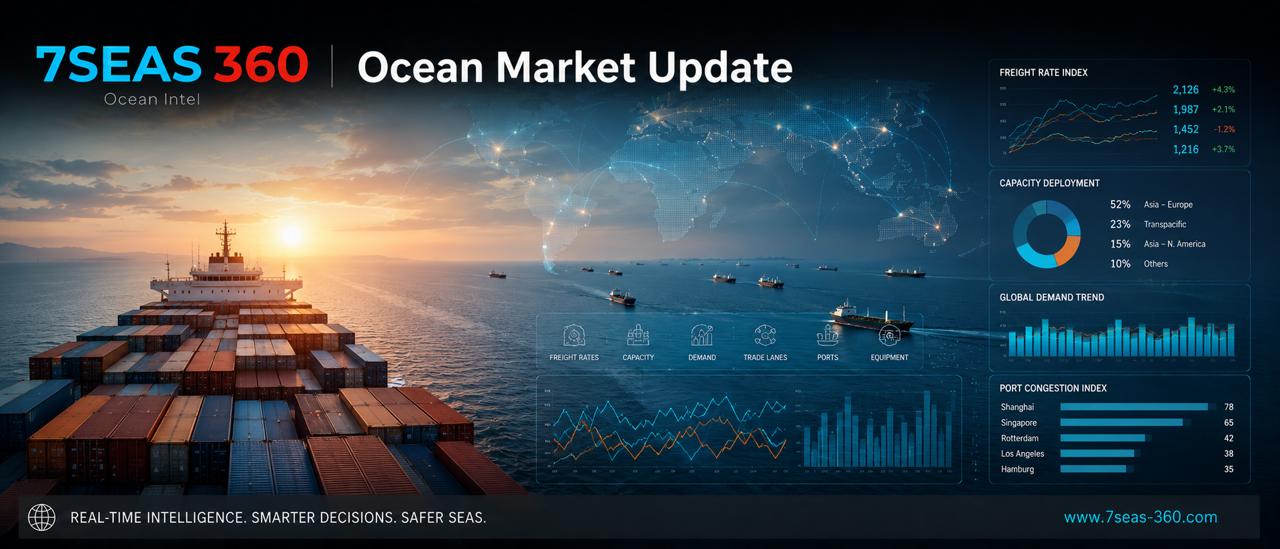
This week's market is a study in contradiction. On paper, the fundamentals are soft. Spot indices have been grinding down since June, the Freightos Baltic Index shed another 2% to USD 3,520 per FEU, and Xeneta's view for the year remains a further slide in both spot and contract levels. Demand is not what is holding this market up.
What is holding it up is dysfunction. More than 4.3m TEU of containership capacity is sitting outside ports rather than moving cargo, a figure that now exceeds the 2022 pandemic peak and swallows roughly 11% of the world fleet. Typhoon recovery at Shanghai and Ningbo has berths backed up to twelve days, Shanghai delivered 21% on-time arrivals in July, and Ningbo's schedule reliability sits at 34.6%. Effective capacity, not nominal capacity, is what prices this market, and effective capacity is scarce. Layer on 49 blank sailings across the East-West trades between weeks 34 and 38, and the picture is a market where carriers are managing supply into a weakening demand curve and, for now, winning. The clearest evidence is the Golden Week outlook: Linerlytica expects the backlog to keep vessels fully utilized through a holiday window that normally empties them.
For shippers this creates an awkward planning problem. Rates are drifting down, which argues for patience, but reliability is poor enough that the landed cost of a delay outweighs a two-percent rate saving. The divergence between trades sharpens it further. Transpacific is holding firm while Asia-Europe continues to soften, so a single global procurement stance no longer works. Trade-by-trade positioning is the only defensible approach into the Q4 tender season.
The geopolitical layer turned this week. Houthi forces captured Mokha on Thursday and the island of Mayun on Friday, putting them roughly 75 km from Bab el-Mandeb and materially improving their ability to interdict traffic through the strait. The group has told media that international navigation is safe and that its shipping ban applies only to Saudi vessels, and no container carrier has announced a reversal. That should be read as a statement of current intent, not a structural guarantee. The selective Suez return, led by CMA CGM with COSCO, Wan Hai and MSC routing individual strings, was always built on a risk calculation that can be repriced quickly. Carriers have kept the Cape of Good Hope routing available precisely for this reason.
The operational read for the coming weeks: assume Asian origin reliability stays poor through Golden Week, build buffer rather than chase the lowest spot rate, and treat any Suez-routed string as contingent. On the Red Sea, the risk is now positional rather than rhetorical, which is a different and more durable kind of exposure.
The market this week looks calmer than it is. A composite index that has not moved and a Transpacific that is quietly firming can easily be read as stability, but the flat headline number is the product of two opposing forces rather than the absence of pressure. Transpacific strength, supported by aggressive capacity withdrawal into the tail of peak season, is cancelling out an Asia-Europe trade that is losing ground week after week. Take away the blank sailings and the picture changes.
The more consequential development is congestion. More than 4.3m TEU of containership capacity is now waiting to berth globally, a figure that exceeds even the peak of the pandemic years. That queue is doing real work in the supply-demand balance: it is absorbing tonnage that would otherwise be competing for cargo, and it is the reason spot rates have not fallen further than they have. Asia is the epicenter. Every one of the region's fourteen busiest ports recorded deteriorating reliability in July, with Shanghai down to 21% and roughly 2.4m TEU of capacity displaced across North Asia by successive typhoons. Northern Europe is absorbing the second-order effect, with Rotterdam and Antwerp delays now feeding back into Asian rotations and stretching transit uncertainty across the entire east-west network.
On the Red Sea, the direction of travel is now unambiguous even if the pace is not. MSC's decision to officially restore Suez routings on four major east-west services moves the return from opportunistic transits to published network design, and Premier Alliance cargo is effectively following through slot arrangements on the Tiger service. CMA CGM has been consistent since January. Gemini remains deliberately slower, running ad-hoc transits through the remainder of the year before committing to regular Suez rotations from January 2027. Security conditions underpin the shift: no commercial vessel attacks have been recorded in 2026, though threat advisories for the corridor remain in force and the underlying political conditions are unresolved.
For shippers, the near-term calculus is unchanged but the medium-term one is not. Congestion is currently the market's shock absorber, and when it clears, roughly 7m TEU delivered between 2024 and 2026 becomes visible all at once against a demand base growing 2.5-3.5%. Add the round-trip capacity released by a full Suez normalization and the structural surplus on east-west trades is meaningful. The current flat market is a plateau, not a floor. Contract negotiations opening now should be priced against a softer 2027, not against this week's index.
The container market split cleanly along trade lines this week. On the Transpacific, spot rates firmed for a second week running, with Asia to US East Coast pricing reaching a fresh 2026 high near USD 9,400 per FEU and West Coast levels around USD 7,400. The driver is supply-side, not demand-side. Mid-August general rate increases stuck because typhoon disruption in East and South China removed effective capacity from the rotation, and because carriers layered on cancellations, with 14 blank sailings scheduled between 24 August and 13 September. Volumes have held up through August in part because shippers who pulled orders forward against an expected tariff step-up kept booking when it failed to materialise. That is a timing effect, not a structural one, and it does not survive the turn of the quarter.
Asia-Europe told the opposite story. Rates eased on both the North Europe and Mediterranean legs as the Suez return accelerates. Every service that swings back from the Cape of Good Hope shortens its round-trip by roughly ten to fourteen days and hands the trade back the tonnage that the long routing had absorbed since late 2023. Gemini has moved SE4/AE19 through the canal with Jeddah added in both directions, Ocean Alliance is running the CMA CGM-operated FAL3 eastbound via Suez while keeping westbound around the Cape, and MSC formalised a first phase of five sailings from 24 August. Maersk now puts more than 30% of its Asia-Europe volumes back through the canal. Cumulatively this is the largest single release of latent capacity the trade has seen in nearly three years, and it lands on a market that is already long.
The geopolitical counterweight arrived in the same week. A Houthi missile strike on the Egyptian-owned Tihamah killed six seafarers and injured ten more, the first deaths from Red Sea attacks in more than a year. Transits, which had climbed to their highest four-week total since January 2024 at around 1,090 movements, dipped again in the days after. At 41% below pre-crisis levels, the recovery remains partial and reversible, and carriers are routing selectively rather than committing networks wholesale. Shippers should read the Suez return as a rolling commercial decision reviewed voyage by voyage, not as a settled reopening.
European landside conditions add a second constraint. Northern gateways are carrying elevated waiting times as Cape-routed and Suez-routed arrivals bunch together, Hamburg continues to struggle with rail capacity into the inland network, and low water on the Rhine has cut barge payloads and triggered surcharges. The practical consequence is that faster ocean transits are not yet translating into faster door-to-door times.
The structural picture behind the weekly noise has not changed. Xeneta expects global long-term rates to fall by up to 10% across 2026, which would leave them roughly 20% below December 2023 levels, with fleet growth near 3.6% against demand growth near 3%. China to US demand was down 13% year on year in August. Capacity discipline is doing real work, but discipline is a management tool, not a market fundamental, and the tonnage returning through Suez makes that work harder each week. For shippers entering tender season, the negotiating position is improving on Asia-Europe and has not yet turned on the Transpacific.
This week the container market did something that looks contradictory on the surface and is entirely rational underneath: carriers accelerated their return to the Suez route in the same week that the Red Sea produced its first shipping fatalities in more than a year. On 10 August, Maersk and Hapag-Lloyd formalised what had already been happening on the water, confirming a structural switch of Gemini services back through the canal. The AE19/SE4 Asia-Med loop has been transiting in both directions since the end of July, and the AE2/NE1 Asia-North Europe service follows with the MANCHESTER MAERSK westbound on 16 August. CMA CGM has been sending eastbound FAL3 voyages through Suez since 22 July, and COSCO has put its first vessel through Bab el-Mandeb in over two years on the revived RES4.
The driver is not confidence in the security situation. It is arithmetic. Almost six months of war has left the fleet structurally short of vessels and equipment, and protracted congestion across North Asian and European terminals is absorbing whatever slack remains. Every Cape rotation ties up tonnage and boxes that the network cannot spare. Cutting roughly ten days out of an Asia-Europe round trip is now worth accepting a war risk that has, if anything, worsened: a Houthi attack in the Bab el-Mandeb on 11 August killed six crew, and US forces struck a container ship in the Gulf of Oman on the same day over an alleged attempt to breach the blockade of Iranian ports. War risk premiums are rising and underwriters are examining voyages individually.
Rates continued to diverge along the two main head-haul trades. The Drewry composite rose 1% to USD 4,339 per FEU for a second consecutive weekly gain, carried entirely by the Transpacific, where Shanghai-New York added 10% to USD 8,706 and Shanghai-Los Angeles rose 6% to USD 6,244. Asia-Europe went the other way, with Asia-North Europe off 1% and Asia-Mediterranean down 7% on the FBX as the European peak faded. Xeneta still puts Far East-USWC spot 271% above pre-crisis levels and USEC 287% above, which is the more useful number for anyone budgeting: the absolute level, not the weekly direction, is the story.
Capacity discipline is doing the heavy lifting on the Pacific. Carriers cancelled ten sailings in each of the past two weeks, with 49 blanks scheduled across the major East-West trades from week 34 to week 38, a cancellation rate around 7%. Expect that discipline to hold as long as the Transpacific peak stretches and Asia-Europe stays soft, because the Suez switch will start feeding effective capacity back into the Europe trades from September onwards. That is the pressure point to watch: shorter transits plus a soft European demand picture is a rate-negative combination, and the disruption is now visibly leaking into long-term contract negotiations.
On the corporate side, SeaLead filed for liquidation on 3 August after nine years and a peak fleet of 59 ships, a reminder that a high-rate environment does not protect operators without network depth. Hapag-Lloyd meanwhile joined Zim on the new AS3/ZFS Asia-South America East Coast service starting 13 September, continuing the build-out of secondary trades while the main arteries stay unsettled.
Practical read for shippers: do not treat the Suez return as a restoration of normal. It is a partial, service-by-service reallocation under active threat, and any single incident can reverse individual loops within days, as it has before. Book Asia-Europe with routing flexibility written into the contract, verify the actual routing per sailing rather than per service, and hold Transpacific cover where you have it, since the tightening there is deliberate and carrier-controlled.
The container market split cleanly in two this week. On Asia-Europe, spot rates fell for a fourth consecutive week: Drewry's WCI held Shanghai-Rotterdam flat at $4,653 per FEU but marked Shanghai-Genoa down 2% to $5,506, and the SCFI is pointing to further declines of 2.1% on North Europe and 3.4% on the Mediterranean in the week ahead. Freightos puts Asia-North Europe around $5,000 per FEU, some 14% below the July peak, and Asia-Mediterranean around $6,000, roughly 16% off and back to mid-June levels. Vespucci Maritime's Lars Jensen read Maersk's withdrawal of its 14 August Far East-Mediterranean peak season surcharge as confirmation the market has passed the apex of peak season, and sources quoted by The Loadstar suggested that simply holding rates flat would now count as a win for carriers.
The transpacific told the opposite story. WCI recorded Shanghai-New York up 4% at $7,893 per FEU and Shanghai-Los Angeles up 3% at $5,894, with the SCFI showing US East Coast up 2.6% to $9,290 and US West Coast up 4.1% to $6,484. Drewry credited successful August GRIs and, importantly, port congestion across central and southern China constraining sailing capacity. Linerlytica reported the SCFI composite rebounding 4.7% in week 31 on increases across the transpacific, Latin America, the Indian subcontinent and the Middle East, and conceded the transpacific rally had caught it off guard. Jensen offered a caution worth taking seriously: last week's near-$700 SCFI jump on Asia-USWC translated into only a $155 move on the WCI, which points to a phantom GRI rather than a durable repricing. Freightos noted East Coast rates have now sat at roughly $9,000 per FEU since early July, an unusually long plateau that tariff frontloading appears to be sustaining.
The supply side is the story to watch into next week. Typhoon Dolphin, designated an orange-category storm by Chinese authorities, was forecast to make landfall between Zhoushan in Zhejiang and Fuding in Fujian late Sunday or early Monday with sustained winds of 38 to 45 metres per second. Zhejiang raised its coastal typhoon alert to the highest level and halted port operations, Ningbo Lishe airport suspended all Sunday flights, Yangshan was cleared of vessels by late Friday, and Yangtze River Delta rail services stop from Sunday. Rain and wind are forecast across eastern China through 12 August, with parts of eastern Zhejiang facing more than 600mm. This lands on ports already carrying backlogs from earlier July storms, and China has additionally ordered vessels transiting the Taiwan Strait to follow its traffic control instructions, a move Taipei has rejected. Expect schedule reliability on Asia-Europe and transpacific headhaul strings to deteriorate over the next two to three weeks, and expect that tightening to give carriers more leverage on the mid-August FAK filings than the underlying demand picture would justify on its own.
Demand, meanwhile, is normalising. The NRF and Hackett Associates Global Port Tracker recorded 2.23m TEU at major US ports in June, up 13.2% year on year against a depressed 2025 comparison, with first-half volume of 12.7m TEU up just 1.1%. July is estimated at 2.21m TEU, down 7.6% year on year, and the forecast steps down through September, October and November before a modest December rebound, with full-year 2026 essentially flat at 25.5m TEU. The pull-forward was policy-driven: the temporary 10% Section 122 global tariffs expired on 23 July and were replaced the following day by Section 301 duties of 10% to 12.5% covering 60 economies and 99% of US imports. Carriers are compensating with capacity rather than price, with 58 blank sailings scheduled across the major East-West trades between weeks 32 and 36.
On the geopolitical side, the Strait of Hormuz remains effectively closed to normal commercial traffic, with only limited shuttle cargoes moving under US military escort and some vessels running dark. Iranian lawmakers are debating the text of a draft understanding with Oman, and while Deputy Foreign Minister Kazem Gharibabadi said agreement had been reached in principle, hardline amendments reported by Fars include banning US and Israeli ships, banning Israel-linked cargo, demanding compensation from hostile states, and levying transit fees. Supreme Leader assent is unconfirmed. ADNOC reported three of its vessels attacked in the strait this week and the UAE condemned a further attack on Saturday. For container operators the direct exposure is limited, since the Gulf is a comparatively small box trade, but the second-order effects are not: Brent around $82 a barrel feeds bunker costs, war-risk premiums remain elevated across the region, and Houthi activity has resumed around Yemen and the southern Red Sea. Notably, container lines have not pulled back from Bab el-Mandeb, with services still calling Jeddah and Maersk and CMA CGM holding their trans-Suez routings. The week's sharpest reminder of sanctions risk was commercial rather than kinetic: SeaLead Shipping, ranked the world's 13th-largest carrier a year ago with 53 ships, is in liquidation after OFAC designated it as part of the Shamkhani network, with a wind-down licence running only to 12 September.
The container market enters August in an unusually contradictory state. Spot rates have now fallen for three straight weeks, yet nothing about the underlying supply picture has loosened. The Drewry composite at USD 4,255 per FEU sits about 8% below its early-July peak, and the softening is broad: Asia-Mediterranean gave up 6%, Asia-North Europe 3%, and the transpacific eased 2% into Los Angeles while New York held flat. What makes this different from a classic demand-led correction is who is pushing prices down. Linerlytica has carriers quoting Asia-Europe business below USD 5,000 per FEU, and forwarders on the US west coast describe the transpacific slide as a deliberate move to bring pricing back to a level that generates bookings. That is discounting into a market carriers themselves describe as tight.
The response is a coordinated attempt to reset. Transpacific GRIs of USD 2,000 to 3,000 per FEU landed on 1 August, and MSC has already signalled the follow-through with new FAK levels from 15 August at USD 7,800 per FEU to North Europe and USD 6,700 to the Mediterranean. The Shanghai Containerised Freight Index, which leads the WCI by a week, is sending mixed signals: North Europe and Mediterranean quotes are down another 4%, while Shanghai to both US coasts jumped 12.5% on GRI optimism. Whether that optimism survives contact with actual volumes is the question that defines the next fortnight. Carriers are backing it with blank sailings rather than hope, with eight transpacific and three Asia-Europe cancellations scheduled for the coming week and roughly 46 blanks programmed across the east-west trades through mid-August. One telling data point: BAL Container Lines pulled a 14,000 TEU extra loader from the US west coast and chartered the vessel to Maersk for Asia-Europe instead, which is not the behaviour of a carrier expecting a transpacific surge.
Demand is doing exactly what the calendar predicted. US retail import forecasts show July peaking at a record 2.47m TEU, August stepping down to 2.22m TEU, and September through November falling below 2.0m TEU. The front-loading that pulled cargo forward ahead of the latest tariff measures has emptied the pipeline behind it, and China-to-US volumes remain materially below prior-year levels. Against a structural backdrop of roughly 3% demand growth versus 3.6% fleet growth, the arithmetic favours the shipper for the remainder of the year, provided nothing external intervenes.
Something external is, in fact, intervening. Renewed escalation around the Strait of Hormuz has pushed bunker prices up sharply enough for CMA CGM to reinstate a Middle East Emergency Fuel Surcharge of USD 75 to 165 per TEU from 1 August, with ONE following from 15 August. For shippers this is the most immediate cost exposure of the month, because unlike a GRI, an EFS is not negotiable at the same table and tends to survive rate erosion. The Red Sea picture remains cautiously constructive but slow: Maersk and Hapag-Lloyd have returned one Asia-Mediterranean-Turkey service to Suez, CMA CGM continues to lead the phased return, and ZIM has not moved pending insurance clarity. Full normalisation would release significant effective capacity and put further downward pressure on rates, which is precisely why carriers are in no hurry.
For cargo owners the practical read is straightforward. Treat the August GRI window as a spike to be waited out rather than a new floor, but budget separately for fuel surcharges that are tied to a geopolitical driver no carrier controls. Reliability, not price, is the greater risk this quarter: with Northern European and Southeast Asian hubs still congested and blank sailings thinning the schedule, the cost of a missed connection now exceeds the cost of a few hundred dollars of rate movement. Where possible, secure space early in the month, hold contract volume steady rather than chasing the spot dip, and keep the Hormuz situation on a weekly review cycle.
The container market is entering the back half of peak season with the balance tipping toward shippers. After the frontloading surge of June and early July, spot rates on the major East-West fronthauls have now declined for two straight weeks, with the Drewry WCI composite down 4% to $4,374 per FEU. The driver is straightforward: carriers have deployed record capacity into the Transpacific just as demand cools, and even a deliberate blanking programme of 46 cancelled sailings over the next five weeks is only slowing the slide, not stopping it. The paradox of the week is congestion. Around 10% of the global fleet, some 3.4m TEU, is tied up at anchorages, the highest level in four years, with Shanghai and Indian west coast ports under particular strain. That absorbed capacity is quietly supporting rates; if congestion unwinds, the effective supply injection could accelerate the rate correction into August. Geopolitics adds a second layer of uncertainty. The on-again, off-again Red Sea return stalled as Gemini reversed its ME11 Suez routing on renewed Houthi threat assessments, even as Maersk tested the corridor with a 16,500 TEU unit this week. Meanwhile, the expiry of the 10% US blanket tariff on 24 July, with successor measures expected in early August, leaves US importers guessing on landed costs. For shippers: window for spot savings is opening on Asia-Europe and Transpacific, but congestion surcharges and tariff-driven demand swings warrant close monitoring through August.
The container market has crossed an inflection point this week. After a peak season that effectively began in May rather than July, the two forces that drove rates up are now working in opposite directions. Carriers are adding capacity to the main Asia head-hauls at a pace of 3 to 6% per week, while demand shows no underlying growth to absorb it. The result is a second straight week of spot rate softening on every major east-west lane. What keeps this from becoming a rapid unwind is congestion. With roughly 11% of the world fleet, some 3.4m TEU, sitting in port queues, a large share of the capacity carriers are nominally deploying is not actually available to the market. Effective supply is therefore much tighter than the deployment numbers suggest, and that is holding the floor under rates.
The congestion picture is now a two-ended problem rather than a European one. Delays at Shanghai and Ningbo push vessels off schedule at origin, and by the time those ships reach Hamburg, Antwerp or Rotterdam they have missed their berth windows and queue again. Inland barge waits in the Rotterdam and Antwerp region approaching four days extend the delay past the quay and into the hinterland. For shippers this means transit time variability, not headline rate levels, is the operative planning risk for the rest of Q3. Blank sailings at a 6% cancellation rate are a modest management tool by historical standards, and their concentration on the Transpacific eastbound trade signals where carriers see the most demand softness.
On the geopolitical side, the Red Sea remains the single largest swing factor. The 14 June Iran and US ceasefire memorandum has held, and Houthi attacks on Israeli-linked shipping have not resumed, which is what allowed Maersk and Hapag-Lloyd to attempt a second, deliberately narrow return on 6 July. The caution is well founded. A cargo vessel reported an attack near Al Hudaydah on 5 July, and the calm is measured in weeks rather than quarters. The Suez Canal Authority's decision to raise container ship transit surcharges from 15 July cuts against the return economics at exactly the moment carriers are weighing the risk. A large-scale Suez return would release a substantial block of effective capacity by shortening Asia to Europe voyages, and against a 38.3% orderbook that would be the decisive bearish event for 2026 rates. It has not happened yet, and this week's evidence points to a slow, service-by-service migration rather than a step change.
The container market entered mid-July at full stretch. July 1 general rate increases and peak-season surcharges stuck across the major east-west trades, pushing spot rates up another roughly $1,000/FEU and taking the transpacific climb past $3,000/FEU since the end of May. Freightos data puts Asia-US West Coast at about $6,200/FEU, up 120% since mid-May, and Asia-US East Coast near $8,000/FEU, up 85% in six weeks; Asia-North Europe reached about $5,400/FEU and Asia-Mediterranean cleared $7,000/FEU. Notably, falling bunker prices are not feeding through to rates - demand, not cost, is setting the market. The driver is capacity that looks ample on paper but is being absorbed by congestion. Linerlytica and Loadstar reporting put roughly 3.4m TEU stuck in port queues, a four-year high, with about 10% of the global fleet waiting at anchor. North Asia is the worst bottleneck at 38% of global congestion, followed by North Europe at 13%. Carriers have responded by loading record volumes into Asia-Europe and slashing blank sailings, but the queues neutralise much of that added capacity. The week's structural signal came from the Gemini Cooperation: Maersk and Hapag-Lloyd announced on 6 July they will route the AE15 service (Asia, Mediterranean and Turkey) back through the Suez Canal and Red Sea rather than around the Cape, with the 19,000 TEU Majestic Maersk expected at Suez around 24 July. It is the pair's second attempt in 2026 to restore trans-Suez routing after an earlier return was aborted, and it remains a cautious, single-service move rather than a market-wide shift back. Looking ahead, a further round of GRIs and PSSs lands on 15 July - MSC is pushing for $7,700/FEU to both North Europe and the Med, CMA CGM for $7,000 to North Europe and up to $8,500 to the Med. Whether they hold is the key question: front-loading ahead of the 24 July US tariff deadline has lifted inbound US demand an estimated 15% month-on-month, but the first small week-on-week rate reductions suggest this peak may be at or near its ceiling.
The container market entered July in a firm, rising posture, driven less by a demand boom than by an early peak season colliding with tightening effective capacity. Transpacific spot rates extended their climb, adding roughly 8-11% over the past week to leave Shanghai-Los Angeles near $6,350/FEU (up around 120% since mid-May) and Shanghai-New York close to $7,900/FEU, now sitting above 2025's frontloading-driven summer high. Asia-Europe lanes held their gains, with North Europe around $4,900/FEU and the Mediterranean near $6,500/FEU, up 70% and 85% respectively since mid-May. The mechanism behind the strength is increasingly on the supply side. Worsening congestion at major hubs in the Far East and Northern Europe is absorbing tonnage: Shanghai and Ningbo are seeing berth delays of two to seven days on heavy seasonal volume, weather and vessel bunching, while Rotterdam and Antwerp face inland barge waits stretching toward four days. Disruption at one end of the trade lane is now feeding the other in a self-reinforcing cascade, with an estimated 3.4 million TEU of capacity idled in queues. Carriers are compounding the effect deliberately, running 31 blank sailings across the main east-west trades from week 26 to week 30 (about a 4% cancellation rate) to hold rates where they want them despite an underlying global oversupply of ships. Alliance discipline varies sharply, with Gemini cancelling just 2.8% of sailings against 15.9% to 19.9% for its rivals. On the geopolitical side, the Red Sea picture is stable but unresolved: the Bab el-Mandeb corridor remains largely bypassed, most carriers still route via the Cape of Good Hope, and only selective Suez transits by Maersk and CMA CGM have resumed, keeping the longer-mileage premium baked into rates. For shippers, the near-term signal is continued upward pressure and reduced schedule reliability through the summer peak.
The container market enters the final week of June firmly in an early peak season. Transpacific spot rates have surged on the back of June 1 general rate increases and peak-season surcharges, with US West Coast levels rising more than 50% inside two weeks and East Coast rates pushing toward the $7,000/FEU mark. The driver is demand timing rather than a structural tightening: the National Retail Federation has moved its projected peak import month forward to June as US importers frontload cargo ahead of potential tariff changes and higher bunker-related costs. Carriers are reinforcing the rate momentum with disciplined capacity management, scheduling roughly 31 blank sailings across the main East-West lanes over weeks 26 to 30, the bulk of them on the transpacific eastbound leg. That discipline is uneven, however, with the Gemini cooperation cancelling under 3% of sailings while MSC, Premier and Ocean alliances run materially higher, and underlying deployed capacity remains high enough that analysts continue to warn the rate strength may prove difficult to sustain into the third quarter. On the geopolitical axis, the slow normalisation of the Suez-Red Sea corridor remains the dominant variable for Asia-Europe routing and, indirectly, for global vessel supply. A small number of large container ships have resumed transits and a second Ocean Alliance backhaul service has returned, but the recovery is halting: Maersk has rerouted select sailings back around the Cape of Good Hope, the Houthi ban on Israeli-linked vessels still stands, and Suez throughput remains well below pre-crisis levels. Until carriers gain confidence in sustained safety, the absorbed capacity from longer Cape routings will keep a floor under the wider market even as peak-season demand does the heavy lifting on price.
The container market entered an unusually early peak season this month, and spot rates have responded sharply. Drewry's World Container Index climbed 12% to $3,969 per 40ft container in the week to 18 June, building on a 23% jump to $3,433 the week before. The gains are broad-based across both major head-haul trades. On the transpacific, Shanghai to New York rose 15% to $6,769 and Shanghai to Los Angeles added 10% to $5,142. On Asia to Europe, Shanghai to Rotterdam rose 15% to $4,342 and Shanghai to Genoa rose 12% to $5,756. Carriers implemented a fresh round of general rate increases and peak-season surcharges on 15 June, and Drewry expects further increases in the coming weeks.
The demand driver is front-loading. Shippers are pulling bookings forward ahead of US tariff changes expected in July, with additional cargo linked to the 2026 FIFA World Cup. Linerlytica sees the momentum lasting at least through the end of July. On the supply side, carriers are managing capacity tightly: 34 blank sailings are scheduled across the main East-West trades from week 25 to week 29, a cancellation rate of about 5%. That discipline matters because June capacity is recovering from May's cuts, which on its own would make further hikes harder to land.
Geopolitics continues to underpin the tightness. After the Houthis resumed attacks in late March amid the Iran conflict, the tentative moves to return container ships to the Red Sea and Suez have largely been shelved, and the Cape of Good Hope detour remains the default. That absorbs vessel capacity and feeds into congestion at the European and Mediterranean gateways the diversion funnels traffic toward. Singapore transhipment is running near critical utilisation, Algeciras has roughly half its vessels waiting for a berth and Tanger Med about a quarter, while Rotterdam, Hamburg and Antwerp see intermittent delays. For shippers, the practical takeaway is to book early and budget for surcharge volatility into July; a sudden large-scale Red Sea return would be the main wildcard, and would likely bring its own wave of arrival congestion in northern Europe and the Med.
Container shipping entered the second week of June 2026 with clear upward momentum on rates as an earlier-than-usual peak season took hold. Freightos reported spot rates spiking on the peak-season rush, with the FBX Asia-North Europe lane climbing 14% week on week to $3,522 per FEU, while Xeneta's XSI for the Far East to Europe sat around $3,393. The sharper story is on the Transpacific, where Xeneta estimates China to US West Coast spot rates are now roughly 84% above pre-Middle East-conflict levels, with the Far East to US East Coast up about 70% and North Europe and Mediterranean fronthauls up 44% and 40% respectively since the end of February. The demand surge is driven less by underlying consumption and more by timing: shippers are front-loading cargo ahead of anticipated US tariff changes in July, with additional volume linked to the 2026 FIFA World Cup. Carriers have kept capacity disciplined, with blank sailings holding at around 5% of scheduled East-West departures, and Xeneta's Peter Sand has warned that worsening congestion at North European hubs such as Rotterdam, Hamburg and Antwerp could push rates higher still. On the geopolitical side, the Red Sea remains the defining structural factor: most lines continue to default to the longer Cape of Good Hope routing, and southern Red Sea and Bab el-Mandeb transits stay depressed at 30-35 vessels per day against a pre-disruption norm of about 70, with industry consensus expecting diversions to persist well into 2027. With longer voyages still absorbing capacity, an early peak season, and tariff-driven front-loading all converging, the market is firmly in an elevated rate environment heading into the summer.
The container market shifted into overdrive this week. Drewry's World Container Index jumped 23% to $3,433 per FEU and the SCFI climbed 155 points to 2,726 — its highest level in about two years and a fifth straight weekly increase. The transpacific led the move: Shanghai–Los Angeles spot rates rose 31% to $4,565 per FEU, while Xeneta data shows Far East–US West Coast rates have more than doubled (+109%) since the Middle East crisis began on February 28. Asia–Europe followed with Shanghai–Rotterdam up 25%. Three forces are converging: a peak season arriving roughly two months early as US importers frontload ahead of the expected late-July switch from 10% Section 122 tariffs to higher Section 301 rates; additional cargo tied to the 2026 FIFA World Cup and retail restocking; and the continued closure of the Strait of Hormuz, which is tying up tonnage and congesting transshipment hubs from Singapore and Port Klang to Colombo with record dwell times. Carriers are responding by restoring capacity — just three transpacific blank sailings are announced for next week, down from eight — and reliability gaps are widening, with Gemini's 2.8% cancellation rate far ahead of the other alliances. Linerlytica expects rate momentum to hold at least through late July. The wildcard remains geopolitical: with Hormuz still closed and incidents like the projectile strike on MSC Sariska V at Umm Qasr underscoring persistent risk, shippers should budget for elevated rates and longer transits well into Q3.
The container market enters June on a firmer footing than fundamentals alone would suggest. The Drewry World Container Index climbed about 3% to roughly $2,800/FEU, its fourth consecutive weekly gain, lifted by an early peak season on both the Asia–Europe and transpacific trades. Demand is being pulled forward into June ahead of an expected 1 July bunker adjustment, and carriers are reinforcing the move with aggressive commercial action: Emergency Fuel and Peak Season Surcharges of around $2,000/FEU for June, plus a fresh CMA CGM FAK from 1 June near $4,700/FEU on Asia–Europe and $5,500–5,700/FEU on Asia–Mediterranean. Headline lanes reflect the strength, with Shanghai–Genoa at $4,253/FEU and Shanghai–New York at $4,597/FEU. Yet the rally rests on management rather than demand. Xeneta notes transpacific spot rates remain more than 50% above pre-conflict (end-February) levels largely because US shippers are delaying long-term contracts amid Middle East uncertainty, forcing cargo onto the spot market. Carriers are blanking sailings at near-pandemic intensity and have cut non-alliance West Coast capacity to a decade low, even as Linerlytica warns that a record 13M TEU orderbook (38.3% of the fleet) points to a structural overcapacity overhang. Underpinning it all is geopolitics: the Strait of Hormuz remains largely blocked since late February, the US port blockade only wound down on 29 May, a CMA CGM vessel was attacked in transit, and lines continue to shun the Red Sea in favour of the longer Cape of Good Hope route. The net effect is an elevated, surcharge-driven market that could soften quickly once peak-season front-loading fades and idle tonnage returns.
The container market enters the final week of May with a clear tension between geopolitics and fundamentals. The Strait of Hormuz remains effectively shut to box shipping for a third consecutive month, and Washington's decision this week to pause a planned strike on Iran in favour of talks has stabilised — but not de-escalated — the situation. With Cape-of-Good-Hope routings still the norm and bunker costs running hot, mid-May GRIs from Hapag-Lloyd, CMA CGM and Yang Ming have started to bite: Asia–North Europe FAK is now anchored at $3,500/40ft and West Med at $4,500/40ft, while a $2,000/FEU transpacific GRI took effect on 15 May. Spot levels reflect a split market — Asia–Mediterranean firmed 3% week-on-week to roughly $3,600/FEU, Asia–North Europe eased 2% to about $2,800/FEU, and the transpacific plateaued at ~$2,800/FEU (USWC) and ~$4,300/FEU (USEC), although daily prints turned higher into the back end of the week. The bigger story is that European importers appear to be pulling the peak season forward, ordering earlier than usual to ensure cargo lands ahead of Golden Week given the longer Cape transit; carriers including Yang Ming have publicly flagged the early uptick. Capacity discipline is doing most of the heavy lifting: effective Asia–N. Europe capacity is down 3% month-on-month and Asia–Med down 10% on blanked sailings, with seven blanks already booked on the transpacific for the coming week. Carriers are now reaching for the next leg — MSC and peers have announced June FAK lifts of roughly $2,000/FEU on Far East–NWC/Med/Black Sea, though most analysts doubt the full increase will hold given persistent overcapacity (fleet growth ~3.6% vs demand ~3% in 2026). On the trade-war front the tone has softened: the Trump–Xi summit appears to have had a stabilising effect, with China reopening access for 425 US beef plants, both sides agreeing to stand up bilateral trade and investment bodies, and the EU racing to finalise its US trade deal ahead of the July White House deadline. For shippers the playbook into June is unchanged — secure space early, expect surcharge layering, and plan around schedule volatility rather than headline rate moves.
Five weeks after the late-February US/Israel-Iran war erupted, the container market has settled into an uneasy plateau. Average Far East spot rates are flat month-on-month but anchored more than 50% above pre-conflict levels on the transpacific, with Far East to US West Coast at $2,884/FEU and US East Coast at $3,974/FEU on 13 May (Xeneta). Asia-North Europe sits at $2,531/FEU and Asia-Mediterranean at $3,451/FEU - the Mediterranean lane has now largely unwound its Hormuz spike and is only 4% above pre-crisis. The driver is not demand strength but capacity discipline: Linerlytica notes a string of blank sailings clustered around the May Day holiday, with effective capacity down roughly 25% on the transpacific that week, and Drewry sees capacity reductions of 3% MoM on Asia-North Europe and 10% MoM on Asia-Med for May overall. Premier Alliance's transpacific reshuffle and slot-sharing arrangements continue to absorb supply, while Gemini Cooperation maintains its reliability lead (0.9-day average delay vs 5.9 for Premier earlier in the year). The Strait of Hormuz remains the dominant macro risk: Iran's blockade has held since 28 February, only 191 vessels transited in April (vs ~3,000 normally), and as of 8 May more than 1,550 ships with 22,500 mariners are stranded in the region. The UK has now joined the international defensive mission, but 'Project Freedom' escorts are paused amid renewed diplomacy. Hapag-Lloyd alone puts the cost of the disruption at $60m per week. Bunker prices have roughly doubled at major hubs, and all top-five carriers have Emergency Fuel Surcharges live. Red Sea remains a binary trigger - Houthi threats to retaliate against the Iran strikes hang over the route, but Maersk's ME11 service is back via Suez and east-west canal share has climbed to 18.7%. Looking past the headlines, BIMCO's 2026 framework (fleet +3.0% vs demand +2.5-3.5%) is the gravity that ultimately reasserts itself. A Red Sea normalisation would erase up to 10% of effective ship demand; combined with falling long-term contract rates (N. Europe $2,010/FEU, Med $2,308/FEU - down ~25% from late 2025), the gradual softening trajectory Xeneta has flagged remains the base case into the summer peak.
Week 19 closed with the Strait of Hormuz crisis entering its tenth week and the partial reopening already under strain. After Iran's IRGC navy declared the waterway safe and the US paused offensive operations, a Qatari LNG carrier transited toward Pakistan and a Maersk-operated boxship made the passage under US Navy escort, the first significant container movements through the strait in weeks. Optimism was short-lived: on 5 May the Maltese-flagged CMA CGM San Antonio was struck during transit, injuring eight crew and reinforcing the IMO tally of 32 incidents since hostilities began. Two days later Iranian forces and US destroyers exchanged fire after a US strike on an Iranian tanker, leaving roughly 2,000 ships still queued in the Gulf and war-risk insurance pricing 15-20 times pre-war levels. The container market is digesting two opposing forces. On Asia-Europe, spot rates have unwound the war premium and now sit at pre-conflict levels, with FBX Asia-North Europe down 3% to about $2,700/FEU and only Asia-Mediterranean still elevated near $3,850/FEU. Carriers are responding with disciplined capacity withdrawal: Drewry estimates May effective capacity down 3% on Asia-North Europe and 10% on Asia-Mediterranean, while a wave of Gulf service suspensions by major lines is shifting Middle East cargo onto Khor Fakkan, Sohar and Salalah landbridges. On the transpacific, the picture is firmer; FBX Asia-US East Coast jumped 10% week-on-week to $3,069/FEU and West Coast added 2% to $2,127/FEU, lifting the Drewry composite WCI 3% to $2,286/FEU as US importers front-load ahead of any further escalation. Beneath the headline rates, schedule reliability remains the dominant concern, the Red Sea has not reopened in any meaningful sense (Bab el-Mandeb still 45% below 2023 volumes), and the 2026 supply-demand gap of roughly 60 basis points means any easing of the geopolitical risk premium would expose carriers to renewed rate pressure very quickly.
Der globale Containermarkt zeigt in der ersten Maiwoche 2026 ein zweigeteiltes Bild. Während die Transpazifik-Routen Auftrieb erhalten — Asia → US East Coast +10%, West Coast +2% laut FBX — gibt der Asia-Europa-Korridor weiter nach (Nordeuropa -3%, Mediterranean +7% leicht erholt). Der Drewry World Container Index fällt zum dritten Mal in Folge auf $2.216/FEU. Treiber der Transpazifik-Stärke sind kriegsgetriebene Frontloading-Effekte sowie ab 1. Mai eingeführte Emergency Fuel Surcharges und Peak Season Surcharges — CMA CGM allein mit $2.000 PSS. Gleichzeitig steigt die effektive Kapazität auf den USEC-Routen laut Drewry um 11% gegenüber April, was die Rate-Erholung mittelfristig deckeln dürfte.
Die Strait-of-Hormuz-Krise bleibt der dominante geopolitische Joker: Die US-Operation 'Project Freedom' zur Eskorte gestrandeter Schiffe wurde Anfang Mai pausiert, ein Maersk-Containerschiff transitierte unter Marineschutz, ein französischer CMA-CGM-Frachter wurde am 5. Mai beschossen. Prediction-Market-Trader auf Kalshi rechnen frühestens für August/September mit normalem Verkehr; das Pentagon spricht von sechs Monaten Minenräumung. Im Roten Meer bleibt der Suez-Verkehr trotz 100 Tagen ohne Houthi-Angriff rund 60% unter Vorkrisenniveau — CMA CGM hat FAL1/FAL3/MEX wieder auf die Kap-Route zurückverlegt. Strukturell überlagert der Orderbuch-Überhang von rd. 10 Mio. TEU (≈ ein Drittel der aktiven Flotte) das gesamte Marktbild und zwingt Carrier zu aggressivem Capacity-Management aus Blank Sailings, Idling und Slow Steaming.
Five weeks after the US-Iran ceasefire was declared on April 7, the Strait of Hormuz remains effectively closed to commercial shipping. Iran's Revolutionary Guard captured two foreign container ships on April 22 attempting to exit the strait without authorization, and fired on a third — the latest escalation under a dual-control regime where Tehran approves exits and the US Navy blockade controls entries. Only around five vessels per day are transiting, a fraction of the 100-plus daily pre-war norm. While the immediate panic-driven rate spikes have subsided and Far East–Europe spot rates are easing 6–13% month-on-month as alternative routing via the Cape of Good Hope, Khor Fakkan, Sohar and Jeddah stabilizes, underlying drivers of disruption persist: longer transit times, schedule reliability at multi-year lows, congestion at alternative hubs, and elevated war-risk premiums (double-digit millions of USD per trip for high-risk flags). With 40-plus boxships still stuck in the Gulf, BIMCO and Linerlytica both flag a worsening structural picture: fleet has grown 7% YoY to 33.5m TEU, the orderbook stands at a record 11.7m TEU, and overcapacity is forecast at 19% in 2026 — meaning any easing of the geopolitical premium will quickly expose carriers to renewed rate pressure.
The week of April 14–17 brought a new pressure point to an already strained global container market: surcharges on Transatlantic trade lanes took effect, triggering a 25% month-over-month spike in Rotterdam–New York rates to $1,968/FEU. This move — unusual in its magnitude for a trade lane typically insulated from Middle East disruptions — reflects how the Hormuz crisis is now cascading across every major East-West corridor, not just those with direct route exposure. The US further escalated pressure on Iran this week by expanding its maritime blockade with global boarding powers and a broad 'contraband' crackdown, keeping commercial transits through the Strait of Hormuz at a mere ~16 vessels per day versus a pre-war average of 135. The brief ceasefire of early April has yielded no meaningful normalization of traffic flows.
On the Transpacific, spot rates defy the absence of direct regional exposure, climbing 3–10% week-on-week depending on coast, driven by shipper anxiety and a rush to front-load cargo ahead of further US tariff escalations. Carriers are simultaneously navigating a separate strategic pressure: fleet reshuffling ahead of USTR port fees on Chinese-built vessels. The Premier Alliance split its MS2 transatlantic service into two discrete loops this week, enabling ONE to redeploy 10 Chinese-built ships away from US calls — a move that tightens available capacity and further supports elevated rate levels.
Bunker fuel costs, while beginning to ease from their initial 200% post-crisis spike, remain roughly double pre-crisis levels in Singapore, creating a durable floor under freight rates. Schedule reliability globally holds at a precarious 27%. The structural overcapacity that defined the market entering 2026 (3.6% fleet growth vs. 3.0% demand) is now effectively masked by rerouting inefficiencies, fleet displacement, and blank sailing strategies — leaving shippers facing a market that looks tight despite an oversupplied fleet on paper.
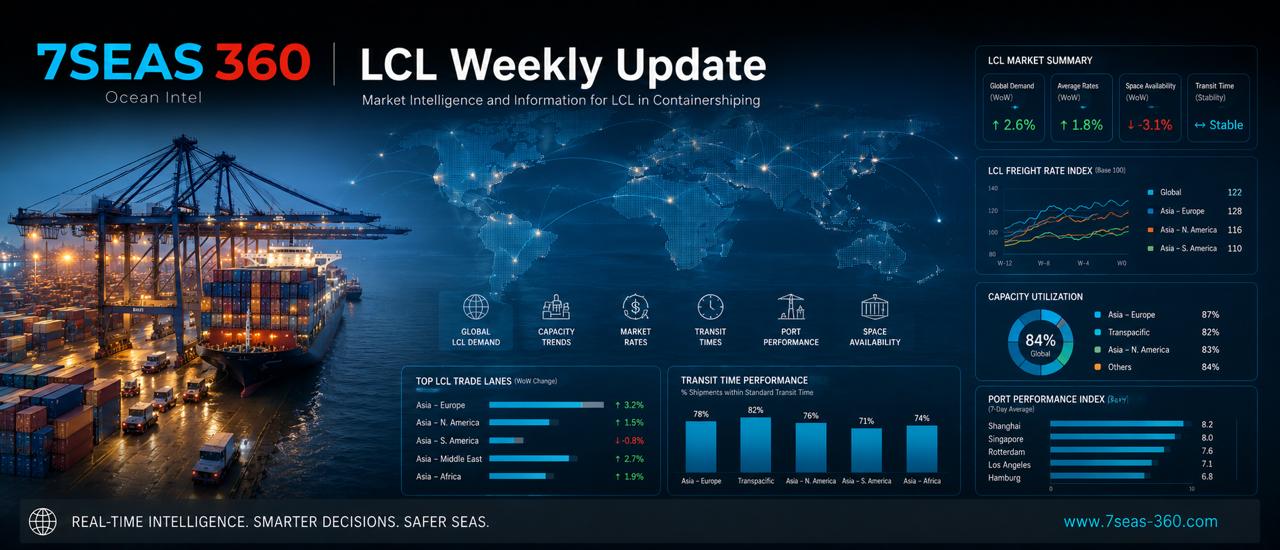
The panel average rose 0.7 percent to $131.02/W-M and the headline number is once again the least useful figure on the page. What the average conceals this week is a clean break in the panel. Every US-weighted book gained, with Teamglobal up 2.6 percent, Vanguard up 2.2 percent and ECU up 2.1 percent. Both Europe-weighted books fell, SACO by 2.4 percent and Greencarrier by 2.8 percent. Shipco sits between the two at plus 1.7 percent on its mixed exposure. The result is a spread of $27.95/W-M between the strongest and weakest book, a third straight quarterly high and three times the $9.45 of early August. A single market average is now a poor guide to what any individual shipper will be quoted, and the difference between the right and the wrong consolidator on a given lane has become larger than most of the rate movements we have reported all quarter.
The underlying market did the same thing. Drewry's composite was flat at $4,465 per 40ft only because the transpacific and Europe moved in opposite directions with almost equal force. Shanghai to Los Angeles rose 5 percent to $7,185 and Shanghai to New York 3 percent to $9,587, while Shanghai to Genoa fell 10 percent to $4,368 and Shanghai to Rotterdam 5 percent to $4,092. The transpacific gain is manufactured rather than earned: Drewry counts 47 blank sailings across weeks 37 to 41 with transpacific eastbound taking 59 percent of them, and carriers have withdrawn close to a fifth of transpacific capacity to hold the line. Europe now has eight consecutive weeks of decline behind it and this was the steepest of them since July, which breaks the pattern of settled 2 to 3 percent grinding we described last week. Cost inputs turned against the shipper at the same moment. Singapore VLSFO ran to $859 per tonne on 7 September and $839 on 8 September from $777 on 1 September, roughly 8 percent higher on tight barge supply, taking the EBS component back to about $29.45/W-M and above its 25 August level. North Asian congestion is unchanged and unhelpful, with 99 vessels at anchorage off Shanghai and waiting times at 5.46 days.
Outlook: the two halves of this market now need two different playbooks and it is a mistake to run one. On the transpacific, last week's advice to take space rather than chase rate has been vindicated and should be executed rather than reconsidered. The 5 percent Los Angeles move came from withdrawn capacity, not returning demand, which means it is defensible for as long as carriers keep blanking and fragile the moment they stop. Book the space you need through early October, accept the rate, and stop arguing EBS because two weeks of falling bunker have been erased in one and the cost basis for a reduction no longer exists. On Europe the guidance we hardened last week now needs partial reversal. A 10 percent single-week fall on the Mediterranean is not a market grinding toward a floor, so do not fix Mediterranean for two to four weeks at this level. Hold short on the Mediterranean and let it find its base. North Europe at minus 5 percent is the closer call and a two-week fix remains defensible there, but no longer four. The risk to the whole view is that congestion and Panama slot caps do the work that demand is not doing: if the Shanghai queue is still at 99 vessels when pre-Golden Week volume lands, effective capacity tightens on its own and both halves of the panel turn at once.
The panel gave back a little, to $130.14/W-M from $130.82, and the number itself is the least interesting thing about this week. A 0.5 percent decline after three weeks of gains is noise. What sits underneath it is not. Every consolidator moved less than 1.5 percent, yet the gap between the top and bottom of the panel widened again to $20.95/W-M, a fresh quarterly high and more than double where it stood three weeks ago. Teamglobal at plus 0.3 percent and Vanguard at plus 0.1 percent held their ground on US West Coast exposure, which was the one lane that did not fall. ECU at minus 0.6 percent and Shipco at minus 0.4 percent carry more US East Coast weight and gave back part of August's gain. SACO at minus 1.2 percent and Greencarrier at minus 1.5 percent remain Europe-weighted and remain the softest books on the panel. Drewry's composite fell 1 percent to $4,473 per 40ft in the week to 27 August, with Shanghai to New York down 2 percent to $9,333, Los Angeles flat at $6,818, Rotterdam down 3 percent to $4,287 and Genoa down 2 percent to $4,866. The transpacific run paused; it did not reverse.
The development that matters this week is operational, not commercial. Global port congestion hit a record 4.3 million TEU of waiting capacity in late August, above the 2022 post-Covid peak, with North Asia holding half the world's anchorage backlog and more than 1.5 million TEU sitting off Shanghai after Typhoon Narra landed on top of backlogs from Bavi, Noul and Dolphin. Schedule reliability is at 60 to 65 percent and late arrivals are running five days plus behind. For LCL that is a consolidation problem before it is a rate problem: cut-offs slip, boxes miss their intended sailing, and the cost lands on the shipper as transit time and rollover rather than as a higher rate per W-M. Panama tightens the same screw from the other side, with daily transit slots capped at 34 from 4 September and 32 from 15 September, and the draft cut to 48 feet effective 2 September. Against all of this, the cost inputs are moving the shipper's way. Singapore VLSFO fell to $777 per tonne on 1 September from $808 on 25 August and $841 on 18 August, and the panel's EBS component eased to about $27.30/W-M. War risk firmed marginally to about $18.10/W-M, again on exposure rather than price, because congestion is pushing more lines back through Suez to claw back schedule.
Outlook: treat this as a week to fix positions rather than chase them. On the transpacific the base is high and has stopped rising, so the argument for booking early has shifted from rate risk to space risk. With slot caps landing at Panama from 4 September and a record berth queue in North Asia, the September and early October problem is getting a box on the water, not what it costs. Take the space, and take the EBS reduction in the same conversation, because two consecutive weeks of falling bunker input leave no cost basis for the August level. On Europe the guidance from last week holds and hardens. Seven weeks of decline at a pace that has settled into 2 to 3 percent is a market grinding toward a floor, not falling to one, and rolling week to week no longer pays for itself. Fix North Europe and Mediterranean for two to four weeks now. The risk to that view is congestion rather than demand: if North Asian queues do not clear before the pre-Golden Week rush, effective capacity tightens on its own and the Europe floor arrives earlier and harder than the rate data currently suggests.
The panel gained a third week, to $130.82/W-M from $128.30, and this time the move was large enough to matter at 2.0 percent. It remains a two-speed market. Teamglobal at plus 3.6 percent, Shipco at plus 3.1 percent and Vanguard at plus 2.9 percent are carrying transpacific weight into their books. Greencarrier at minus 0.1 percent and SACO at plus 0.2 percent are not. ECU, the most balanced book on the panel, sits at plus 1.8 percent, almost exactly the panel average, which again confirms that the split is a lane effect and not a commercial one. The spread between the top and bottom of the panel is now $18.71/W-M, a quarterly high and nearly double where it stood two weeks ago. Drewry's composite rose 4 percent to $4,526 per 40ft in the week to 20 August, with Shanghai to New York up 9 percent to $9,507 and Shanghai to Los Angeles up 9 percent to $6,802, against Genoa down 2 percent to $4,955 and Rotterdam down 1 percent to $4,401. Read those four numbers together and the picture is clearer than last week: the transpacific is accelerating, and Europe has stopped falling hard.
That second point is the change of the week. Asia to Europe has been down for six consecutive weeks, but the pace has compressed from 4 to 8 percent to 1 to 2 percent. A decelerating fall is not a turn, and there is nothing in the demand picture that argues for one, but it does mean the strategy that worked through August has run out. On the transpacific the drivers have hardened. Carriers filed a 1 September general rate increase on East Asia to USA, the seventeenth of the year, with CMA CGM, COSCO, Evergreen, HMM, Hapag-Lloyd, Yang Ming and ZIM all in. Behind it sit 49 blank sailings across the major East to West trades from week 35 to week 39, a 6 percent cancellation rate, and a Panama Canal draft cut to 48 feet on 26 August and 47.5 feet on 3 September. Xeneta had Far East to US West Coast at $6,965 per FEU on 12 August with spot running $4,103 above long-term, and that gap is what gives carriers the confidence to keep filing. The one input moving the other way is fuel. Singapore VLSFO fell to $808 per tonne on 25 August from $841 on 18 August, and the panel's EBS component eased to about $28.40/W-M. War risk moved the other way for a reason worth understanding: at about $17.90/W-M it is up not because premiums rose but because more cargo is sailing through the priced water, with Suez transits at a two-year high of 252 vessels before settling at 222 and more than 30 percent of Cape-routed Asia to Europe volume back on the short route.
Outlook: the transpacific case is now strong enough that waiting is the expensive option. With a filed 1 September GRI, a 6 percent cancellation rate through late September and Panama draft cuts landing in the same window, the plus 6.8 percent on Asia to US East Coast and plus 6.1 percent on US West Coast should be read as the middle of a run rather than the end of one. Book what you can for September and early October now, and use the softer EBS as the lever in the conversation rather than the base rate, because the base is where carriers have the strongest hand. On Europe the advice changes from last week. Weekly repricing on a falling base worked while the base was falling at 4 to 8 percent; at 1 to 2 percent the value of waiting has largely gone. Take a two to four week position on North Europe and Mediterranean now rather than rolling week to week, and treat the Mediterranean at minus 1.4 percent as the last of the discount rather than the start of more. If the September blanking programme lands as filed, the Europe floor will form before the end of the month.
The LCL panel gained a second week, to $128.30/W-M from $127.13, but the average is now the least useful number in this newsletter. What matters is that the panel has broken into two groups. Teamglobal, Shipco and Vanguard are up between 1.7 and 2.4 percent on transpacific weighting. Greencarrier and SACO are down 0.9 and 0.6 percent on Europe. ECU, the most balanced book on the panel, sits between them at plus 0.9 percent, which is close to the panel average and is the clearest evidence that the split is a lane effect rather than a commercial one. Drewry's composite rose 1 percent to $4,339 per 40ft in the week to 13 August, but the components tell the real story: Shanghai to New York up 10 percent to $8,706, Shanghai to Los Angeles up 6 percent to $6,244, against Shanghai to Genoa down 8 percent to $5,080 and Shanghai to Rotterdam down 5 percent to $4,425. Fifteen to eighteen points of divergence in one week is not noise. Last week's newsletter said the direction had changed but the magnitude was small and the two halves were moving apart. The magnitude is no longer small on either side.
The surcharge floor has stopped rising. The 15 August tranche, ONE at $75 per TEU and $100 per reefer on long-haul following CMA CGM's $150 per TEU on 1 August, is now fully applied and the panel's EBS component holds at roughly $29.00/W-M. The fuel input behind it turned slightly softer, with Singapore VLSFO at $841 per tonne on 18 August against $872 on 11 August, although the market is trading with unusual intraday range on tight Singapore supply. War risk is flat at about $17.50/W-M, and the reason is worth stating plainly: the tiering has settled. Hormuz remains at 7.5 to 10 percent of hull value, but the Asia to Europe headhaul that carries most LCL volume runs on the Bab el-Mandeb tier at 0.5 percent and the Red Sea approaches at 0.1 percent. Continued Hormuz headlines therefore no longer translate into LCL cost. Where the pressure has moved is capacity: Drewry counted 10 blanked sailings in each of the past two weeks with seven scheduled for the coming week, while Asia to Europe blanks fell to three from four. Carriers are cutting supply into Europe because the demand is not there to hold the announced FAK levels of $6,700 to $7,100 per 40ft on the Mediterranean, and $7,800 and $6,200 per 40ft to North Europe from MSC and CMA CGM. Spot assessments came in below all of them within days.
Outlook: expect the divergence to persist for at least another two to three weeks. On the transpacific the drivers are real and not easily reversed, with firm volumes and Chinese port congestion constraining effective capacity, so the plus 5.4 percent on Asia to US East Coast and plus 3.3 percent on US West Coast should be treated as the start of a run rather than a spike. On Europe the fifth consecutive weekly fall, with announced FAK levels failing on arrival, points to further softness into September unless blank sailings deepen materially. For LCL buyers the practical guidance splits cleanly. On the transpacific, stop negotiating and start booking, because every week of delay now costs money and the surcharge stack is stable so there is nothing to wait for on that line. On Europe, the base is falling and the announced increases are not holding, so hold out and reprice weekly rather than accepting any September level offered now. The Mediterranean at minus 4.1 percent is the softest leg on the panel for a second week and remains where the value sits.
The LCL panel turned this week. The six-consolidator average printed $127.13/W-M against $126.22 on 5 August, a 0.7 percent rise that ends three consecutive weeks of decline. Last week's newsletter argued that the slowing pace of the fall was arithmetic rather than demand, base freight and surcharges pulling in opposite directions with the surcharge side reinforced. That is exactly what has now flipped the sign. Drewry's World Container Index rose 1 percent to $4,297 per 40ft in the week to 6 August, its first gain since early July, and the transpacific did all the work: Shanghai to New York up 4 percent to $7,893, Shanghai to Los Angeles up 3 percent to $5,894, on August GRIs that carriers actually held against firm volumes and congestion in central and southern China. Europe did not participate. Shanghai to Genoa fell another 2 percent to $5,506 and Shanghai to Rotterdam was flat at $4,653, a fourth week without upward movement on the headhaul leg that matters most to European consolidators. The panel spread reflects that split precisely, with the transpacific-weighted books at plus 0.8 to 1.1 percent and the Europe-weighted books at plus 0.4 to 0.5 percent.
The surcharge floor rises again on Friday. ONE's emergency fuel surcharge takes effect 15 August at $75 per TEU and $100 per reefer across long-haul trades, the second tranche after CMA CGM's $150 per TEU headhaul charge on 1 August, while Hapag-Lloyd is converting its temporary inland emergency surcharge into the standard structure with the North Europe emergency line expiring 14 August. Taken together these lift the panel's EBS component to roughly $29.00/W-M from $27.50, and the underlying driver is visible in the bunker market rather than in carrier strategy: Singapore VLSFO stood at $872 per tonne on 11 August, about double its pre-war level, with the spread to Rotterdam unusually wide. Consolidators procuring Asia-origin slots sit on the expensive side of that spread, which is why the pass-through is landing on transpacific legs first. War risk moved up modestly to about $17.40/W-M. Hormuz hull premiums are still quoted at 7.5 to 10 percent of vessel value, and the exposure widened this week with a fatal attack on a cargo ship in the Bab el-Mandeb, a reminder that the southern chokepoint has not normalised while attention sits on the northern one. Lloyd's List Intelligence describes the strait six months in as predictably unpredictable, and the working assumption in the insurance market is that premiums stay elevated even if the Tehran-Muscat talks conclude, because capacity withdrawn from the war-risk line does not return on a signature.
Outlook: the direction of travel has changed but the magnitude is small, and the two halves of the market are moving apart. Transpacific should firm further as the 15 August surcharges and the MSC and CMA CGM FAK levels take hold, with Drewry expecting volatility to ease rather than rates to fall. Asia to Europe should stay flat to marginally soft, with blank sailings held at three for a second week and no volume signal to support a push. For LCL buyers the negotiating stance now needs to split by lane. On the transpacific the window for pressing base freight is closing this week, so lock what you can before Friday. On Europe the base is still soft and there is no reason to concede on it, but the surcharge stack will arrive there regardless, so separate the two lines in the conversation rather than negotiating an all-in number. The Mediterranean remains the only leg on the panel still falling, down 0.9 percent, and that is where the remaining value sits.
The LCL panel fell for a third week, but the rate of decline halved. The six-consolidator average printed $126.22/W-M against $126.92 on 29 July, a 0.6 percent drop that compares with 1.0 percent the week before and 0.8 percent the week before that. That deceleration is not a sign of demand returning. It is the arithmetic of a market where base freight and surcharges are moving in opposite directions, and where the surcharge side has just been reinforced. Drewry's World Container Index fell another 3 percent to $4,255 per 40ft in the week to 30 July, its third consecutive decline, and the Mediterranean took the worst of it again: Shanghai to Genoa lost 6 percent to $5,630, its second heavy fall in a row, while Rotterdam eased 3 percent to $4,667 and Los Angeles 2 percent to $5,739. Shanghai to New York was flat at $7,578 for a second week, the only leg on the panel that has stopped moving. Drewry attributes the softness to weaker demand and slower front-loading following the new US tariff measures, with carriers leaning on blank sailings to slow the descent.
What changed this week is the surcharge floor. CMA CGM's emergency fuel surcharge took effect on 1 August at $150 per TEU on long-haul headhaul and $75 per TEU on backhaul and regional services, and ONE follows on 15 August at $75 per TEU headhaul. For LCL consolidators these are not headline numbers but input costs: they arrive in slot procurement over the next two to four billing cycles and lift the panel's EBS component to roughly $27.50/W-M from $26.00. The war-risk line moved again as well, to about $17.00/W-M, with Hormuz hull premiums quoted at 7.5 to 10 percent of vessel value and Marsh reporting underwriters increasingly unwilling to write the exposure at all. The one genuinely new development is on the other side of that ledger. The US International Development Finance Corporation has been directed to stand up a reinsurance facility of up to $40 billion on a revolving basis, covering hull, cargo and liability. If it functions as intended, it puts a ceiling on a cost line that has had none since the spring, and it is the first structural counterweight to the war-risk spiral that has defined this quarter.
Outlook: base rates should keep drifting lower into mid-August, though the pace is now being managed rather than left to the market. Carriers have eight transpacific blanks scheduled next week against seven this week, Asia-Europe blanks fall to three from four, and MSC's 15 August FAK announcement of $7,800 per 40ft to North Europe and $6,700 to the Mediterranean is a clear attempt to draw a line. Drewry expects Asia-Europe to hold roughly stable next week. For LCL buyers the negotiating logic is unchanged but sharper: the base-freight component is soft and will stay soft, so press it. The surcharge stack is now supported by two carrier-announced fuel surcharges with fixed effective dates, so budget for it rather than argue it. The Mediterranean is where the value sits this week, down 5.2 percent on the LCL panel and 6 percent on base freight, and it is also where the surcharge pass-through will bite first if the mid-August FAK holds.
The LCL market's descent gathered pace this week, but the story is no longer one-directional. The six-consolidator panel averaged $126.92/W-M, down from $128.22 on 22 July, a 1.0 percent decline that follows last week's 0.8 percent and confirms the turn as a trend rather than a wobble. For the first time in the cycle every panel member printed negative: Teamglobal fell 1.7 percent and Vanguard 1.2 percent on their transpacific exposure, while Europe-weighted SACO and Greencarrier, still positive a week ago, gave up about 0.9 percent each. The base-freight picture behind the panel is unambiguous. Drewry's World Container Index dropped 4 percent to $4,374 per 40ft in the week to 23 July, its second consecutive fall and the steepest of the downcycle. Shanghai to Los Angeles lost 6 percent to $5,878, Shanghai to New York fell 4 percent to $7,598 in its first decline since late April, and Shanghai to Genoa fell 5 percent to $5,988 as the Mediterranean finally cracked. Only Rotterdam, down 1 percent to $4,824, is resisting.
Yet the all-in LCL rate is falling far more slowly than base freight, because the two surcharge components are climbing the other way. The fuel-linked EBS rose to about $26.00/W-M after Singapore VLSFO surged $46/mt in a single session on 23 July and reached roughly $869/mt by 26 July, a move that flows mechanically into consolidator bunker formulas over the coming cycles. The war-risk line is worse. Eight ships were hit in the Strait of Hormuz between 13 and 20 July according to the IMO, which has now advised vessels to avoid transiting the strait until crew safety can be assured. Hull war-risk premiums have jumped to 7.5 to 10 percent of vessel value, up from 1 to 3 percent only weeks earlier and from 0.25 percent before the war, lifting the panel's WR component to about $16.00/W-M. The market is thus splitting into two prices: a softening freight market and a hardening risk market, and the second is eating a growing share of the first's decline.
Outlook: expect the panel to keep drifting lower, with Drewry flagging a further slight decrease next week as capacity returns faster than demand; six transpacific blank sailings are scheduled against nine this week, a sign carriers are re-deploying tonnage into a cooling market. But the floor under all-in LCL rates is rising even as the ceiling falls. If the Gulf escalation persists, or underwriters follow through on warnings that they may curtail coverage altogether, the war-risk component could move from a surcharge line to a capacity constraint, as operators reroute or pause Gulf-touching services. Shippers should negotiate hard on base rates, which are genuinely softening, while budgeting for surcharges that will not follow them down; the spread between the two is now the defining feature of this market.
The LCL market turned this week. After ten straight weeks of gains the six-consolidator panel averaged $128.22/W-M, down from $129.24 on 16 July, a 0.8 percent decline and the first negative print of the cycle. The move was small in size but decisive in meaning: the rally that carried rates from the low-120s through the second quarter has run out of road. The pullback came from the same place the climb started, the transpacific. Transpacific-weighted Teamglobal fell 2.5 percent and Vanguard 1.7 percent, while Europe-weighted Greencarrier and SACO clung to plus 0.5 percent each, a fraction of last week's plus 5 percent. Even the European leg, which led the market only a week ago, has now stalled.
The underlying benchmarks confirm the top. Drewry's World Container Index fell 2 percent to $4,547 per 40ft in the week to 17 July, ending ten consecutive weeks of gains, its first decline since the spring. The component lanes rolled over together: Shanghai to Los Angeles dropped 3 percent to $6,272, Shanghai to Genoa fell 3 percent to $6,300, Shanghai to Rotterdam eased 1 percent to $4,873, and Shanghai to New York held flat at $7,879. Capacity is the driver. The Loadstar reported that ocean capacity is rising, demand is cooling and the market is starting to turn; transpacific space is loosening even with blank sailings still deployed, and the West Coast spot, up roughly 120 percent since mid-May, is now unwinding as the front-loading ahead of the late-July US tariff deadlines burns off. Carriers lost their grip on price with it: the early-July transpacific GRIs of about $2,000 per 40ft and CMA CGM's $4,000/FEU peak-season surcharge largely failed to stick, and the EBS component held near $24.50/W-M rather than climbing further.
Outlook: the near-term bias has flipped from up to down, but the descent should be gradual rather than a cliff. With demand cooling and capacity returning, expect the panel to keep drifting lower over the coming weeks as the transpacific gives back the sharpest gains and Europe follows with a lag. The one force pushing the other way is risk. The war-risk component ticked up to about $14.25/W-M after Hormuz escalated again, with two UAE supertankers hit, a sailor killed and US strikes on Iran, and hull war-risk premiums now quoted at 3 to 10 percent of vessel value. That premium is sticky and asymmetric: it will not fade while the Gulf stays hot, and any fresh incident would push it higher even as base freight softens. Shippers should treat the peak as behind them, avoid chasing expiring surcharges, book on softening spot where they can, and keep the Hormuz premium as the one line item that can still surprise to the upside.
The LCL market kept climbing in the week to 16 July, but the engine changed. The six-consolidator panel averaged $129.24/W-M, up from $124.40, a 3.9 percent gain that eased off the prior week's 4.7 percent. What stands out is not the slightly slower headline but the rotation beneath it. For a month the transpacific had led every move; this week Asia to Europe took over. Europe-weighted Greencarrier led the panel at plus 5.0 percent and SACO followed at plus 4.8 percent, while transpacific-weighted Teamglobal slowed to plus 2.8 percent, the first clear sign that the transpacific leg of the peak may be topping out even as the European leg accelerates.
The benchmarks tell the same story. Drewry's World Container Index rose 2 percent to $4,639 per 40ft, its highest since September 2024, and Drewry attributed the gain specifically to Asia to Europe: Shanghai to Rotterdam jumped 5 percent to $4,933 and Shanghai to Genoa rose 2 percent to $6,463, while the transpacific flattened, with Shanghai to Los Angeles up just 2 percent and Shanghai to New York unchanged. The Freightos Baltic Index was sharper still for the week of 15 July, putting Asia to North Europe up 10 percent to around $5,400/FEU and Asia to the Mediterranean up 11 percent to above $7,000/FEU, both ahead of the US coasts at plus 8 percent, with a further roughly $2,000/FEU of increases slated mid-July on the Europe trades. Carriers filed transpacific GRIs of $2,000 to $3,000 per 40ft for 15 July and HMM set a $3,000 per 40ft transpacific peak-season surcharge, keeping the EBS component near $24.50/W-M. On the risk side, the war-risk component held firm at about $13.75/W-M after the Middle East ceasefire broke down, with hull war-risk premiums settling near 5 percent of vessel value, three vessels attacked in the week, and the IMO advising ships to avoid the Strait of Hormuz until crew safety can be assured.
Outlook: the near-term bias stays upward, but the shape of the risk is changing. The transpacific looks closer to its ceiling, with early-July frontloading having pulled demand forward and carriers now testing how much peak is left through mid-July GRIs; a stall there would drag the panel average even as Europe keeps rising. The Asia to Europe trades have more room to run in the short term on strong FAK filings and the queued mid-July increases, so Europe-weighted cargo should be booked early. The war-risk premium is not fading: with the ceasefire broken and an IMO advisory in place, any fresh incident in the Gulf would push the component higher rather than lower. Shippers should book European cargo ahead of the mid-July stack, expect transpacific to plateau rather than fall sharply, and keep treating Hormuz de-escalation as an upside case to watch, not a base case to plan around.
The LCL market accelerated in the week to 8 July, and for the first time in a month both of its main cost drivers pushed the same way. The six-consolidator panel averaged $124.40/W-M, up from $118.85, a 4.7 percent gain that ran ahead of the prior week's 3.5 percent. The re-acceleration came from a war-risk narrative that flipped. Markets had entered July expecting the Strait of Hormuz reopening to unwind the insurance premium, but the reopening stalled: commercial transit was still running at roughly 32 percent of pre-crisis volume in early July, war-risk insurance held near eight times pre-crisis levels, and the US government directed the DFC to stand up a reinsurance facility of up to $40 billion to keep cover in the market. The War Risk component embedded in LCL pricing firmed back to about $13.50/W-M from $11.00 a week earlier.
Peak-season demand and the July surcharge calendar supplied the second push. Drewry's World Container Index rose 9 percent to $4,530 per 40ft, its highest of the cycle, concentrated in the transpacific, where Shanghai to Los Angeles gained 10 percent and Shanghai to New York 11 percent, and eight transpacific blank sailings were announced for the following week. Xeneta put the Far East to US West Coast spot rate at $6,639/FEU, about 253 percent above the late-February pre-crisis level, with offered West Coast capacity at an all-time high. On the fuel side, bunker surcharges of around $500 per FEU entered July pricing, contracted shippers absorbed a roughly 80 percent quarterly BAF increase, and CMA CGM set a $4,000 per FEU peak-season surcharge on all transpacific containers from 10 July, lifting the EBS component to about $24.00/W-M. That flowed straight into the panel, where transpacific-weighted Teamglobal led at plus 6.0 percent and Europe-weighted Greencarrier lagged at plus 3.8 percent.
Outlook: the near-term bias stays firmly upward, and the balance of risk has shifted back toward the upside. With the Hormuz corridor still unverified for mines and a mine-free lane estimated to take around two months to certify, the war-risk component is unlikely to retreat quickly, and a fresh incident would spike it. At the same time, frontloading ahead of the July surcharge stack and the US tariff timeline is keeping transpacific capacity tight and Southeast Asian transshipment hubs congested. Shippers should book transpacific cargo early while space is scarce, budget for the full July surcharge stack rather than assume relief, and treat any Hormuz de-escalation as an upside case to watch rather than a base case to plan around.
The LCL market extended its climb in the week to 1 July, but the character of the move changed. The six-consolidator panel averaged $118.85/W-M, up from $114.87 a week earlier, a 3.5 percent gain that ran at less than half the prior week's 8.2 percent pace. The composition of the rise tells the story: with the acute Strait of Hormuz war-risk shock beginning to unwind, peak-season demand has taken over as the primary driver. Drewry's World Container Index rose 5 percent to $4,166 per 40ft, its highest since September 2024, but the strength was concentrated in the transpacific, where Shanghai to Los Angeles jumped 12 percent and Shanghai to New York rose 6 percent, while Asia to Europe was essentially flat. That split flowed straight into the LCL panel, where transpacific-weighted Teamglobal led at plus 4.0 percent and Europe-weighted Greencarrier lagged at plus 3.0 percent.
The surcharge picture is now pulling in two directions. On the war-risk side, Iran and the United States signed the Islamabad MOU, providing for a toll-free 60-day reopening of the Strait of Hormuz and Iranian mine clearance within 30 days, and the US-led Joint Maritime Information Center downgraded the Hormuz threat level from SEVERE to SUBSTANTIAL, the first downgrade since the crisis began. War-risk insurance remains well above pre-crisis norms but has started to retreat, and the War Risk component embedded in LCL pricing eased to about $11.00/W-M from $13.50 a week earlier. Pushing the other way, carriers applied a 1 July BAF increase of roughly $300 to $400 per FEU and a new peak-season surcharge of about $2,000 per FEU, lifting the EBS component to around $22.50/W-M. Freightos put transpacific spot rates up 8 percent on the week, to about $6,200/FEU to the West Coast and $8,000/FEU to the East Coast, while Asia to North Europe rose only 3 percent and the Mediterranean 2 percent.
Outlook: the near-term bias stays upward, but the driver has rotated from geopolitics to demand and fuel. Frontloading ahead of the July BAF hikes and the approaching US tariff deadline is stretching transpacific capacity and congesting Southeast Asian transshipment hubs, which should keep US-bound LCL rates firm into Q3. The Hormuz de-escalation is a genuine downside risk to the war-risk component if the 60-day reopening holds and mine clearance proceeds, though a relapse would reverse that quickly. Shippers should book transpacific cargo early while capacity is tight, treat the July surcharge stack rather than war-risk as the main cost variable this month, and watch whether the Hormuz truce converts into sustained relief on insurance-linked charges.
The LCL market broke out of its mid-June plateau and moved sharply higher in the week to 24 June, as a fresh war-risk shock met an already tight peak-season market. The six-consolidator panel averaged $114.87/W-M, up from $106.19 a week earlier, an 8.2 percent gain that more than doubled the prior week's pace. Every operator rose between 7.5 and 9.0 percent, with Teamglobal and Greencarrier again at the front. The catalyst was twofold: Drewry's World Container Index jumped 12 percent to $3,969 per 40ft in the week to 18 June, with Transpacific and Asia to North Europe and Mediterranean both up 13 percent, and Iran's armed forces declared the Strait of Hormuz closed to all vessels effective 11 June, hardening a crisis that had been simmering since the 28 February escalation.
The surcharge picture is now the dominant driver. War-risk insurance for the strait has surged to roughly 4 percent of hull value for a seven-day transit, on the order of 4,000 times pre-crisis levels, and the War Risk component embedded in LCL pricing rose to about $13.50/W-M. On top of that, carriers are stacking mid-month general rate increases and peak-season surcharges: Asia to Europe daily spot rates climbed about 10 percent on the week, mid-month increases of $1,000 to $2,000 per FEU are being applied, and CMA CGM has announced a $4,000/FEU transpacific PSS effective 10 July. Vessels are reported fully booked through month-end, with carriers rolling containers and trimming allocations to defend the higher levels. The EBS component ticked up to around $20.40/W-M on flagged BAF increases, but fuel remains secondary to war-risk and demand.
Outlook: with Hormuz declared closed, Red Sea diversions still in force via the Cape of Good Hope, and July surcharges already announced, the near-term bias is firmly upward and the risk of further step-changes is elevated. The clearest downside risk to surcharges would be a credible de-escalation in the Gulf paired with Suez normalisation, neither of which appears imminent. Shippers should book as early in the cycle as possible while capacity stays tight, build in longer transit allowances around the Cape, and expect war-risk and peak-season components to remain the swing factor in total LCL cost through July.
The LCL market entered mid-June on a clear upward track, mirroring a full-container market that has surprised to the upside. Drewry's World Container Index climbed 3% to $3,549 per 40ft in the week to 11 June, building on a 23% jump the week before, as carriers and consolidators confirmed an unusually early start to peak season. Demand is being pulled forward by shippers frontloading ahead of Q3, tight equipment availability in Asia, and lingering Mediterranean port congestion. For LCL shippers, this translated into a six-consolidator average of $104.33/W-M, with every operator on the panel reporting a week-over-week increase.
The surcharge picture is mixed. The Emergency Bunker Surcharge held broadly steady near $18.50/W-M, supported by Rotterdam VLSFO around $689 per tonne including EU-ETS, up roughly 4.2% on the year. War Risk eased to about $7.25/W-M as Red Sea diversions slowly unwind and a gradual return to the Suez Canal takes shape, though carriers remain cautious about committing capacity back through the corridor. By lane, Asia to Mediterranean (+7.2%) and Asia to US East Coast (+6.9%) saw the steepest moves, while Asia to US West Coast (+4.8%) lagged as transpacific gains concentrated on the East Coast.
Outlook: with peak season running early and bunker costs structurally higher year on year, the near-term bias for LCL rates remains upward into July. A faster normalisation of Suez routing is the main downside risk to surcharges, but base ocean and CFS handling costs look set to stay firm while demand holds. Shippers with flexible timing should weigh booking earlier in the cycle.
The LCL market entered June 2026 on a firming note, with the average surcharge load across the six tracked consolidators rising to $89.92/W-M. The increase was driven by two reinforcing forces: an Emergency Bunker Surcharge of $52.00/W-M reflecting firmer fuel costs and the longer diversion mileage still in effect, and a War Risk component of $37.92/W-M that has remained structurally elevated as the Strait of Hormuz closure neared its hundredth day. Asia-origin consolidations continue to carry the bulk of this risk premium.
Upward pressure was visible across the consolidator panel, with Shipco (+3.5%) and ECU (+3.2%) leading and Greencarrier (+1.5%) holding the line most tightly. The move mirrors the broader spot market, where early peak-season demand has begun to pull rates higher on east-west lanes — Asia → US East Coast led the four core LCL tradelanes at +4.0%, followed by Asia → North Europe at +3.0%, while Asia → Mediterranean and Asia → US West Coast each posted a more modest +1.0%.
The near-term trend is rising, but the medium-term outlook tilts softer. A controlled, stepwise reopening of the Red Sea corridor is expected to release significant capacity into H2 2026, and with nominal fleet growth still arriving, overcapacity remains the structural story for the year. The key swing factors to watch are the duration of the Hormuz disruption, the pace of Red Sea schedule normalization, and whether North Europe port congestion eases before the main peak-season volumes land.
The LCL market entered the final week of May in a holding pattern, with consolidator surcharge baskets remaining in a tight $38.50–$43.80 per W-M corridor and a market average of $41.46. The picture is one of two opposing forces in balance: softening base ocean rates on the Asia–Europe corridors are pulling pricing lower, while the persistence of war-risk and emergency-bunker surcharges introduced after the March Strait-of-Hormuz escalation keeps the all-in LCL number elevated against historic norms. Xeneta's latest data shows Far East to North Europe spot at $2,531/FEU (–8% month-on-month) and Far East to Mediterranean at $3,451/FEU (–12%), and feeder LCL rates have followed with measured 2–3% week-on-week declines on those lanes.
The transpacific tells a different story. Both Asia–US West Coast and East Coast LCL benchmarks ticked higher this week (+1.5% and +0.8% respectively) as shippers begin front-loading ahead of the traditional Q3 peak-season surcharge cycle and as US importers rebuild inventories drawn down through April. The Vanguard Logistics rollout of its new Vanguard Fuel Surcharge (VFS) — which consolidates and replaces several legacy bunker line-items — is visible in this week's snapshot as a 0.9% WoW uptick in its surcharge total, even though the underlying fuel exposure is roughly unchanged.
Outlook for early June points to continued stability on the surcharge side: carriers have signaled that Gulf war-risk premiums and EFS levies will remain in force through the summer absent a meaningful de-escalation. Base rates, by contrast, are likely to keep softening on Asia–Europe through mid-June before the typical pre-peak firming begins. Shippers locked into index-linked LCL contracts should watch for the double-recovery risk flagged by Container Magazine in March, where stacked emergency surcharges can be charged on top of already-indexed base rates.
The LCL market entered the final week of May 2026 in a notably stable pattern, with the six-consolidator average holding at $88.45 per W/M. Asia-Europe lanes are showing modest upward pressure as carriers announce June 1 General Rate Increases and consolidators reprice ahead of the traditional peak shipping window opening in June. Greencarrier and Shipco moved early, lifting Asia-Mediterranean LCL rates by 0.9-1.2% week-over-week, while ECU held a disciplined +0.6% adjustment on its XLERATE 2.0 service network.
The Trans-Pacific picture remains softer. Both LCL benchmarks to the US East and West Coasts continued their multi-week slide, with USWC LCL down 1.4% and USEC LCL down 0.9% — closely tracking the underlying FCL spot decline that has Shanghai-LA at roughly $2,675/FEU and Shanghai-NY at $3,939/FEU. Persistent overcapacity from 2025 newbuilding deliveries, combined with subdued US import demand and tariff-related front-loading already behind us, is keeping a lid on pricing despite the seasonal calendar pushing higher.
Surcharge components remain well-behaved. EBS softened to $19.80 on stable VLSFO bunker prices, while the War Risk component held at $9.50 as Maersk's MECL1 service and others continue phased Red Sea reactivation under reduced insurance premiums. With June 1 GRIs imminent and Asia factories pushing pre-Golden Week and pre-Christmas inventory, expect the next 2-4 weeks to determine whether the market shifts from 'stable' to 'rising'. Shippers locking annual LCL volumes should consider fixing Asia-Europe contracts now while spot remains soft.
The LCL market entered the second week of May in a classic mid-quarter posture: an off-peak demand backdrop holding spot rates in check, but a steady drumbeat of Emergency Bunker Surcharge revisions from the underlying ocean carriers gradually re-pricing the consolidator surcharge stack. Swire Shipping's EBS revision became effective Tuesday, 12 May 2026, following the broader Maersk EBS round of 25 March ($200 per 20ft, $400 per 40ft on long-haul headhaul trades). All six tracked consolidators reflected the pass-through this week, with the EBS+WR composite averaging $18.38/W-M, up modestly from last week's range.
The divergence between Europe-bound and US-bound tradelanes remains the defining feature of the broader ocean market and is now visible in LCL too. Xeneta's late-April benchmarks showed Far East–North Europe spot at $2,528/FEU (down roughly 10% month-on-month) and Mediterranean at $3,567/FEU (down 15% MoM) as capacity adaptation and seasonal softening let rates ease meaningfully; LCL equivalents tracked lower for the second consecutive week at $48.20/W-M (–2.5%) and $68.40/W-M (–3.1%) respectively. On the transpacific, the picture inverted: Asia–USEC spot LCL climbed to $118.00/W-M (+4.2% WoW) and Asia–USWC to $72.50/W-M (+3.5%), mirroring the 19% and 22% month-on-month FCL gains reported by Xeneta.
Outlook for the next 7–14 days: with no consolidator showing a single-week move above the 5% threshold and WR effectively static, the market remains in the 'normal' band — but rising. We expect EBS components to stay firm through end-May as the Swire revision works through downstream tariffs and bunker prices continue to set the tone. Shippers tendering long-term contracts should treat the current off-peak window as a structural opportunity rather than a sustainable floor, particularly on transpacific lanes where carrier discipline and surcharge pass-through remain the dominant pricing levers heading into Q3.
Der LCL-Markt zeigt sich in der ersten Mai-Woche 2026 zweigeteilt: Auf den Asien-Europa-Korridoren setzt sich die saisonale Q2-Abkühlung fort. Xeneta meldet zur Woche bis 30. April einen Rückgang der Far-East-North-Europe-Spotraten um 10% auf $2,528/FEU; Mediterranean liegt 15% unter Vormonat. Kapazitätszuwachs nach Nordeuropa von 7,6% week-over-week beschleunigt diese Entwicklung. Die sechs aktiven Consolidators (ECU, SACO, Greencarrier, Teamglobal, Shipco, Vanguard) zeigen geringfügig rückläufige bis seitwärts laufende Surcharge-Niveaus mit Wochenveränderungen meist unter 2% — ein Indiz für die Stabilisierungsphase.
Auf dem Transpazifikkorridor zeichnet sich ein gegenläufiges Bild ab: FBX-Daten signalisieren ein Festigen der Asia-USWC-Tarife, während Asia-USEC um 3% zurückging. Der per 12. Mai 2026 wirksame Swire-EBS-Aufschlag und die Crowley-Anpassung des Emergency Fuel Recovery Surcharge zum 17. Mai signalisieren erneut steigenden Bunkerkostendruck — relevant für Shipco und Vanguard, die einen US-Schwerpunkt haben. Vanguard hat zudem den neuen Vanguard Fuel Surcharge (VFS) eingeführt.
Für Verlader heißt das: kurzfristige Spot-Buchungen Asien-Europa profitieren weiterhin vom Soft Q2-Bias, während Transpazifik-Sendungen vor der Pre-Peak-Season-Fenster im Juni eingebucht werden sollten. War-Risk-Komponenten haben sich auf $50–100 pro TEU eingependelt; ein Wiederaufflammen der Houthi-Aktivitäten oder eine Hormuz-Eskalation würde diese Komponente sofort verteuern — die Cape-of-Good-Hope-Routenführung bleibt für die meisten LCL-Consolidators Standard und limitiert Sensitivität gegenüber Red-Sea-Schocks.
The LCL market entered the final week of April 2026 with a clear softening tone across all major Asia-outbound lanes, even as elevated surcharge structures keep total rates well above pre-Hormuz levels. Drewry's World Container Index has now declined for two consecutive weeks (-1% to $2,232/40ft on April 23), and Xeneta's Asia–North Europe and Asia–Mediterranean benchmarks are off 6% and 13% respectively versus one month ago. For LCL consolidators, this base-rate softening is partially offset by sticky EBS and War Risk components that were imposed industry-wide in March following the Strait of Hormuz closure and have not been rolled back.
Among the six tracked consolidators, Greencarrier and Shipco continue to price at the top of the band ($110–$112/W-M), reflecting their stronger Europe-direct service mix and exposure to the Mediterranean lane that remains structurally elevated. Teamglobal is the only consolidator showing a slight uptick (+0.3% W/W), driven by tightening capacity out of Indian gateways. ECU, SACO, and Vanguard all sit between $103 and $109/W-M with modest week-over-week declines, broadly tracking the FCL benchmark moves.
The outlook is volatile: most major carriers have pre-announced a Peak Season Surcharge of approximately $2,000/40ft FCL effective 1 May, which historically translates into a 5–8% LCL uplift within two weeks of implementation. Combined with the unchanged WR/EBS regime and a still-closed Strait of Hormuz, BCOs should expect rates to bottom this week before pushing back up through mid-May. Lane selection matters more than ever — Mediterranean and US East Coast routings carry the steepest surcharge stack, while West Coast remains the most cost-efficient transpacific entry point at $128.60/W-M.